💡 The US Treasury Is Sounding the Alarm
Every year, the Treasury warns that the government’s fiscal path is unsustainable. Now, the Treasury Secretary is also telling the Fed to go easy on rate hikes. Why, and what comes next?

✌️ Welcome to the latest issue of The Informationist, the newsletter that makes you smarter in just a few minutes each week.
🙌 The Informationist takes one current event or complicated concept and simplifies it for you in bullet points and easy to understand text.
🫶 If this email was forwarded to you, then you have awesome friends, click below to join!
Full disclosure, and as many of you already know: I hold bitcoin and hard assets personally and professionally, and I sit on the board of a bitcoin treasury company, so weigh my opinion accordingly. Nothing here is individual advice, and I don’t know your personal situation. If you have an advisor, these are conversations you should be having with them.
Today’s Bullets:
Bessent’s Warning to the Fed
An Unsustainable Fiscal Path
The 2032 Deadline
How It Gets Paid
Inspirational Post:
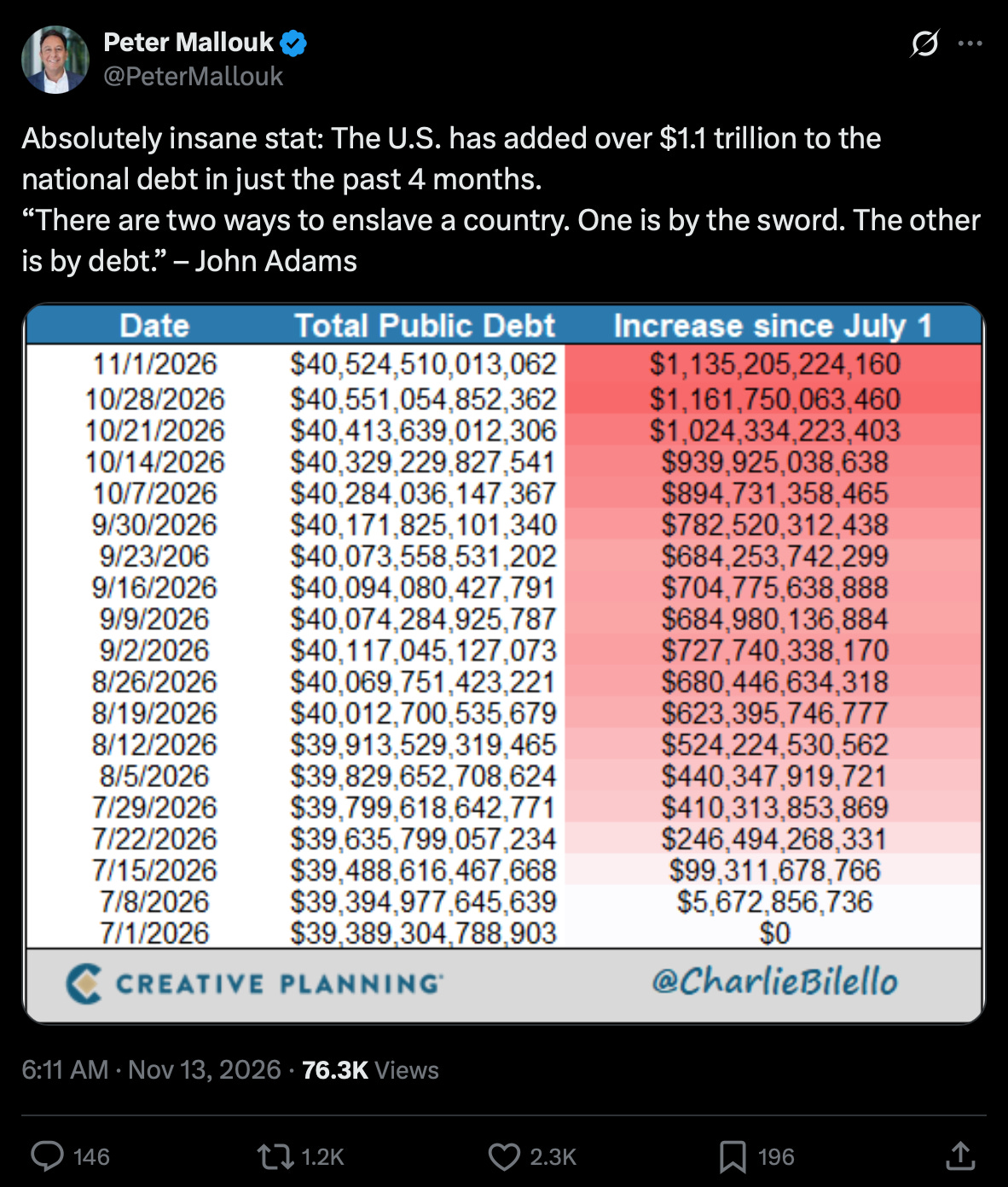
Insane, indeed.
They say that the definition of insanity is doing the same thing over and over again and expecting different results.
Often misattributed to Albert Einstein, the line first shows up in 1981, at 12-step recovery groups, including in literature published by Narcotics Anonymous.
A pamphlet for drug addicts, mind you.
You’ve likely heard the warnings over and over again from CEOs, investors, economists. How the government spends too much. How the deficits are too big. How Congress has to get its finances in order.
Blah blah blah, yada yada yada.
But this year, it seems, something is different.
The Treasury has said it every year in its own report, using phrases like “unsustainable fiscal path”. But now the Treasury Secretary himself is on TV, warning the Fed about possible policy mistakes.
But why now, why the urgency?
What has changed?
To answer that, we need to ask a few other questions first.
Like, what exactly does the Treasury’s own report say about where all this debt is headed? What major event is on the horizon that puts government finances in a precarious position? And most importantly, who ends up paying for all of it, and how?
Good questions, ones that matter to all of our investments and portfolios. And ones that we’re going to answer, nice and easy as always, right here today.
So pour yourself a big cup of coffee and settle into your favorite seat, as we read the Treasury’s own warning and unpack its urgency, with this Sunday’s Informationist.
Partner spot
Doom, or Domination? AI, the Blue Wave, and What’s Next for Bitcoin
Doom or domination? Gloom or glory? Depending on who you ask, the next few years will either break bitcoin… or make it more important than ever.
Bitcoin’s November correction wiped out nearly all of its August run-up. Now the question is where it goes from here.
Some see AI bringing smarter attackers and pressure on bitcoin’s cryptography; others see a world of AI-driven abundance where bitcoin is one of few scarce assets remaining. Some expect a blue wave to bring back anti-crypto policy; others expect more money printing—the conditions bitcoin was built for.
On December 1 at 1 PM CT, join myself, Mark Moss, Doomberg, and Dr. Jeff Ross for a live conversation on which way things could break.
The panel will open the floor for audience Q&A if time allows, so bring your questions.
Tuesday, December 1 at 1 PM CT — online, free to attend.
Register now: Unchained Events: Doom or Domination
Bessent’s Warning to the Fed
So, what has changed?
The man in charge of the government’s checking account has started warning the Fed. In public. Repeatedly.
Let’s be clear here, Scott Bessent is not the one who decides the government budget, but he’s the one who facilitates it. He collects the taxes, pays the bills, and borrows the difference.
The Fed, meanwhile, sets interest rates. In September, for the first time since 2023, it raised them. In October it held steady, with two members voting to raise again.
Enter Secretary Bessent.
Before the September meeting, he told CNBC:
“Traditionally, you don’t raise interest rates into a supply shock unless you see second or third order effects.”
Less than two weeks after the hike, he said on Fox News:
“[Federal Reserve policy makers] should have an open mind about interest rates.”
And just on Friday, to CNBC:
“So I think that to hike too much into an energy supply shock when it’s coming down, these are very noisy numbers...the Fed’s supposed to look into the future, not look in the rearview mirror.”
As well as:
“Core inflation remains under control.”
Sure sounds to me like a guy who’s telling the Fed what’s up. Warning them not to make a policy mistake here.
Of course, when CNBC asked him in late October whether more hikes would be a policy mistake, he said, “that’s not necessarily so.”
Let’s be real, though. The message is clear.
Question is, why would the Treasury Secretary care so much about the Fed’s rate decisions?
He’s effectively pointing to the economy. Communicating his stance that raising rates will not solve a supply-side issue, but rather usher in demand destruction.
So why does it worry him? Is it the economy and potential taxes that are on his mind? A recession that would negatively impact both?
Well, yes, of course, partly.
But then there’s the other part. The interest bill.
See, the US government now owes more than $40.5 trillion, $12 trillion of which must be refinanced by the end of next year, along with $2 trillion of deficit spending. This is where the math begins to work against them.
Because when the Fed hikes, the Treasury’s interest bill climbs, and fast.
How big is that bill?
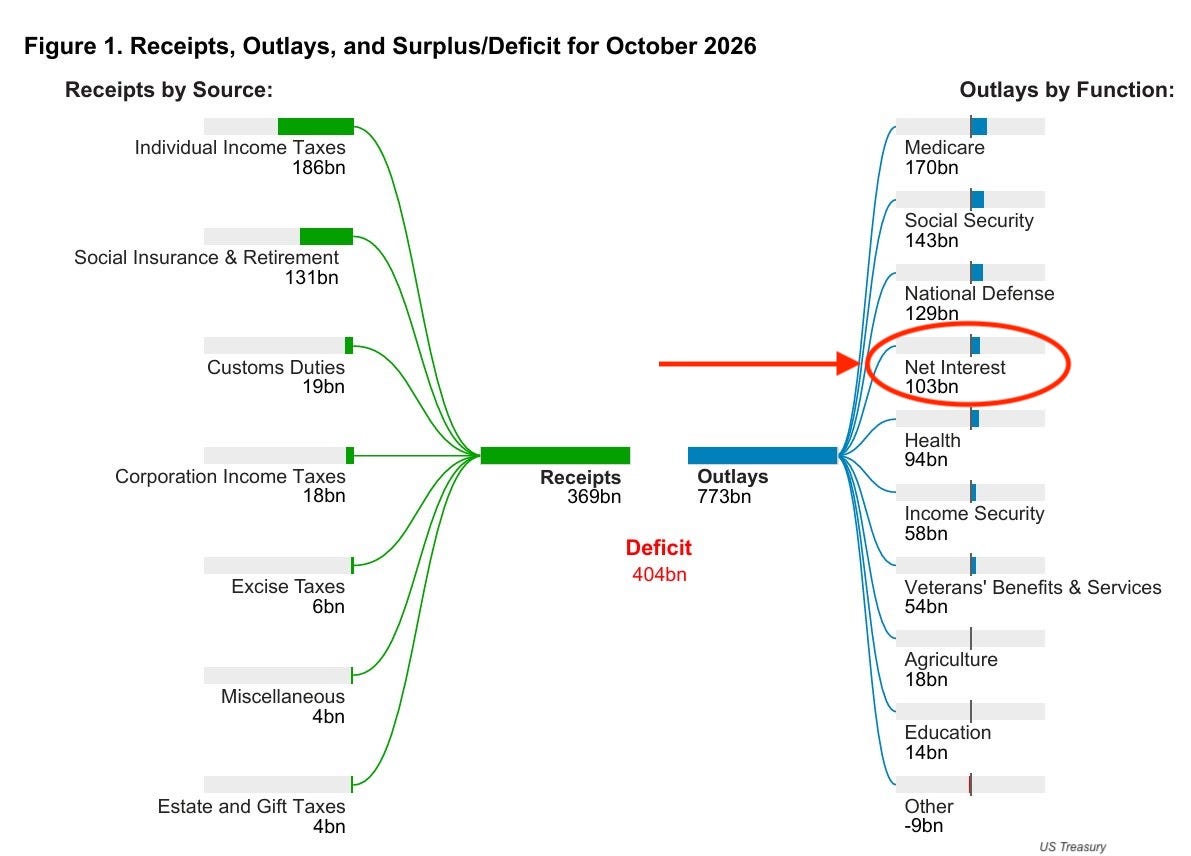
In October alone, $103 billion went to interest, more than veterans’ benefits, agriculture, and education combined. About 80% of what we spent on defense, during a war.
Good grief.
If you’ve been reading The Informationist, then you likely remember the fiscal dominance piece from last month.

TL;DR: when the government’s debt gets so large it starts to dictate what the Fed does, implicitly or explicitly.
A Treasury Secretary on TV, again and again, talking the Fed out of hiking? That’s fiscal dominance, right out in the open.
So how do we know that the Treasury really is worried about all this debt?
Well, let’s turn to its own annual report to see.
An Unsustainable Fiscal Path
Every year, the Treasury publishes something called the Financial Report of the United States Government. It’s basically the government’s version of an annual report, just like we get from public companies. You know, balance sheet and all, along with a letter from the de facto CFO, aka Secretary Bessent, at the front.
Side note: the GAO, the government’s own auditor, still can’t vouch for and validate these books. Twenty-eight years running. But I digress.
And every year, the report includes a section with a familiar title: An Unsustainable Fiscal Path.
Some of my longtime readers have heard me talk about this before. So what exactly is the Treasury trying to communicate?
“A sustainable fiscal policy is defined in this report as one where the debt-to-GDP ratio is stable or declining over the long term.”
In other words, a sustainable fiscal policy means the debt grows no faster than the economy that has to support it.
And the Treasury says ours is categorically not sustainable.
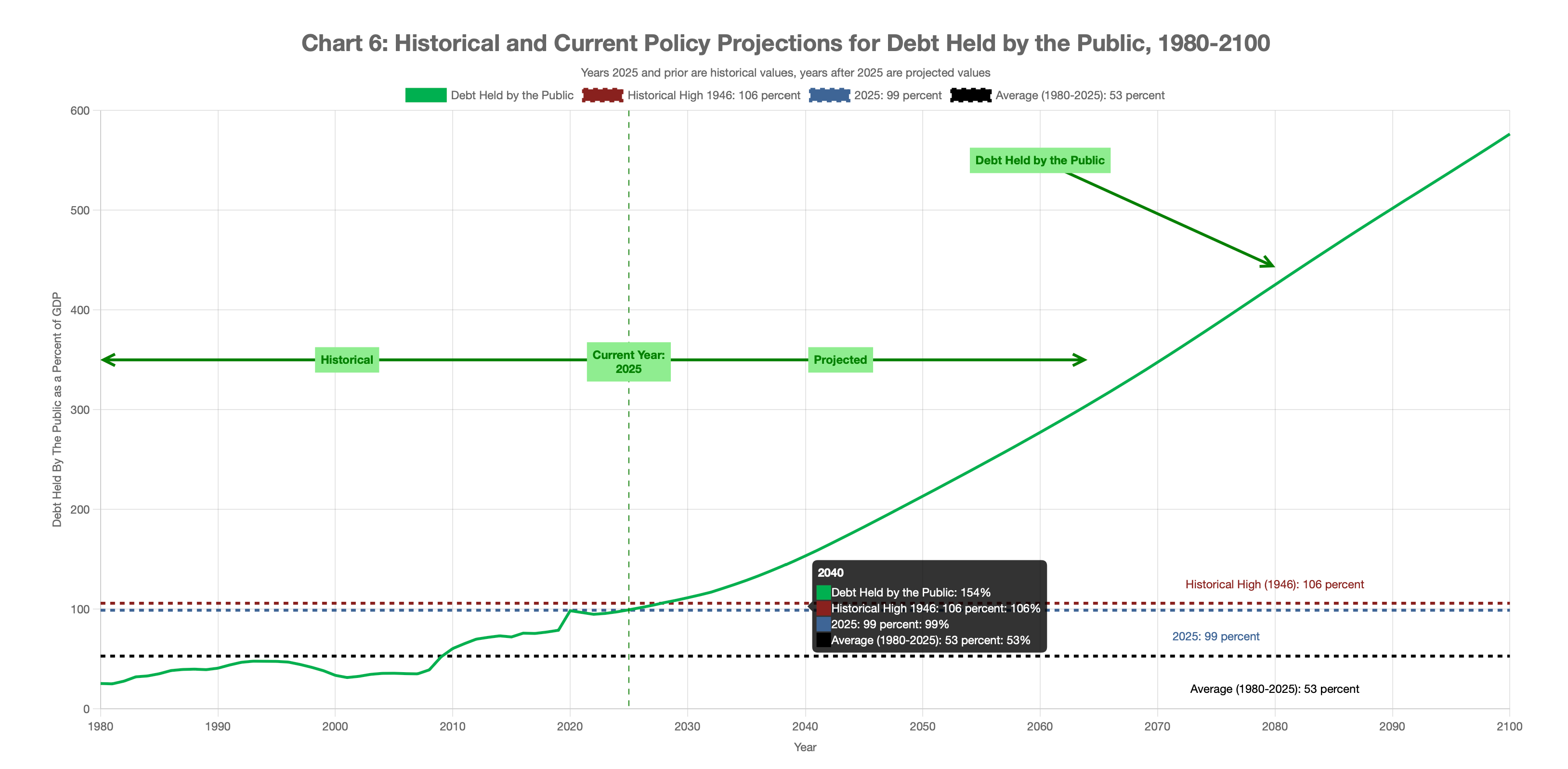
See that green line moving up and to the right? That’s what the government owes outside lenders, as a percentage of the whole US economy.
At the end of fiscal 2025, it was at 99%. By 2029, it crosses the record set right after World War II. By 2040, in just 14 years, it becomes over 150%. From there, it just continues to explode higher until it reaches 576% by 2100.
That’s right. The debt would be nearly 6 times the size of the entire economy.
Remember, this is the whole economy, not tax receipts, which are just a fraction of the economy.
Now you might be asking, “Why does it just keep climbing?”
Here’s why:
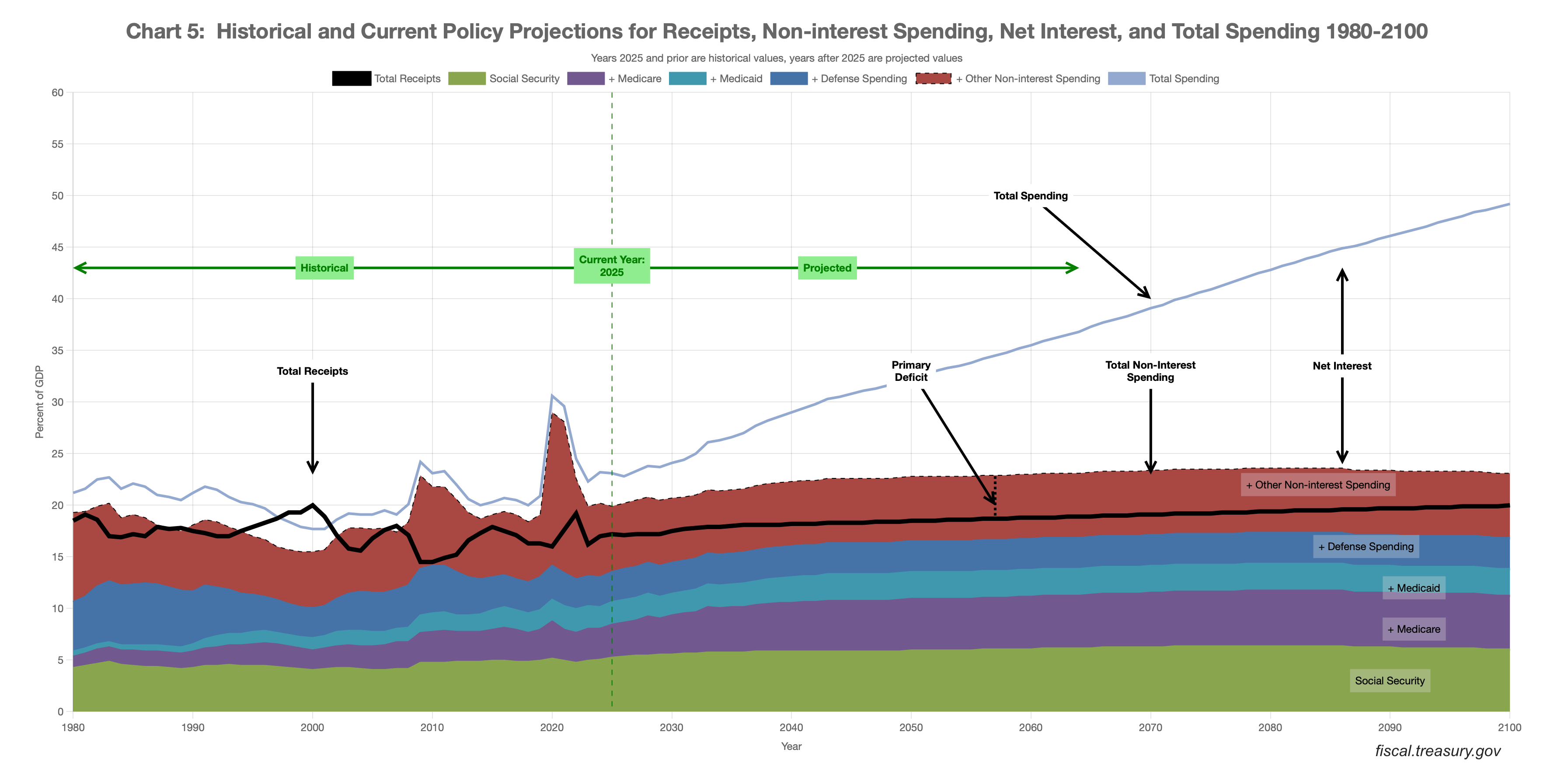
See the gap between the top line and the colored layers?
That’s interest.
By 2038, the Treasury projects interest becomes the government’s single biggest expense, bigger than Social Security. And by 2100, it’s more than half of everything the government spends.
This is from the US Treasury itself. They publish these reports. They publish these charts for the entire world to see.
And yet, the people in Washington read their warning, and then they do the same thing over and over again.
Sound familiar?
Thing is, I’m not sure they’re even expecting any different outcome. In fact, I think they know exactly what they’re doing, and just don’t care. They’re happy to kick the can down the road every single year and keep their constituents and donors (aka beneficiaries of their policies) happy.
Just to get reelected.
If you want the full tour of the government’s books, and the massive hole in them, we walked through it back in May.

Bottom line, charts like these that run through 2100 are easy to ignore. Most of us, and virtually every single politician, won’t be around to even see it.
No joke, I’ve actually had boomer-aged friends say this to me, almost word for word:
They’ve been talking about the debt forever, blah blah. It’s fine, blah blah. I’ll be dead before anything comes of it.
Yeah, well, our kids won’t.
And the real problem is, the next deadline is a hell of a lot closer than that. Close enough that my boomer friends will likely be around to see it.
The 2032 Deadline
So what’s that closer deadline?
Social Security. More specifically, the trust fund that pays retirement and survivor benefits.
In June, Social Security’s own trustees projected that fund becomes insolvent in the fourth quarter of 2032. A quarter sooner than they projected last year.
Now let’s clarify what that means.
Social Security checks will keep going out after that, because payroll taxes keep coming in. But under current law, those taxes only cover 78% of scheduled benefits. And so the checks going out to retirees will get cut to match.
In other words, if your check is supposed to be $2,000 a month, it becomes $1,560, overnight.
Awesome.
That’s every retiree and survivor on the program.
Guess what else happens in the fourth quarter of 2032? That’s right, another presidential election.
So what happens?
Well, the way I see it, Congress has three options in 2032:
Let the cut happen.
Raise taxes to cover the gap.
Borrow the difference.
Which one do you think they pick?
Exactly, door number three, per usual.
And guess who agrees with us?
Yep, the US Treasury itself.
How do we know?
Go back to the 576% on that chart. The Treasury defines the assumptions driving it, and one of them is this:
“[S]cheduled Social Security and Medicare Part A benefit payments are assumed to occur beyond the projected point of trust fund depletion.”
Translated: the chart assumes Congress never lets the cut happen. The government just keeps sending out full checks and borrows the difference.
And every dollar borrowed to cover those checks lands right back on that interest bill, of course.
We walked through Social Security’s own math back in 2024, if you want more details there, too:

So, one last question.
If the plan is to just keep borrowing more, who’s going to step up and lend it?
How It Gets Paid
First, the answer that the Treasury gave us in its own report.
In essence, to hold the debt at today’s 99% of GDP through 2100, Congress would need to raise taxes or cut spending by 4.7% of GDP. Every year. For 75 years.
Starting now.
That’s effectively raising every tax by about a quarter. Or cutting a fifth of everything the government spends outside of interest.
Wait ten years to act, and it becomes 5.6% of GDP. Wait twenty, it’s 6.9%.
And remember, we just landed on door number three.
Oh, and that 576% path? The Treasury notes that it does “not reflect any adverse economic consequences resulting from continuously rising debt levels.”
No recessions, no depressions, and everyone just keeps buying all that debt without a care in the world. An extremely optimistic and rosy projection, one that is likely to be worse and accelerate to the downside faster than even the Treasury expects.
And so, when the Treasury soon walks through door number three, who do they meet?
The Fed.
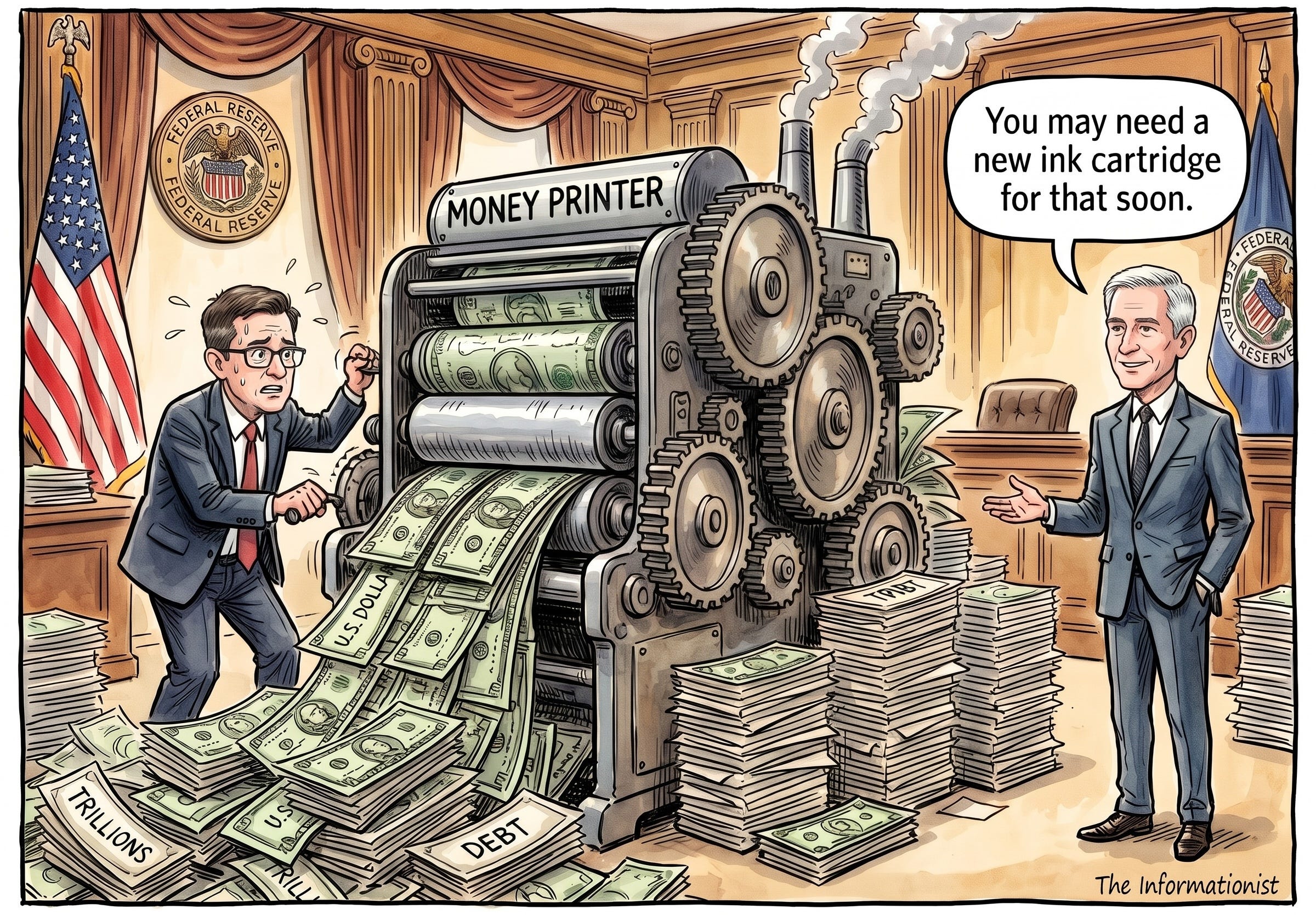
The one and only buyer who can print the money to cover it.
We’ve seen this movie before:
2008: the banks broke, and the Fed started buying bonds. QE1.
2019: the repo market seized up in September, and by October the Fed was buying $60 billion of Treasury bills a month. (Powell insisted, “In no sense is this QE.” Sure, Jerome, sure.)
2020: Covid lockdowns hit, and the Fed bought trillions in bonds within months.
First a crisis, then the print. Like clockwork.
It’s almost as if the crises have become necessary.
Question is, will the next crisis show up on its own, or get a little help? You know, like the Fed raising rates to usher in demand destruction and a possible recession, or worse, a credit crisis.
I have my opinions, of course, but I’m pretty sure how it ends.
Back to that line about insanity. Remember where it came from? Recovery groups. And in every recovery, step one is admitting you have a problem.
The politicians admit it every year, and the Treasury says it in writing. Then they simply raise the debt limit, shuffle spending around here and there, but rarely cut any of it.
Instead, they reach for the next fix.
And the next fix is always the printer.
Larry Lepard wrote a whole book on where this leads, The Big Print. Highly recommended and well worth your time.
So, back to the original question here, how does it all get paid?
By you.
Through structural and perpetual debasement of the underlying currency. Every dollar you hold, worth a little less each year.
As my longtime readers know all too well, this is exactly why I own hard assets like bitcoin and gold, assets nobody can print.
I personally prefer bitcoin, because I believe it to be the best expression of anti-debasement. But that’s me.
Either way, the US Treasury is sounding the alarm. Every year in its report, and now on live TV before the whole world.
The situation is only getting worse. And when the response finally comes, I expect it to be the biggest print we’ve ever seen.
What I’m Watching This Week
Treasury auctions, last week and Wednesday. Last week I said I’d be watching demand at the Treasury’s auctions. Well. All three tailed, selling at a higher yield than the market expected, the first time since May that happened. Thursday’s 30-year drew its weakest demand since June. Indirect bidders, which include foreign buyers, took 68.1% of it, versus 72.3% in October. Next up is a $16 billion 20-year auction on Wednesday. If that’s weak, I expect the Treasury to start phasing it out soon.
The Fed, December 9. I also said that if inflation came in hot, the odds of a December hike would likely move higher. October CPI came in hotter than expected, producer prices are still up 6.5% over the year, and as of Friday, fed funds futures price a December hike as a done deal, up from about 78% odds the Friday before. And by next September, they now price about three and a half hikes, versus fewer than two a week ago. Next week, 11 Fed officials are scheduled to speak, starting with Chair Warsh on Monday, and I’ll be listening closely to what they say about this latest round of hot inflation.
Nvidia and the Fed minutes, Tuesday and Wednesday. Nvidia reports after the close on Tuesday, and on Wednesday afternoon we get the minutes from the Fed’s October meeting, where two officials voted to hike again. We’ll see how Nvidia is handling the drama around Jensen Huang’s resignation this past Thursday, with CFO Colette Kress stepping in as interim CEO, and what its plans are going forward. Nvidia is a market bellwether, so there will be a lot of attention on this call. The Fed minutes will give us a bit more insight into where their heads were before the latest inflation prints, and perhaps just how much they understand the energy impact on pricing.
Who’s buying our debt, Wednesday. Also on Wednesday afternoon, the Treasury’s TIC report shows how much foreign investors bought or sold of US securities in September. In August, net long-term inflows came to $279 billion. After last week’s auctions, I’m looking to see whether that demand was already slipping.
Bitcoin. Bitcoin had a rough couple of days, falling more than $5,000 since Wednesday’s close to about $68,240 as of Friday afternoon. With yields jumping and a December hike now priced in, I can’t say I’m shocked. But I want to be clear: I maintain my long-term confidence in bitcoin, and barring a meltdown in the overall markets, I still believe we’ve seen the lows for this cycle. On the bitcoin power law, one standard deviation below the mean sits around $72,500, and bitcoin is now trading under it. Its support trend line is close by, too, at about $65,000. To me, both are strong signs we’re near the bottom of this interim drawdown.
That’s it for today. I hope you feel a little smarter knowing why the Treasury is sounding the alarm, and who ends up paying for it in the long run.
If you enjoyed this free version of The Informationist and found it helpful, please share it with someone who you think will love it, too!
Talk soon,
James ✌️
If you’re not yet a premium subscriber, I’d love to have you join us.
Join 1,500+ premium readers who get the Sunday issue in full every week, and What I'm Watching This Week at the close of each issue.
As Lyn Alden keeps reminding all of us.... Nothing stops this train!
Thanks for making it so visual. Every Congress person should have it on their desk as a standing picture...
James, no snark intended, but with all due respect, could you lighten up on lumping all boomers into one group and castigating/vilifying us? We get enough hate without smart people like you piling on. I mean, you seem way to smart to make the kind of inductive leap required to scapegoat a specific group for an issue. Yet you want to make sure to point out what a few boomer acquaintances have said. And this is not the first time.
I am a boomer in the top 3% or so. Not the top 1%, but high enough to be targeted by any policies that aim to target the haves for the benefit of the have-nots. I believe that taking care of the have-nots and narrowing the wealth gap is the single most important thing that our country needs to do, and if that costs me money, so be it.
The inductive leap that leads to blaming any one group for society's problems is the cause of prejudices of all kinds.
If forced to pick one group on which to lay the most blame for where we are today, I'd cite the wealthy. There may be a whole lot of very wealthy boomers, but there are even more who live on social security, check to check. Even though I paid into social security and Medicare all my life, I expect and am okay with the idea that my SS will someday be cut based on a means test of some kind.
Thanks for reading.