

✌️ Welcome to The Informationist, the newsletter that makes you smarter about money in just a few minutes each week.
🙌 One topic. Exposed and explained so you can make better decisions with your money. Like a simple walk down Wall Street.
🫶 If this was forwarded to you, you have awesome friends. Join 45,000+ readers here.
Today’s Bullets:
💯 The Triple Digit Mark
🎩 The Dynamic Debasement Duo
💸 The Tax You’re Already Paying
🍌 The Old Playbook
🧊 What Lies Beneath
Inspirational Tweet:
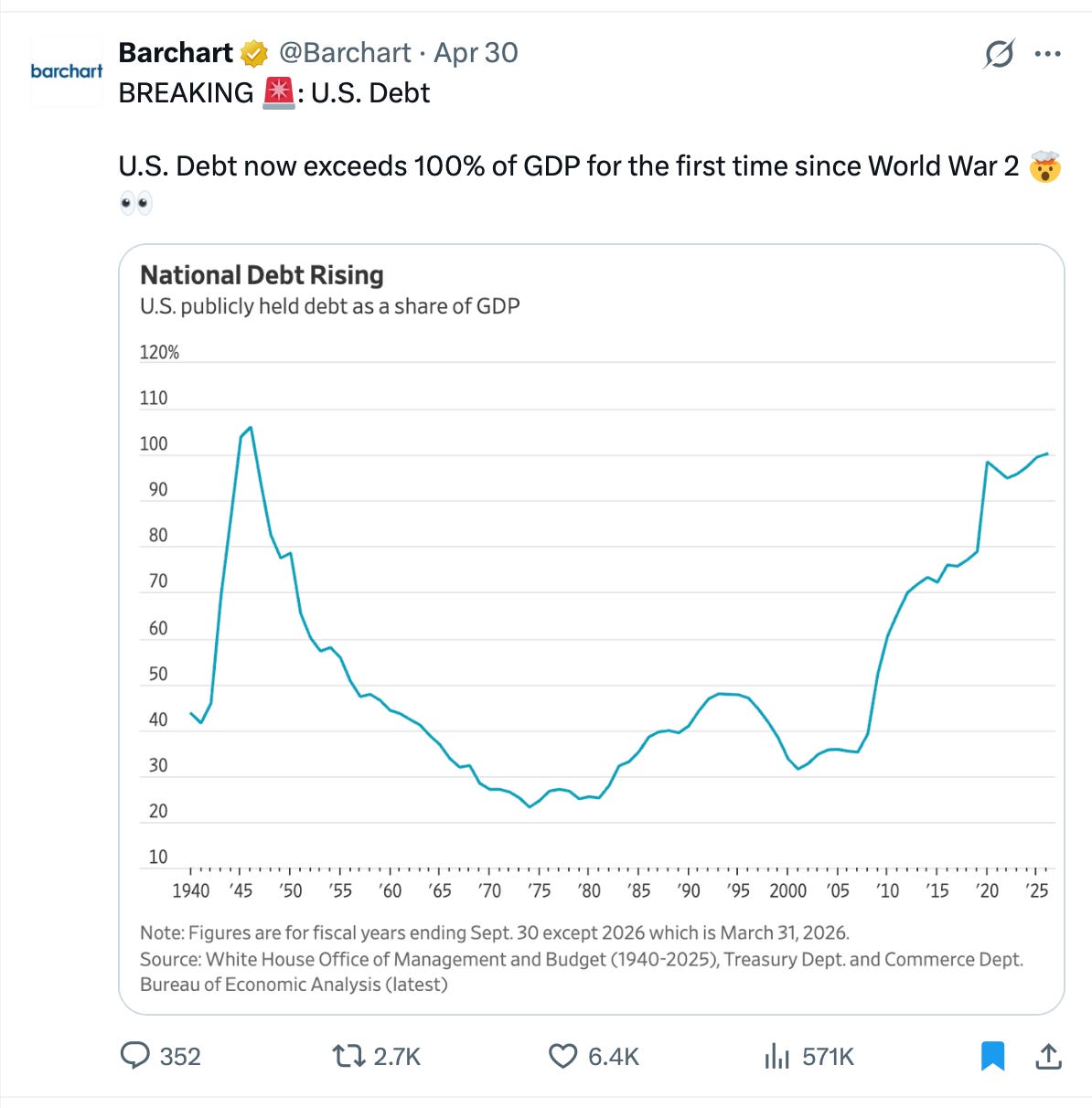
Congratulations, America! You just scored a hundred on the test. 🎉🥳🇺🇸
But let’s face it. It’s not exactly the hundred percent you want.
We could call it dubious honor, but no, that would minimize the reality of the situation, make it trite.
Because truth is, this is a truly dangerous dis-honor.
Something that the new Secretary of the Treasury and the incoming Fed Chair are both well aware of and, according to their words, somehow plan to fix.
Question is, how dangerous is the situation, truly? Can the debt tanker be steered back to safer waters? Or is America doomed to become a so-called banana republic?
All good questions, and ones we will sift through, nice and easy as always, here today.
So pour yourself a big cup of coffee and settle into your favorite seat for a candid look at where America actually stands, and what it means for your money, with this Sunday’s Informationist.
Partner spot

Are we in a typical four-year-cycle bear market with more downside to come, or will 2026 prove to be a deviation from the multi-cycle trend? James Check is back to break down what onchain data is revealing about the path into this downturn and how this market compares to prior ones.
Join Checkonchain and Unchained for a live presentation and Q&A exploring what signals matter most right now and how investors are thinking about positioning through uncertainty. Register to attend and receive early access to The Bitcoin Checkpoint report.
When: May 5 · 3PM CT · Live online · Free to attend
💯 The Triple Digit Mark
Three months ago, on a stage at the Brookings Institution in Washington, the most credentialed monetary voice in America stood at a podium in front of an audience of economists and quietly delivered a warning.
Now, you may or may not know who Janet Yellen is, depending on how closely you follow this stuff.
You may recognize her though. Because she’s been around for a while. A loooooooong while.
In fact, she has held just about every important seat in the American monetary system. Berkeley professor of economics. President of the Federal Reserve Bank of San Francisco. Chair of the President’s Council of Economic Advisers under Bill Clinton. Vice Chair of the Federal Reserve under Ben Bernanke. Then Chair of the Federal Reserve from 2014 to 2018. And from January 2021 through January 2025, the 78th Treasury Secretary of the United States.
Good Lord. Nobody alive has held more of the levers of American money than Janet Yellen.
So when she stepped to that Brookings podium in early January and said this, sober and on the record:
“The preconditions for fiscal dominance are clearly strengthening.”
Yawn.
This is the kind of warning that economists put on the shelf and the rest of the world ignore. Academic language. Footnoted citations. Tweed jackets. Polite applause from the panel.
Most people heard the headline, moved on, and went back to their week.
Then, last Thursday morning, the US Treasury released a fresh accounting of where America actually stands.
Publicly held debt: $31.265 trillion
GDP for the prior year: $31.216 trillion
The ratio: 100.2%
Or so they thought it was quietly released.
Because journalists, Ph.D. economists, and armchair analysts alike locked onto that 100% number like a meteorologist zeros in on a dangerous weather pattern forming.
Or maybe more appropriate, like a bloodhound discovering a key piece of evidence at the scene of a crime. This one financial.
Why, exactly?
Because, to put it simply, the country now owes more than it earns. For the first time since 1946.
And before we ignite a flurry of comments from the peanut seats, yes, debt-to-GDP briefly poked above 100% during the COVID lockdowns of 2020. But that was a single quarter, not a fiscal year. The economy was shrinking. Massive stimulus was flooding out the government doors. Once growth resumed and inflation pumped nominal GDP higher, the ratio fell back below the line.
2020 was, indeed, a bit of an anomaly.
Not this time.
But to understand why this milestone matters, we need to rewind about eighty years and visit the only other moment in modern American history when the country owed more than it produced.
In 1946, we had a reason. World War II had just ended, the country had spent four full years pouring everything it had into defeating actual fascism, and the bill came due. Enormous. Unprecedented. Roughly 106% of GDP at its peak.
That bill eventually got paid down. We will get to how, and why that matters now, in a moment.
For today, just hold one fact in your head. The last time America stood at this number, the country was emerging from the largest war in human history.
Today, that kind of excuse is nowhere to be seen.
Yes, there is a war in the Middle East. Yes, there are flashpoints from Ukraine to the Pacific. But none of them remotely compare to a four-year, full-population, factories-converted, rationing-cards-issued kind of war that the country mobilized for in the 1940s.
No total mobilization. No recession to fight. No emergency on that scale to point to. Just three decades of compounding deficits, two decades of zero interest rates, and one decade of pretending the math wouldn’t catch up.
Which brings us to the picture that has every analyst in America doing a double-take this week.
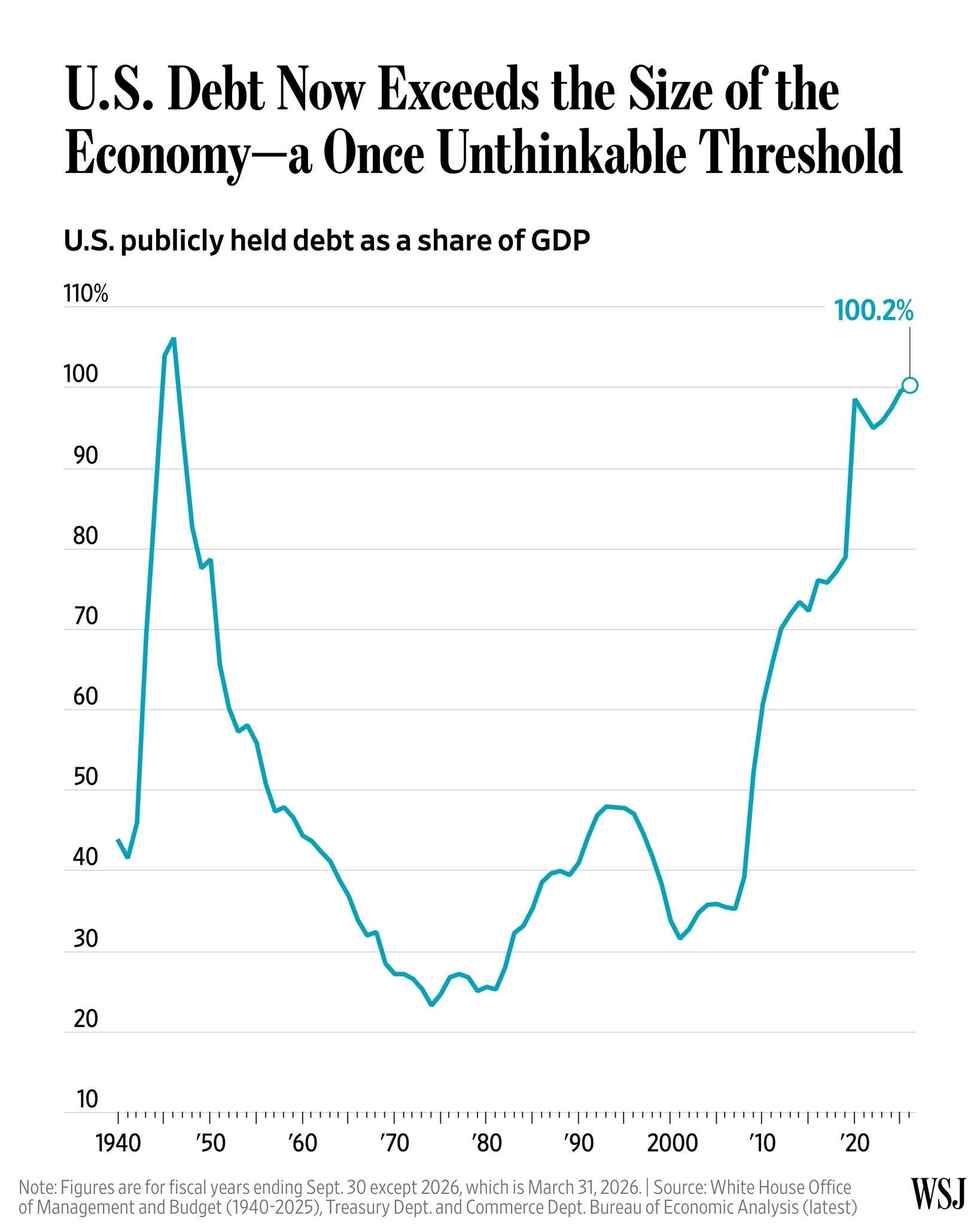
Take a moment with this one. Really study it.
Notice the shape. The line peaked in 1946 at 106%. Then it dropped, decade after decade, all the way down to 22% by 1974. That’s the postwar miracle. That’s the version of debt management we always tell ourselves we can do again.
Now slide your eyes to the right side of the chart.
That line is not falling.
No, it has been steadily climbing for almost two decades, with brief pauses for pretending. Two thousand eight. Twenty twenty. And now, here we are. Standing back on top of the WW2 line again, with one rather glaring problem.
No world war.
No miracle.
No demobilization story to tell our grandkids about how we paid it all down.
Just a country, looking around, and quietly noticing that the chart has gone red on the dashboard.
And here is the part that should give you pause.
On that Brookings stage in January, the woman now warning us about fiscal dominance had been holding the wheel for the past four years. Through every single quarter on the right side of that chart. Watching the line climb in real time, signing off on every refunding announcement, every quarterly forecast, every fiscal year that ended a little worse than the one before.
And while she had the wheel, she did not say the waters were dangerous.
She said they were “different.”
Which is the kind of thing every captain says, right up until the moment the ship hits something it should have seen coming all along.
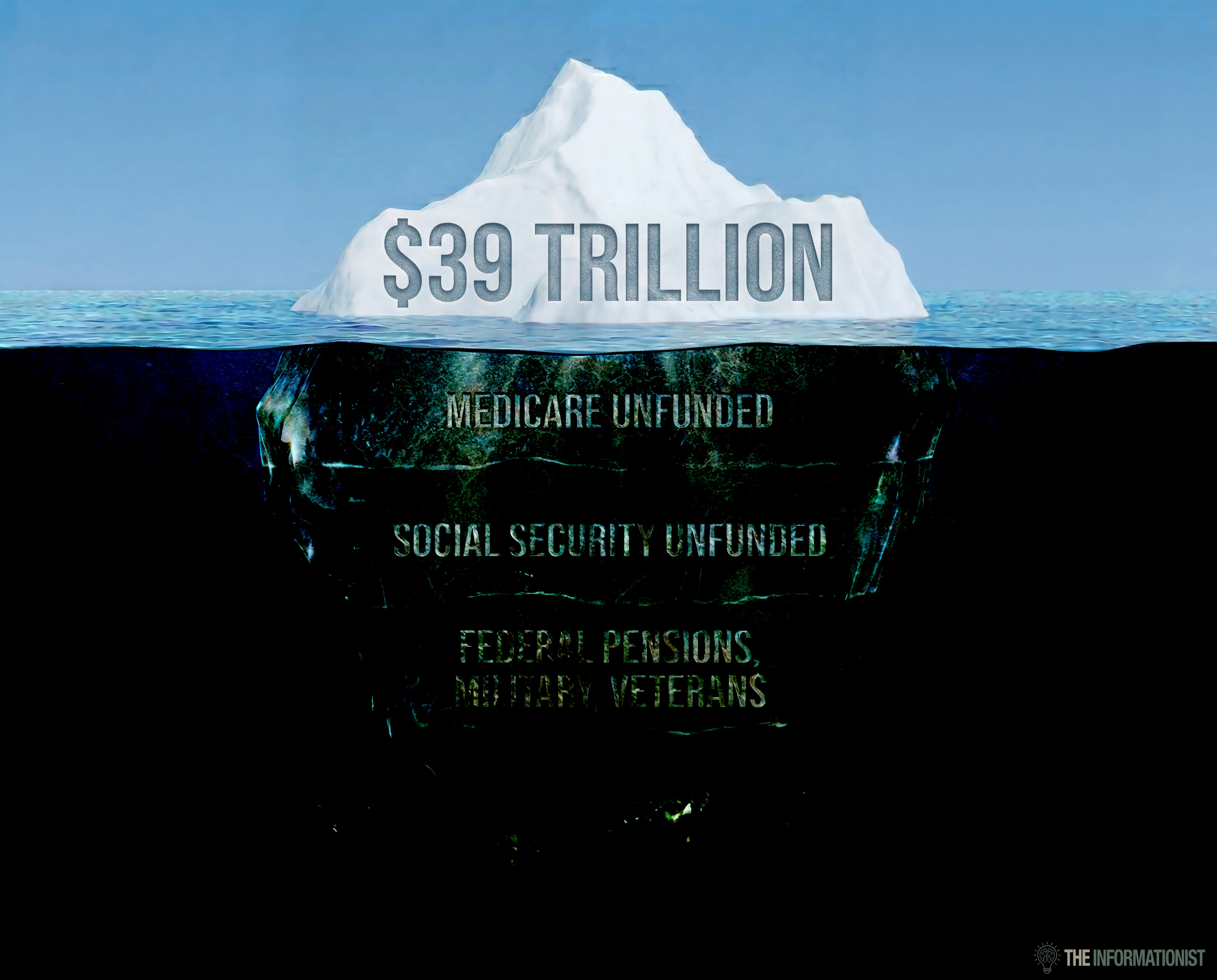
And warning everyone about.
