

📶 Welcome to The Informationist. Each week I take you inside the decisions that move markets and make sense of the forces at work.
✅ One topic, exposed and explained, so you can make sharper decisions with your own money.
➡️ If this was forwarded to you, you have good taste in friends. Join 45,000+ readers here.
Full disclosure, and as many of you already know: I hold bitcoin and hard assets personally and professionally, and I sit on the board of a bitcoin treasury company, so weigh my opinion accordingly. Nothing here is individual advice, and I don’t know your personal situation. If you have an advisor, these are conversations you should be having with them.
Today’s Bullets:
What Warsh Actually Said
Operation Verbal Twist
The Part He Doesn't Control
Where That Leaves Your Money
Inspirational Tweet:
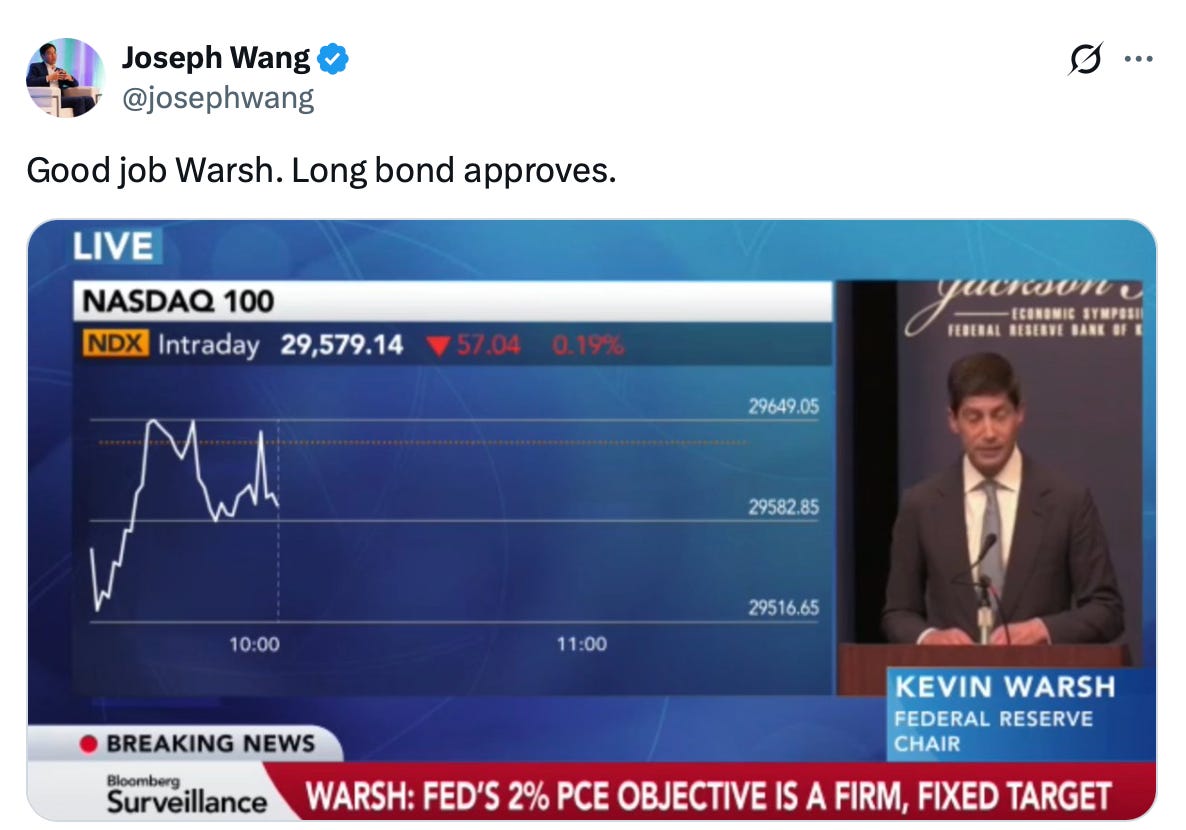
If you’re an investor, professional or not, you likely knew all about Warsh’s speech on Friday morning.
You know, the one he was to give from a formal Fed lectern in the completely informal setting of Jackson Hole, Wyoming. The location of the annual Fed retreat, known as the US Federal Reserve Economic Symposium.
Affectionately known as the Central Banker’s Boondoggle on Wall Street.
But what we didn’t know is what the heck he was going to say. Especially because Warsh has been adamant concerning his stance that the Fed should not be giving forward guidance to markets anymore.
Regardless, there was quite a buzz and build up, even though most people, economists, investors and pundits alike, figured it would be a whole lot of nothing since he wasn’t going to give guidance anyways.
Oh, how they were so wrong.
Because Warsh started speaking and markets started reacting, almost immediately.
US Treasury bonds had some large moves, and as Joseph Wang points out above, the long bond liked what it heard. And stores of value, like gold, silver, and even Bitcoin, got hammered within minutes.
Question is, was it intentional? Did Warsh set out to make the market react like this? And if he did, why? More importantly, why did some of the bonds reverse much of their moves before the day ended? And most importantly, what does it mean for our own investments and portfolios?
All good questions, important ones that we’re going to answer, nice and easy as always, right here today.
So pour yourself a big cup of coffee and settle into your favorite seat, as we work through the new Fed Chairman’s voice and how powerful it really is, with this Sunday’s Informationist.
Partner spot

Was that the bears’ warning shot?
Bitcoin recently rallied past $80,000 as U.S. debt crossed $40 trillion and the Treasury moved to expand buybacks. It’s the first time bitcoin has traded above its 200-day moving average in nearly 300 days.
I’m sitting down with Mark Moss, Strive’s Matt Cole, and Jeff Vandrew for a live fireside chat on September 1st on the catalysts that could drive bitcoin’s next move.
The discussion covers:
Whether this recent move suggests the bottom is in
Where the next wave of demand could come from: ETFs, treasury companies, and institutional buyers
How to prepare for the next leg, from custody to your long-term financial plan
Register now to join live and bring your questions for the audience Q&A.
What Warsh Actually Said
For a guy who insists he’s not going to say anything to the press anymore, Warsh sure did seem to say a lot on Friday.
Let’s start with this little gem, for instance:
“…there should be no misunderstanding: The Fed’s price-stability objective of 2 percent, as measured by the personal consumption expenditures (PCE) price index, is a firm, fixed target.”
No surprise that he mentions PCE, as it has long been the preferred inflation measure for the Fed and it’s been running hot for years now. Today it’s at 3.7%.
Once again, in no uncertain terms, the Chairman insisted that the Fed’s target is 2%, and that is not going to change. Period.
After all, as he said:
“The responsibility for 65 months of sustained, elevated inflation sits squarely with the central bank.”
Some quick math here, sixty-five months is almost five and a half years. And Warsh pretty much assumed the blame for the Fed itself.
Nuance. He knows he wasn’t there, he knows we know he wasn’t there during those years, but hey, he’s here to clean it up for us.
What a guy.
Once again forward guidance made the transcript:
“Here is a quick overview of what I’ll cover in my remarks this morning. You can call it an outline . . . you can call it a trail map . . . just don’t call it forward guidance.”
He closed with the stance of a man on a mission: “I stand here today committed to a discipline, not to a decision.”
Okay, we hear you Kevin.
But what exactly is he getting at with all this talk about no talking?
Well, he also said this:
“The economic literature has long described the distorting effects: a hall-of-mirrors problem. If markets rely materially on the Fed’s guidance and the Fed relies on market prices, we are all more likely to be blinded to new developments . . . more likely to be caught unprepared for a turn of events . . . and more likely to commit errors in policymaking.”
In other words, if the market is focused on guessing what the Fed will do and the Fed worries about what the market expects, then the two of them are just feeding off of one another.
A near-perfect circular reference.
And then, nobody ends up reacting to the actual economy itself. Which makes all that economic data pretty much useless.
Well, it’s hard to argue that it’s actually useful a lot of the times, but I digress.
In any case, Warsh says he wants a quieter Fed, and he wants cleaner information coming back the other way. His words:
“The Fed needs clear market signals, as unfiltered as possible.”
For some reason, as I was watching this and listening to his words and him saying over and over and over again that 2% is the inflation target and it will not budge, a certain movie scene came to mind.

Some of you more experienced readers may remember the film Cool Hand Luke with Paul Newman. In a famous scene, the prisoner chain gang is out in the fields, and the Captain, Strother Martin, is standing over Luke (Paul Newman) after beating him. And he says, “What we’ve got here is failure to communicate. Some men you just can’t reach. So you get what we had here last week, which is the way he wants it. Well, he gets it. And I don’t like it any more than you men.”
In other words, Luke’s refusal to submit will only bring harsher punishment, like the beating they just watched.
And Luke does break. There’s a scene late in the film where he tells them he’s got his mind right, and it guts every man around him.
But it doesn’t hold. He goes right back to being Luke.
Well, perhaps the long bond here is Luke. And maybe what Warsh was really speaking to was the bond market's refusal to recognize that the Fed has a new chairman, and that he is absolutely intent on keeping inflation in check.
And so, in his speech on Friday, Warsh said the words “2 percent” four times and the word “inflation” thirty times.
There would be no failure to communicate.
And the market took a beat-down for it.
The result?
Well, before the speech, Fed Funds futures were pricing odds of a rate hike in September at about 36%. By close of the day, it was 57%.
Even more, looking across the next two years, expected rate hikes moved from 1.8 to about 2.4. That’s about two-thirds of an extra hike, all priced in on the back of a speech that not once articulated where rates were headed.
Remember, every one of those rate hikes, if they do ever show up, lands squarely on what you and I, and every company in the country pays to borrow.
These days, when the Fed speaks, trading floors have the volume turned up and hang on pretty much every word until the moment it’s over. And then we are hit with a flood of analysis and interpretation of the speech from economists and pundits on every corner for the rest of the day.
Friday was one of those on steroids.
Anna Wong, the highly respected Bloomberg economist, summed it all up in a single line.

Well said, Anna.
Remember, at the Fed’s July meeting, the vote was 9-3 to keep rates unchanged, and the three dissenters wanted an immediate rate hike. So to her point, and I agree with her, the chairman appears to have saddled up alongside those three now.
For those of you who have been reading me for a while, you won’t be too surprised by any of this, because back in July we dug into exactly how Warsh uses his voice.

What we basically concluded was that he talks hawkish in public, possibly to protect his own credibility, and then refuses to commit to anything and keeps every door open to him later.
That’s apparently the exact same playbook he ran on Friday. Because even though he said nothing about rate hikes, the market immediately started pricing some in.
Now the question is, do they actually hike in September?
Even though the market is now leaning toward a yes, I’m not there yet because I think what Warsh wants is some breathing room to operate.
He wants to hold things where they are, and see more data before he makes any concrete moves.
At least that’s how I see it.
One interesting thing, the federal deficit didn’t come up once, neither did the national debt, or the Fed’s balance sheet, or the long end of the curve. The word Treasury was uttered just once in the whole monologue, and only as an example of a market that they’ll be watching.
Of course, this is not surprising or unusual, especially because this was a one-way speech, and there was no press Q&A session.
Though with the debt where it is, those are exactly the questions we would have wanted somebody to put to him.
That’s an extremely important point, though, and we’re going to dig into it in a bit.
But first, let’s talk about the market reaction and how powerful, at least temporarily, Warsh’s words were.
Operation Verbal Twist
First a little history. Don’t worry, we’ll keep it short, but it helps make sense of what happened Friday.
To do so, we head back to 1961, when the Kennedy administration had a problem. See, they wanted short-term interest rates high because money was fleeing the country for higher yields. Raising short-term rates here would help keep that money at home, invested in US markets, not abroad. On top of this, they wanted long-term rates low because those rates are what American businesses, consumers, and home buyers actually borrow at, and the economy needed a boost.
They were so desperate to make this happen, that the Fed and Treasury teamed up.
And so they sold short-term government paper and used that cash to buy long-term bonds. Remember, selling pushes bond prices down and their yields up, and buying does the exact opposite. And so, at the front of the curve, yields rose, and at the back end of the curve, yields fell.
The move was originally called Operation Nudge because the plan was to nudge long rates down while holding the short end rates up. Then someone clever noted that the yield curve itself was pivoting around its middle, and likened it to a super popular song at the time.
Chubby Checker’s, The Twist.
And just like that, the Fed/Treasury move would forever be known as Operation Twist.
So, did Operation Twist work? Sort of. Long rates came down about 15 basis points or 0.15%. Not nothing, but not really helpful either.
Flash forward to the period after the Great Financial Crisis, and the Fed ran it again, this time alone, in 2011. Operation Twist Part 2. That time, they got about a quarter of a percent out of it. Again, not nothing, but pretty expensive for such a small move.
In any case, that’s the play. Lift one end of the curve, push the other one down, and never touch the overnight rate at all.
Now you may be asking, why would they want that today?
Put simply, high short rates would make the Fed look serious about inflation. Lower long rates would ease the cost of mortgages, car loans, and of course, corporate borrowing.
Problem is, if bond buyers recognize you are running Operation Twist, then they inherently know that will just wind up causing more money printing, and eventually more inflation.
And so, I believe the question that both Warsh and Bessent are asking themselves and each other is, how can you run Operation Twist without making it so obvious?
This is how.
Nine days before Warsh stood at the lectern in Wyoming, Scott Bessent doubled the size of the Treasury’s long bond buybacks, then went on CNBC and called it a Treasury Twist.
Not Operation Twist, mind you, because that would mean the Fed was involved, and that would mean more money printing.
If you want to know more about this Treasury Twist, we covered the whole incident just last week. You can find that right here.

To be clear, that move does cost money. Real money, going into the open market to buy real bonds.
But what about the Fed side?
Well, like we said, the Fed is not involved in the Treasury twist.
And on Friday, Warsh didn’t buy a single bond. He didn’t sell one either. He didn’t move the overnight rate by a single basis point. He can’t do that for another two and a half weeks.
At least not without an emergency mid-meeting move, and that would just look like panic. Something that no new Fed chair would ever want to communicate.
So how do you impart inflation seriousness without policy?
Words.
He just talked. And talked and talked.
“Two percent.” Four times.
“Target.“ Twice.
“Inflation.” Thirty times.
And the market reacted. Hook. Line. Sinker.
During the speech, the super-short end, the bills that mature before the next Fed meeting, didn’t really move.
But then look at what the rest of the curve did.
First, the short-end.
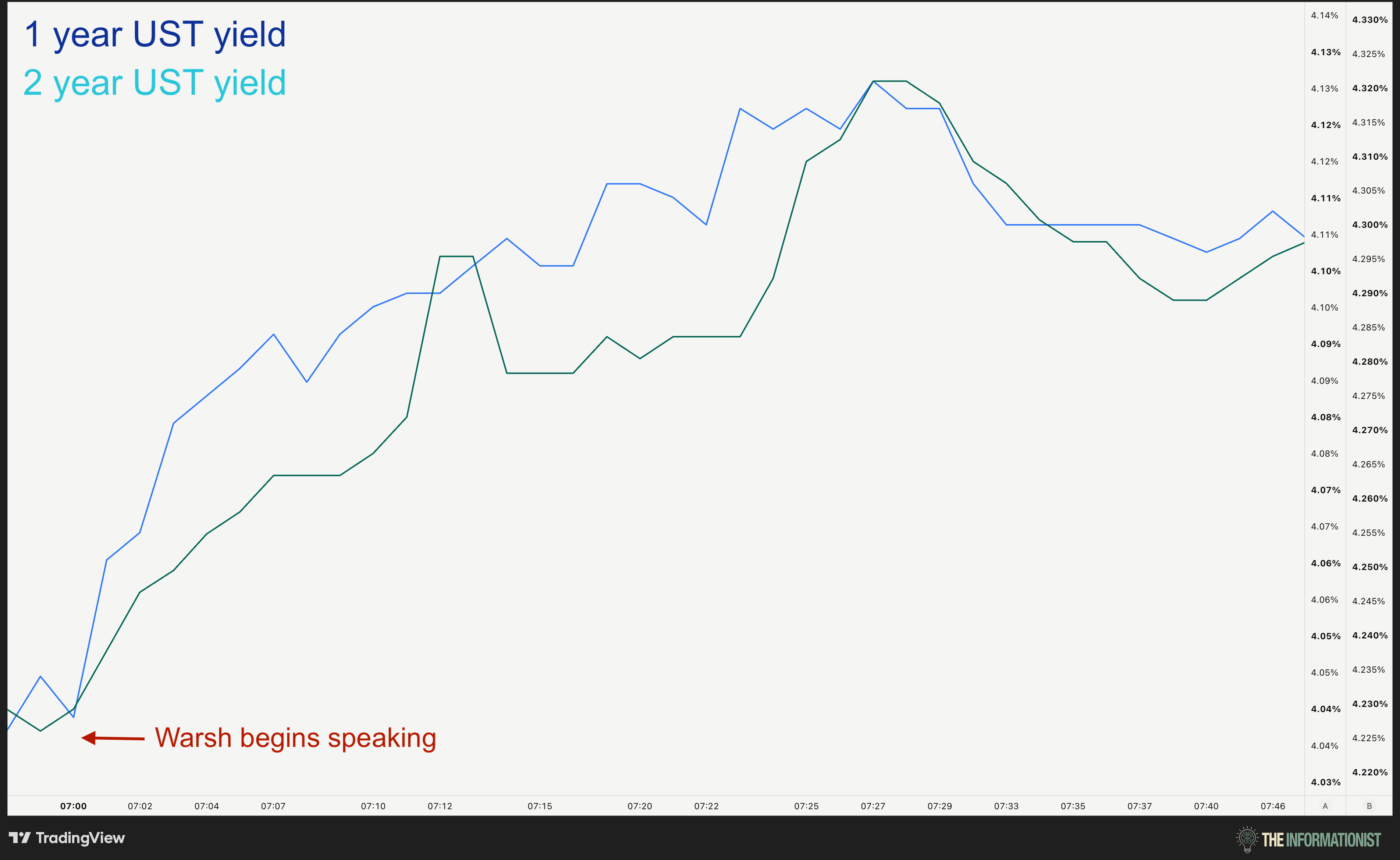
With every utterance of the word inflation, the 1-year yield ticked just a little bit higher, moving up from 4.04% and peaking at 4.13% by end of the speech. About a third of a Fed hike of 25bps.
The 2-year moved up 10 bps. About 40% of a full Fed hike.
Meanwhile, the 30-year Treasury yield went from 5.21% before the speech started to 5.16% before the end of the speech. The 20-year had a virtually identical move.
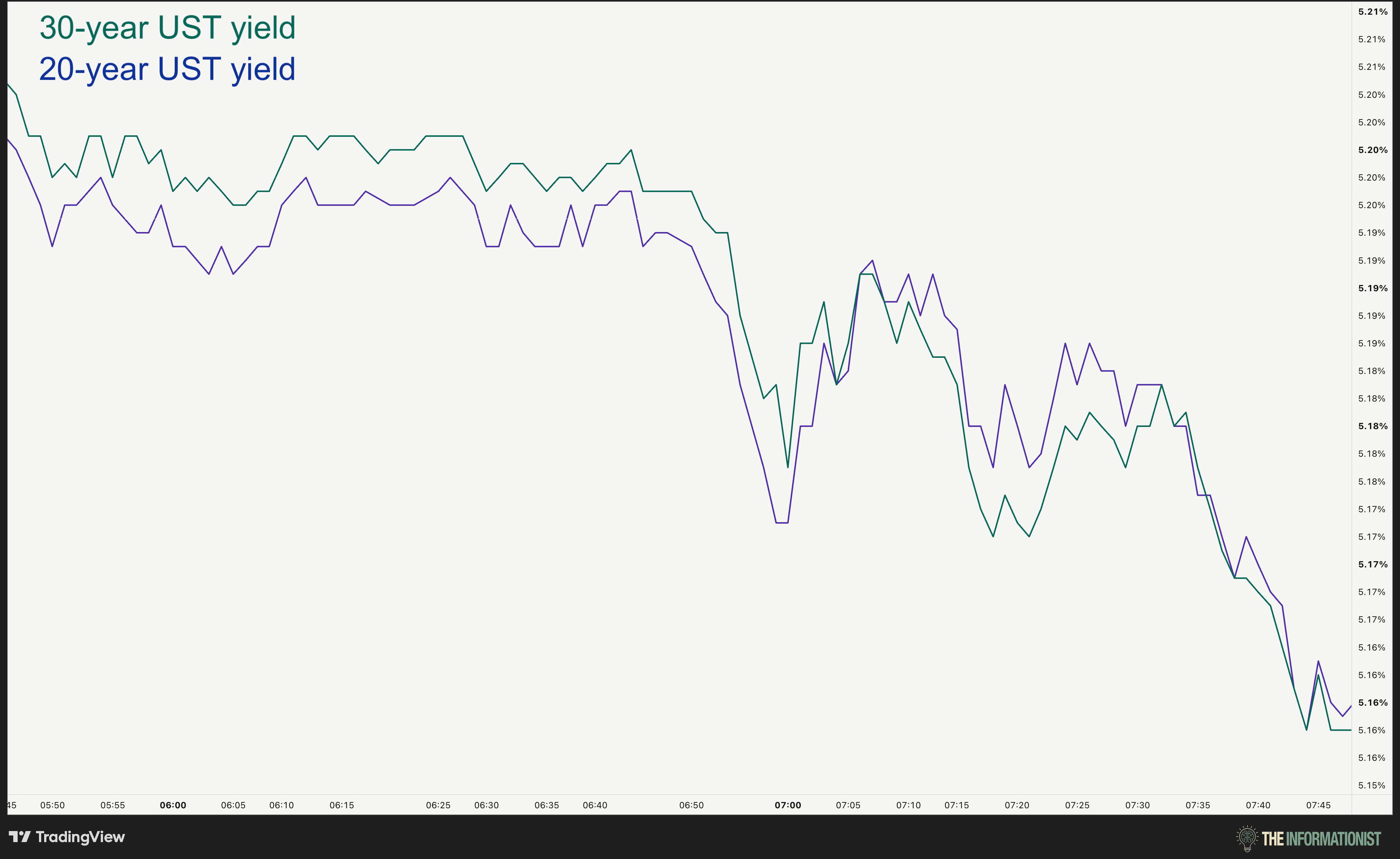
In other words, the reaction of the market as the chairman spoke, was that short yields rose and long yields fell.
I’ve been at this for many years, and that was as clear of a real-time market repricing as anything I can remember seeing.
But no dollars were spent on this one, just words. Lots and lots of one word in particular.
And so we’ll have to call it Operation Verbal Twist.
And for a few hours that morning, it worked exactly the way Warsh would have wanted.
But then, of course, the bond market, as it always eventually does, came to its senses.
The Part He Doesn’t Control
So what did all that talking actually buy Warsh?
To answer that, we need to look at it from three different directions, and they each tell us something different.
Start with the Twist itself.
You could actually see it happen live while he was speaking. The question is whether it lasted.
Here’s the gap between the 30-year and the 2-year throughout the day.
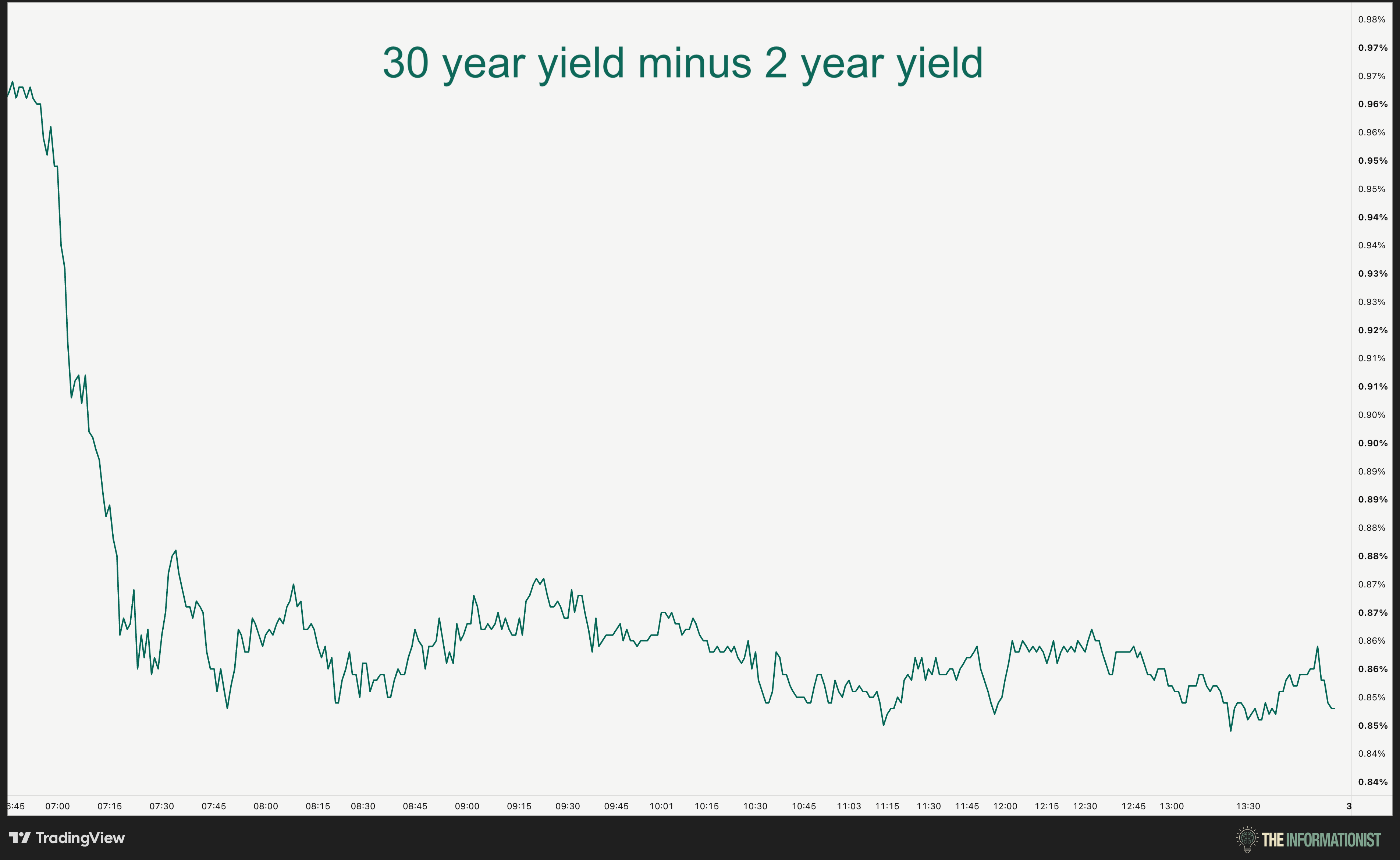
As you can see, it falls off a cliff within the first 20 minutes of the speech, tightening from about 0.96 just before he spoke to around 0.86, and then it just parks there. All morning. All afternoon. All the way up to the close.
It finished 10.7 basis points narrower than Thursday.
Bond investors call that flattening, and for reference, 10 basis points of flattening in a single session is a pretty big move.
OK, now the second direction.
Remember the ten-year breakeven? Exactly, the market’s forecast of what inflation will average over the next ten years. We’ve talked about it a bunch lately because it’s about the best live readout of inflation expectation that we can get.
As Warsh said himself Friday, “It’s the Fed’s job to make sure that inflation expectations do not get unanchored.”
OK then, let’s have a peek at those expectations.
On Thursday, the 10-year break-even closed at 2.3335%. By 8:45 am Friday morning, it had drifted up to 2.3406%
Warsh started speaking at 10am.
Twenty minutes later it had moved to 2.3118%.
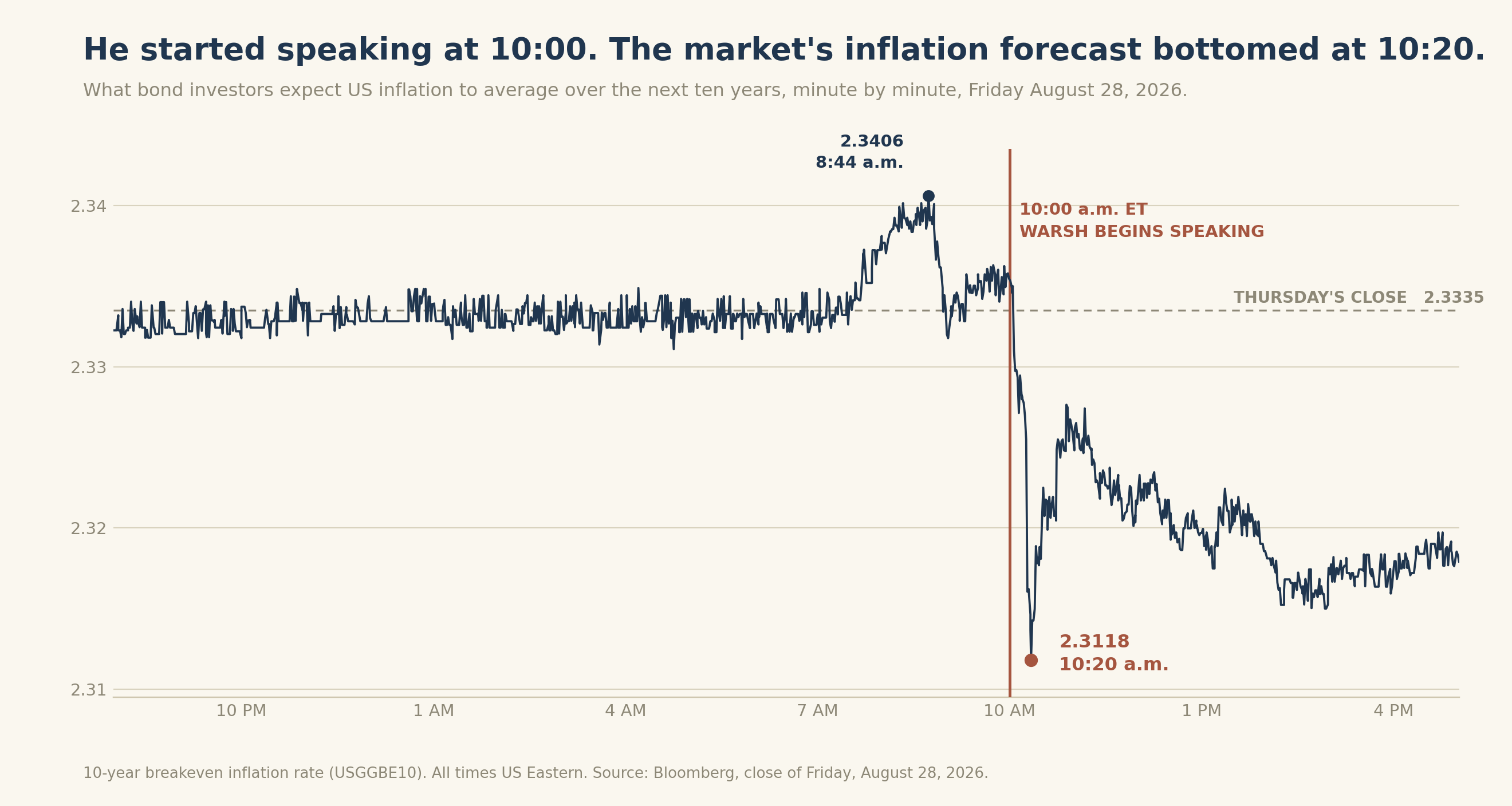
This spread never came back either. It closed at 2.3175%, below where it started, and sat parked there for the rest of the afternoon.
OK. Two for two now.
Which brings us to the third direction.
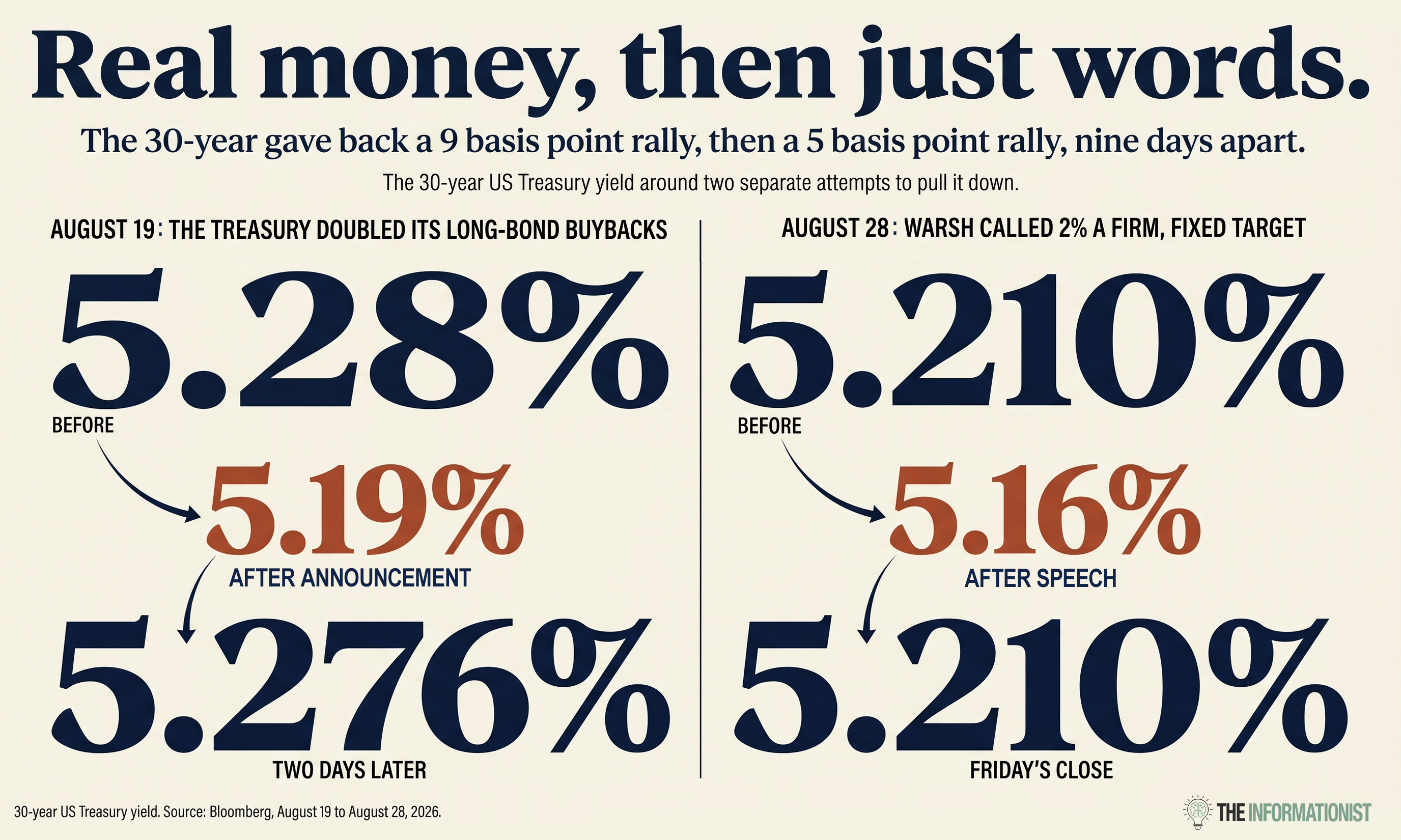
The 30-year Treasury closed Friday at 5.210% right back where it stood before he opened his mouth, and a basis point and a half above Thursday.
And it wasn’t just the 30-year. By the close of trading Friday, every single Treasury bond and bill closed with higher yields on the day. The 1-year rose 12.6 basis points, and from there it falls away, smaller and smaller, all the way down to 1.5 at the 30-year.
Which is also how the flattening ended up sticking. The front end came up hard and stayed up, and the back end barely budged.
So now let’s add it up.
Short-term yields rose, because investors expect rates to go higher as a Fed response to and fight against inflation.
The break-even rate, or expected inflation according to the markets, eased a few basis points.
The 30-year Treasury yield fell at first on Friday, and then it marched higher and ended up on the day.
The question is, if investors expect inflation to be tackled by the Fed, then why would they demand higher rates in the future???
I thought you’d never ask.
It’s because the rent on money has gone up.

If you’ve read the last few Informationist newsletters, you’ll remember this one and what it is all about.
For those of you who have not yet read it, the rent on money is the return that a buyer demands for tying up cash for thirty years. This is on top of whatever they figure inflation is going to do. Bloomberg’s model priced it at about 1.45% on Thursday.
This is against a five-year average of about 0.47%, meaning it is currently priced at about three times the recent norm.
Two more facts.
That number hit a five-year high on August 17.
The Treasury announced it was doubling the size of its long-bond buybacks on August 19.
Two days apart.
My guess is that somebody at the Treasury was looking at that same exact screen of expectations.
Which brings us right back around to Scott Bessent.
Two men. Two completely different tools. Nine days apart.
Bessent went first, and he chose the path of using money. Real dollars, into the open market, buying real bonds. The 30-year rallied 9 basis points on his announcement and then handed every one of them back within two days.
Then Warsh went, and he chose to use words. The 30-year fell 5 basis points while he spoke and then gave every one of those back by the close, finishing at 5.21, right where it started.
Just about the same round trip, nine days apart.
Interesting.
Look, the US Treasury has to sell the paper either way.
We have gone through this math many times over the years, and we went through it again last Sunday, so I’m not going to repeat it ad nauseam here.
One important number, though.
Over $10.5 trillion of existing debt matures and has to be refinanced, with roughly $2 trillion of fresh deficit borrowing stacked on top of it.
All in the next year.
That is what has to get sold. And it gets sold whether inflation prints at 3.7% or 5% or 2%.
Bottom line, inflation promises can’t shrink a deficit. They can’t retire maturing notes. And they sure can’t conjure up new buyers for the onslaught of new notes that are coming.
We still need old buyers and new buyers together to show up at every auction between now and the end of 2027 to take that paper down. And if you can see the tsunami of debt that’s coming at you, you’d be smart to want to be paid a little more for it.
Which brings us all the way back to the original question for today.
Can the Fed just talk rates down?
Friday proved that Warsh can talk the front end around, and he can talk the market’s inflation expectations down, make them stick. At least for one day. But the long end went its own way.
Where That Leaves Your Money
So what did Friday actually do to the things you might own?
Start with the ones that got hit hardest.
Gold peaked at $4,625.30 an ounce, at 10am ET, on the dot, the minute he opened his mouth. It closed the day at $4,453.67.
That’s $171.63 off the high, down 3.7%.
Silver did the same thing at the same time. High of $71, close of $66.37. Down $4.63 from the peak, or 6.5%.
Both metals started to break right at 10am and continued to bleed all day long, both finishing right near the lows of the day.
Bitcoin ran roughly the same pattern on the day. High of 79,775, close of 77,384.
Ouch.
Gold, silver, and bitcoin are all known as assets to own when money is devalued. They are at the core of the debasement trade.
None of them pay yields, and so higher yields usually lead to some selling in these assets. Kind of expected, especially if the market is telling you that inflation expectations are lessening.
At least for a day.
Because, let’s go back to what we just spoke about.
The Treasury still has to unload more than $10.5 trillion of maturing paper over the next 12 months, with about $2 trillion of deficit borrowing on top of that.
Nothing’s changed there, and as far as I can tell, nothing ever will.
And remember the yen?
Right.
On Friday, the yen closed at 160.09 per dollar. The same day that Japan’s Ministry of Finance published the official intervention total: ¥15.4 trillion over the four weeks to August 26, or somewhere around $97 billion.
The largest four-week intervention they’ve ever run.
Good golly Miss Molly.
If you were with us on August 9, you’ll remember the line. Intervention can move a price, and only policy can move a trend. Four weeks and ¥15.4 trillion later, the yen is right back through 160. Remember that one when September comes back around.
Now, what can we do with all of this?
Here is how I personally think about it, which is pretty much the same way I have been thinking about it for four years now.
When a government has to sell that much paper, the value of the money it’s printed against tends to go in one direction only over time. Friday changed none of that, it just gave it a tough afternoon.
And so, the next time you see a long-term yield jump, and you will, ask yourself one question before you listen to a single word of any pundit or analyst’s own take on it.
Is that a rate problem, or a supply problem?
A rate problem is the market responding to the Fed, and it manifests at the front of the curve. A supply problem is the market responding to the sheer amount of paper coming at it, and it shows up at the back.
It appears Friday’s moves were almost entirely in response to a rate problem. As the day wore on, the supply problem reared its ugly head.
Don’t worry, you’ll get to ask it again soon enough.
The next Fed meeting is September 15 and 16, with a rate decision on the 16th. Almost poetic, the Bank of Japan meets the very next day, the 17th and 18th.
And the Treasury’s expanded buyback window opens on September 9 and runs through November 4.
That’s three shots for us to ask the same question in less than a month.
One more thing, and this one’s for a select group of you. I’ve had a number of RIAs and analysts request deeper dives into some of the topics we’ve covered here in recent months.
If you invest or advise for a living, I’ve been building something meant for you.
The Informationist Institutional launches in September.
It’s a quarterly letter, ten to fifteen thousand words, delivered through Substack with a designed PDF you can print, mark up, and forward to a client or a committee. Institutional depth, written the way I write everything else here, so you never have to translate it for anybody.
Every quarter, the same standing departments.
The state of the system, the Fed’s balance sheet, Treasury issuance and who is actually holding the paper, the credit markets, the dollar, and rates.
Hard assets, including bitcoin.
A running scoreboard of the numbers I watch to gauge debasement, updated every quarter.
And what would break the whole thesis, named well in advance.
Plus a live quarterly Roundtable call with me. We’ll walk through the letter and the themes in it, and then it opens up. You ask whatever you want, about anything in the letter or anything that has happened since I wrote it.
The first issue is free. It’ll land right here, same as everything else.
It’ll address the shift in who owns US Treasuries, and what that shift does to duration and to hard assets from here. Which is to say, it’s the long-form answer to the questions you’ve been asking.
The founding rate is $1,800 a year, and for those who want access to the underlying metrics and the data behind the letter, there will be options for that, too.
That’s it for today. I hope you walk away a little smarter about what a Fed Chairman’s voice can actually move and why the long end of the curve keeps moving on its own.
If you found value in this one, please share it with someone you think would too.
And if you’re not yet a premium subscriber, we’d love to have you join us.
Join 1,500+ premium readers who get both issues in full every week: the Sunday deep dive, and the Monday Macro Brief before the open.
Talk soon,
James✌️
Great Stuff James. Thanks.
The “Casino” reopens Monday/Tuesday.
What I still have never understood is why anyone/organisation would decide to purchase 10/20/30 Year Bonds from any country that spends itself into, effectively, bankruptcy.
The Romans were clipping coins when everyone still walked everywhere in sandals 🩴.
At least Oracle is getting smashed for its profligately.
Why do the “Drunken Sailors of Gov’t” on Planet Earth not get a more forceful reckoning?
Would like to hear Your and Readers thoughts on this indescribable myopia.
Best
As always, great write up James! Thank you for taking the time to break these complex topics down in ways we can understand. It sounds like both the Fed and the Treasury are trying everything they can come up with except ONE thing.... spending less money! 😉