

📶 Welcome to The Informationist. Each week I take you inside the decisions that move markets and make sense of the forces at work.
✅ One topic, exposed and explained, so you can make sharper decisions with your own money.
➡️ If this was forwarded to you, you have good taste in friends. Join 45,000+ readers here.
Today’s Bullets:
What Bessent Did
The Treasury’s Bar Tab
To QE or Not to QE
The Market’s Response
Inspirational Tweet:
We sure seem to be talking about the US Treasury Secretary Scott Bessent, quite a bit lately, don’t we?
Fact is, if you’re an investor or an economist, he’s given us little choice. Because the things he’s doing and what he’s been saying have been both newsworthy and impactful to markets.
Like this gem from last week.
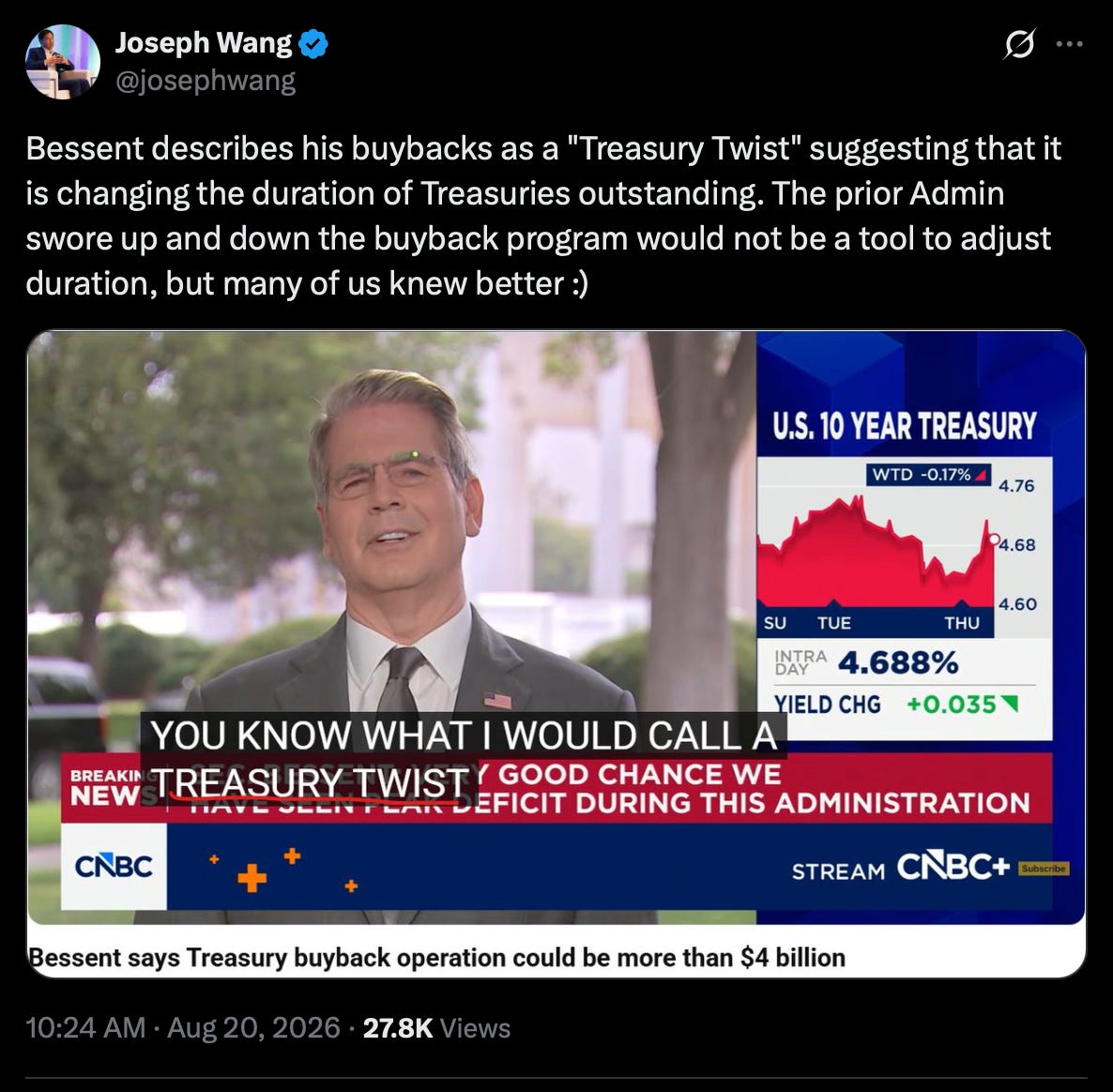
“You know what I would call a Treasury Twist.”
-US Treasury Secretary Scott Bessent
Bessent said that on CNBC Thursday morning when describing the newest US Treasury buy-back program. And Joseph Wang nails his assessment of the new bond buying nickname above, which we’ll get into later.
As for the bond market, it reacted almost violently to the announcement and then shifted right back again.
But why did they move in the first place?
And then there was Bessent right back on TV the next morning, promising even more of the operation.
The 30-year didn’t care. At all, as we will get into as well.
So what’s the operation that Bessent is talking about here? Why did the market love it at first and then turn its back right on it the very next day? Is this QE? Is it yield curve control? What does it mean for our own mortgage rates?
All good questions, important ones that we’re going to answer, nice and easy as always, right here today.
So pour yourself a big cup of coffee and settle into your favorite seat, as we work through what the Treasury is really up to here and what it means for both investors and regular people, with this Sunday’s Informationist.
Partner spot

Was that the bears’ warning shot?
This week bitcoin rallied past $77,000 as U.S. debt crossed $40 trillion and the Treasury moved to expand buybacks. It’s the first time bitcoin has traded above its 200-day moving average in nearly 300 days.
I’m sitting down with Mark Moss, Strive’s Matt Cole, and Jeff Vandrew for a live fireside chat on September 1st on the catalysts that could drive bitcoin’s next move.
The discussion covers:
Whether this week’s moves suggest the bottom is in
Where the next wave of demand could come from: ETFs, treasury companies, and institutional buyers
How to prepare for the next leg, from custody to your long-term financial plan
Register now to join live and bring your questions for the audience Q&A.
What Bessent Did
Let’s talk about Scott Bessent now, shall we? A little history.
Scott knows money. I mean, really knows money. He spent decades of his career at hedge funds, in the trenches, actually buying and selling the exact instruments he’s now charged with governing.
This immediately sets him apart from his predecessor at the Treasury, Janet Yellen.
And so he understands how some hedge funds have been known to call their prime broker and purposely ask about levels or inquire about prices for a certain security or mix of securities. Especially if the prime broker he’s calling is prone to information leakage.
Leading to a whisper, whisper, big hedge fund asking about such and such, you may want to look into it, type of leakage.
Maybe they are seeking to move markets outright or perhaps just to gauge the liquidity of something.
Which brings us to The Notepad Incident.
Just a few weeks ago, the Treasury Secretary of the United States sat down in a cabinet meeting and placed a clearly legible note on his desk.
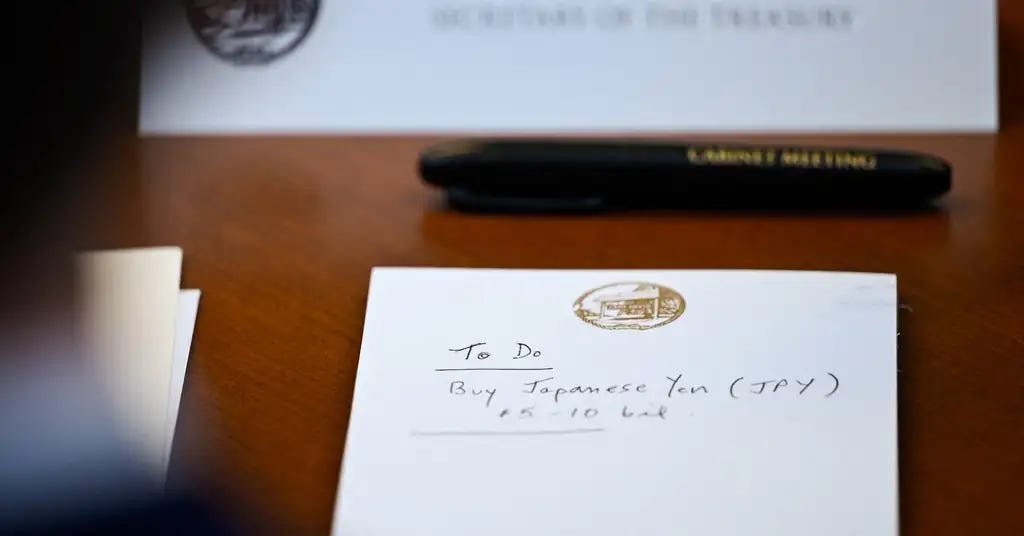
Sitting right behind him, a Reuters photographer snapped a pic, and a few hours later it was all over the news.
Oops?
No.
Deliberate? To maybe get investors to move the market for him?
How?
Well, if you’re a macro investor and you see that the Treasury is tipping off the world that they’re about to buy yen, you’d want to get ahead of it. You’d want to buy yen first, cover short positions, get out of the way.
Why?
The Treasury has arguably the largest balance sheet in the world. Not a freight train you’d want to step in front of, and certainly one you’d want to get out of the way of.
And so sometimes the announcement itself is the operation.
Okay, so what does this have to do with the buybacks that he’s talking about?
First, the program he’s talking about is the Regular Treasury Buyback program that Bessent inherited from Janet Yellen.
What is it?
A little story time. Back in 1994, when an injury effectively ended my short pro hockey career, I was making the rounds on Wall Street, looking for a job, any job that could help me pay back my loans and bills.
One of the shops I ended up interviewing at was Prudential. Located in mid-town Manhattan off of Sixth Avenue, aka Avenue of the Americas, Prudential housed a floor of bond traders. Big guys, former football players, intimidating physically and over the phone. And on every desk of every trader sat a large stack of dot matrix printouts.
You know the kind of printer that continuously prints sheet to sheet, all connected with a perforation and little wheel holes down each side of the paper?
These things.

They would print these things out every few days, and in the stack was a list of every single bond and the price that was fair value at the time. There was no screen you could pull up with a live, reliable price on every bond, which is exactly why the stack existed. It’s not like stocks, where there were centralized exchanges that aggregate prices and are easy to display on a screen.
The dot-matrix stacks of bond prices were known as the Bond Run.
On the desk, if a customer called and wanted to trade a bond and it was not listed in this stack of papers, then it was treated as off the run.
The trader pretty much had to use a calculator and some bond math, figure out what he would be willing to buy or sell the bonds at.
Because of this, they would often build in a nice big cushion, knowing that they would have trouble unloading these things themselves. Just like a car dealer will only underbid the Blue Book value of a car, knowing that it’s illiquid and their profit can easily be eaten up.
Today, most prices are on a screen somewhere, and off the run means the same thing it meant on that desk, just defined a bit tighter: on the run is the newest issue in that maturity, and everything issued before it is off the run.
Back to the Regular Treasury Buyback program that Bessent has been talking about.
Stay with me, it’s simpler than it sounds.
Basically, the Treasury goes into the open market and buys back its own bonds. Not the new ones. The older ones, the ones that are known as off the run. The treasury pays cash for them, and then raises that cash by selling new Treasury bills.
And abracadabra, markets become more liquid. QE, not QE, yield curve control or not, like I said we’ll get into that.
First, before we go blaming Janet Yellen for this brainchild, it came long before her.
It began because the United States had too much money. Believe it or not, back in the year 2000, DC was actually running a surplus. And, Treasury Secretary Larry Summers announced a program to buy back old high-coupon debt. Flush with cash, the Treasury went shopping for its own bonds. After picking up $67.5 billion of them across 45 operations, the surplus dried up and the program ended just two years later.
It was resurrected by Janet Yellen in May of 2024. Except this time she did it for the exact opposite reason. See, the market for older off-the-run bonds had gotten thin, and Treasury entered the market as a buyer to enhance that liquidity. Since the relaunch, the Treasury has repurchased $450 billion of its own paper. Like clockwork, every week.
Until last Wednesday, of course.
No formal warning, no press conference. Just a two-paragraph bulletin put out by the Treasury stating that the buybacks of long bonds, long-dated Treasuries were going from a maximum of $2 billion per operation to at least $4 billion. And that the operation would run from September 9th through November 4th.
That was it.
And long bonds took off. The 30-year yield dropped from 5.28% to 5.19% in a single session. The 10-year dropped 6 basis points. Gold jumped about $100 an ounce within an hour.
But the move-in bonds didn’t last.
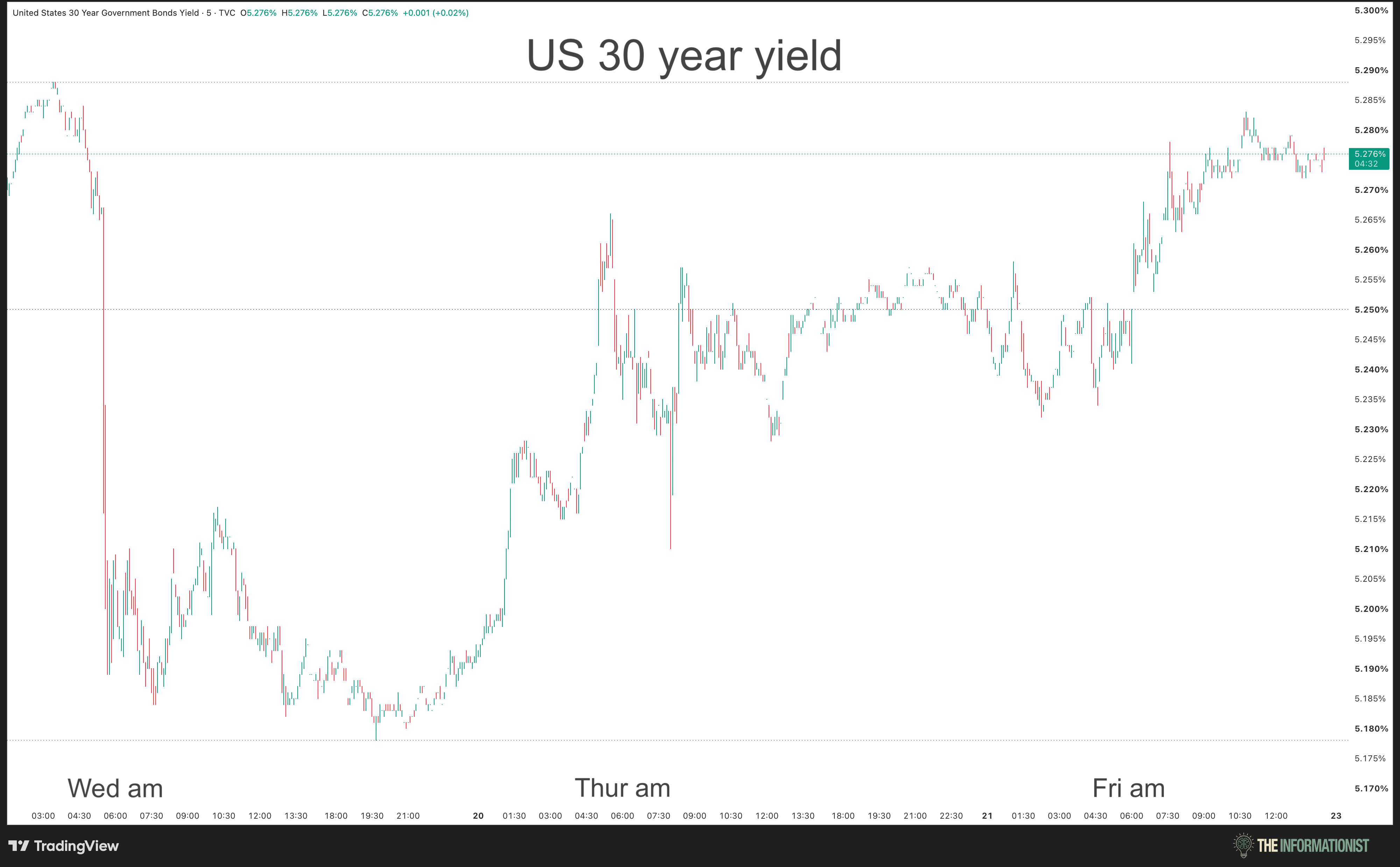
Almost a full round trip on yields by Thursday morning.
And Bessent was on CNBC, telling Sara Eisen “It could be more than the $4 billion per issue.”
And as you can see in the chart, by Friday afternoon, all of the gains the 30-year made had evaporated.
Two days, a total round trip. Nothing to show for it.
So, what happened?
And why did other securities and assets keep moving in the direction they had upon the announcement?
Excellent question, and one that should be the underpinning for every investor’s portfolio today.
Exactly what we’re going to get into next.
The Treasury’s Bar Tab
So why now?
Why would The Treasury Secretary suddenly double an operation that had been running at the same size for two years?
