

📶 Welcome to The Informationist. Each week I take you inside the decisions that move markets and make sense of the forces at work, in a few minutes.
✅ One topic, exposed and explained, so you can make sharper decisions with your own money.
➡️ If this was forwarded to you, you have good taste in friends. Join 45,000+ readers here.
Today’s Bullets:
The Market Moved First
The Number Inside the Number
Thirteen Years on Sale
Everything Priced Off Zero
Can Washington Afford Honest Money?
Inspirational Tweet:
For two years now, the most common question I get from bankers, real estate agents, home buyers and sellers, and anyone who is operating with credit is some sort of version of this.
When do rates finally come back down?
Behind that question sits a hope, and I understand it completely, because it is the world most of us built our financial lives inside. Cheap mortgages. Cheap car loans. A market that climbed for years in part because money cost almost nothing to borrow. Somewhere in the back of our minds, most of us are still waiting for the world of low rates to come back.
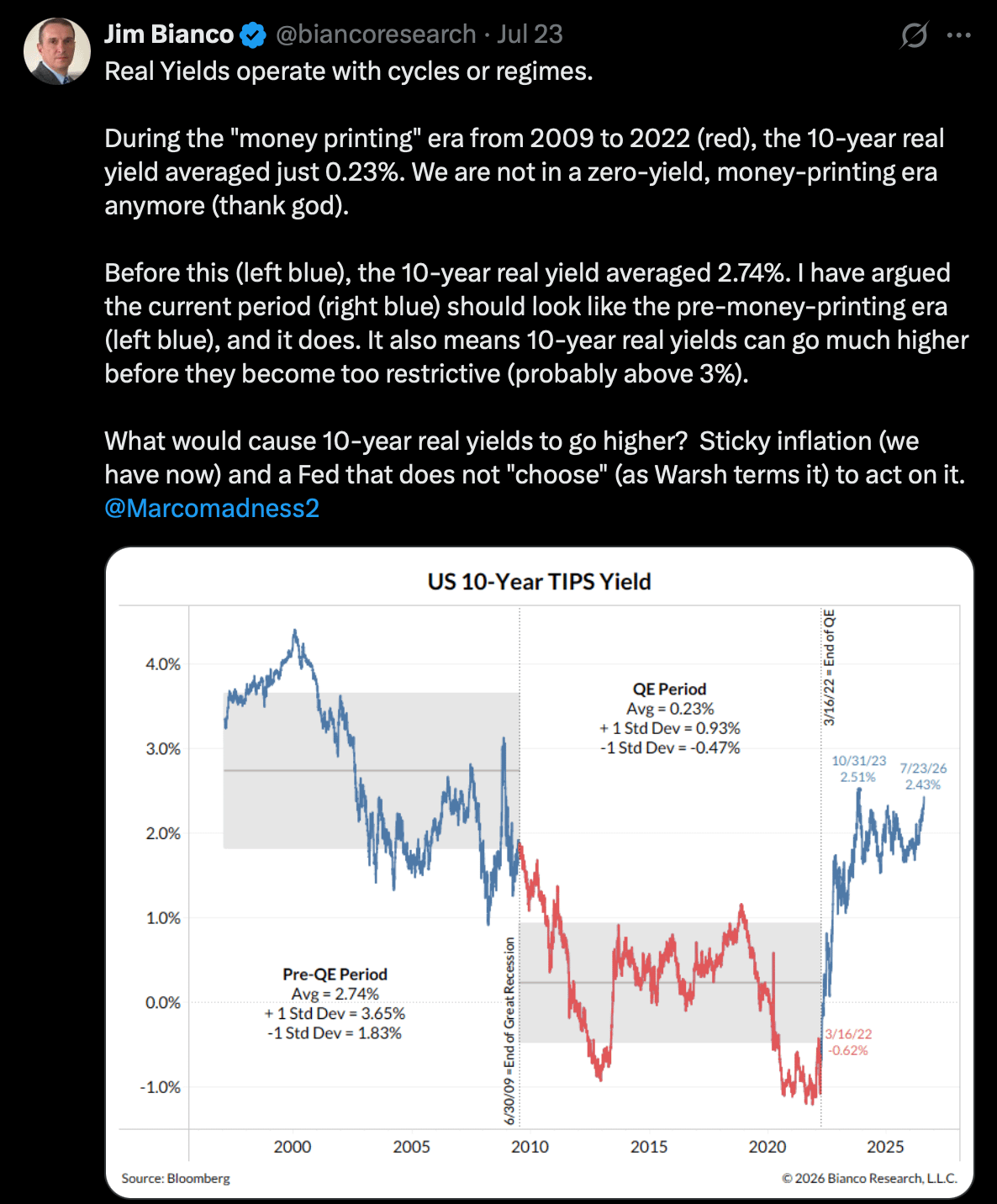
Jim Bianco’s chart above is the most honest answer to that question I have seen anywhere.
Look at the red stretch through the middle, 2009 to 2022. That’s the era we all remember, when borrowing money, after inflation, was effectively free. Bianco calls it the money-printing era, and he has a two-word verdict on its ending. “Thank god.”
Now look at the blue on either side of that chart. The left side is what money cost before any of that started. The right side, the part climbing at the far edge, is where we are sitting today.
Those two blue stretches look alike because they are alike. The price of money has gone back to what it was before the printing began.
Which means the thing we have all been waiting to come back is the thing that already left.
And Bianco’s read is that it has room to go further from here before it even begins to hurt.
So what actually changed, and how much of it has already happened? Who was standing there for thirteen years holding that price down, and where did they go? And what happens to a house, a portfolio, and a government carrying more debt than it ever has, once money costs something again?
All good questions, and super important ones. And ones we are going to answer, nice and easy as always, right here today.
Stick with me on this one. By the end you'll be able to build the single number underneath all of it in about ten seconds, and you'll know exactly what to do with it every week from here.
So pour yourself a big cup of coffee, and settle into your favorite seat, for a look at what happens when the rent on money goes back to normal, with this Sunday’s Informationist.
Partner spot
You’ve spent years thinking about what happens to the dollar. Have you spent any time on what happens to your bitcoin after you are gone?
Most bitcoin holders think they have an inheritance plan, but they don’t.
Knowing where your keys are isn’t a plan. Neither is telling your spouse the seed phrase. And the will your attorney drafted years ago might not account for any of it. Bitcoin inheritance isn’t just a technical problem, but a legal one too. Your heirs need both the keys and the legal authority to actually use them.
There’s a quick way to find out how exposed you actually are. Get your free bitcoin inheritance readiness score in under 2 minutes.
The Market Moved First
The Federal Reserve meets this coming Tuesday and Wednesday, an important second meeting from a newly chaired Fed, and with it comes its next rate decision.
With the Fed saying almost nothing leading up to it, market speculation of the outcome has been pretty volatile recently.
Look at last week, for instance.
On Friday July 17, Fed Funds Futures priced the odds of a rate hike at about 14%. In other words, not likely but not off the table entirely.
Fast forward one week, and by this past Friday (the 24th), the same odds are now 38%.
More than two times as likely as just a week before.
A single meeting can be noise, though, so let’s look further out on the calendar.
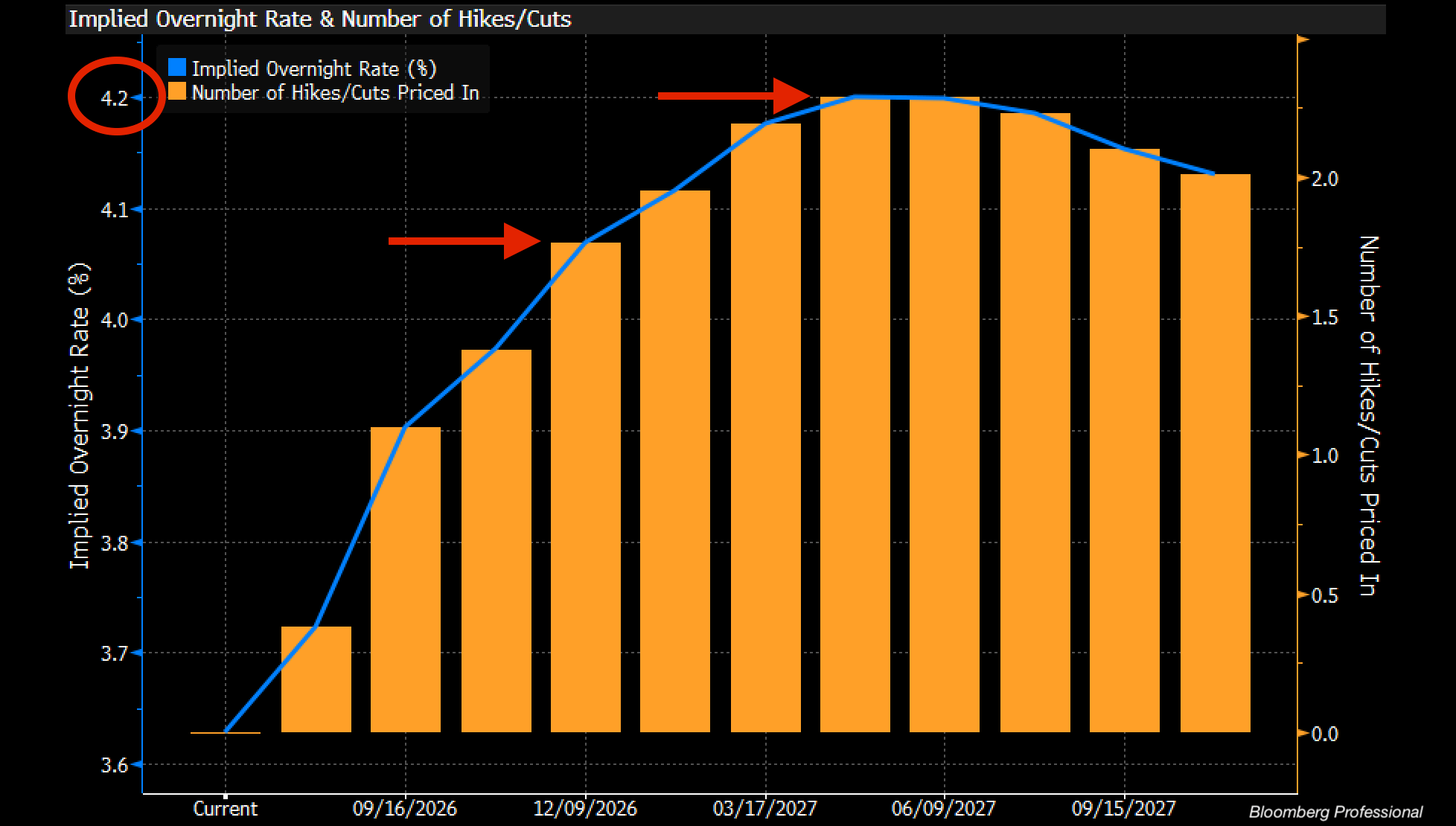
What do we see?
Over the last week, December pricing went from expecting roughly one more quarter-point hike by Christmas to expecting closer to two.
And when we look as far out as the curve goes, the picture doesn’t get much better. Rates peak in the spring of 2027 and barely ease from there. There isn’t a single full cut priced anywhere in it.
The Treasury market mirrored this last week, as the 2-Year US Treasury Note (the one that tells the Fed what the market expects them to do) jumped sixteen basis points in five sessions.
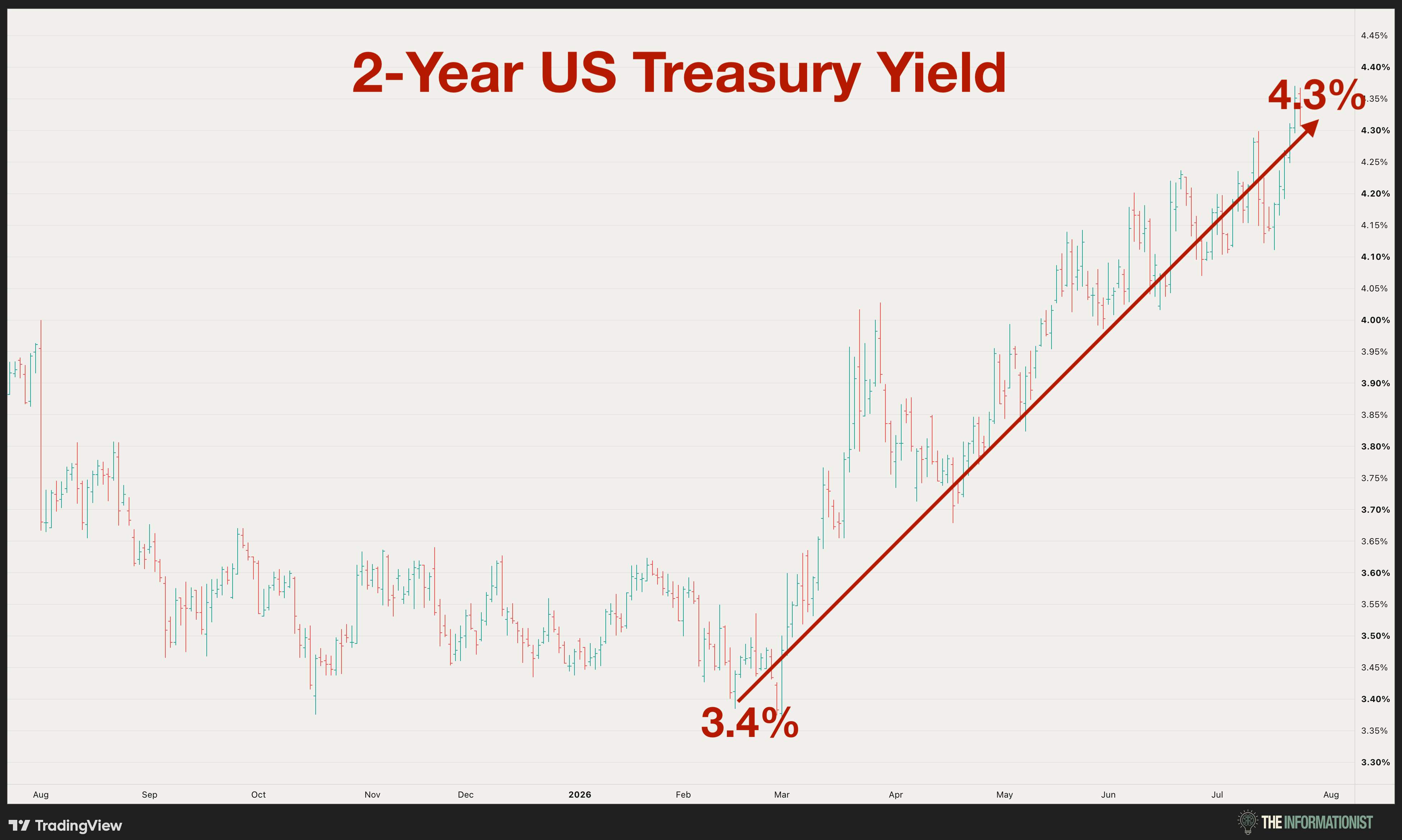
In truth, the market has been changing its mind steadily, in one direction, session after session, since February. For investors, this type of move is far more useful to us than a violent move would be, because a steady grind is much harder to dismiss as noise.
And because there is no dot plot at this meeting, and the next set of projections doesn’t arrive until September, everyone will be hanging on every single word from the new Chairman, Kevin Warsh, himself.
At his first meeting last month, Warsh was asked about the dot plot. His answer?
“I did not submit a, a dot. For me, it’s not helpful in the conduct of policy.”
Ah, but Mr. Chairman, Mr. Market loves speculation on speculation.
Yet, as we talked about recently in How to Read a Fed That Stopped Talking, forward guidance is gone, dropped as “not well suited to the current policy conjuncture.” And the official Fed policy statement came out shorter and simpler, stripped of older language.
Now there’s no guidance to lean on, no fresh forecast to argue with, and no pre-meeting hint to parse. And if Warsh stonewalls reporters like he did in his first meeting, then Wednesday’s statement will be the entire information set given to investors.
Here’s the thing, though.
While we all sit around and debate what the Fed is going to do, where they’re going to price the cost of money through the Fed Funds Rate, there’s a different rate that matters a whole lot more.
Every stock you own, every house on your street, and every dollar the Treasury owes is discounted against it. And on Friday afternoon it printed a twelve-month high.
For thirteen years that number averaged 0.23%.
Somebody was standing in the market making darned sure of it.
Unfortunately for Mr. Market, that somebody has stopped.
The Number Inside the Number
So let’s talk about that number.
