

✌️ Welcome to the latest issue of The Informationist, the newsletter that makes you smarter in just a few minutes each week.
🙌 The Informationist takes one current event or complicated concept and simplifies it for you in bullet points and easy to understand text.
🫶 If this email was forwarded to you, then you have awesome friends, click below to join!
Full disclosure, and as many of you already know: I hold bitcoin and hard assets personally and professionally, and I sit on the board of a bitcoin treasury company, so weigh my opinion accordingly. Nothing here is individual advice, and I don't know your personal situation. If you have an advisor, these are conversations you should be having with them.
Today’s Bullets:
What Is Keeping Mortgages So Elevated?
What Would Bring the 10-Year Down?
Can Washington Shrink the Other Two Points?
What to Expect Next
Inspirational Tweet:
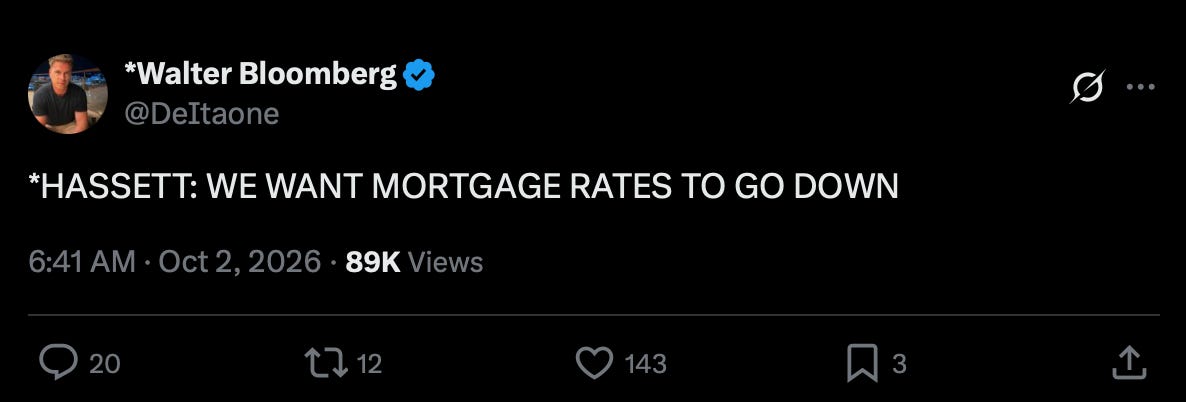
I agree, Mr. Hassett. I agree.
I think we all do.
That said, the “we” that Kevin Hassett is referring to here is none other than the White House.
After all, Hassett is the director of the National Economic Council and one of the President’s top economic advisors. He’s the same Hassett who was in the running for Fed Chair before the job went to Kevin Warsh.
And so, with midterm elections quickly approaching, I believe Hassett is simply expressing the President’s desires here.
Regardless of politics, though, high mortgage rates are painful for just about everyone.
And we’re hearing more and more rumblings about them, with rates climbing steadily higher for weeks and the average 30-year loan now back above 7%.
Question is, what is keeping mortgage rates so elevated, and what needs to happen for them to come back down? Can Hassett and co. do something to speed that up? And most importantly, what should we expect in the meantime, whether we’re buying, selling, or sitting on a mortgage we already have?
All good questions, important ones that we’re going to answer, nice and easy as always, right here today.
So pour yourself a big cup of coffee and settle into your favorite seat, as we figure out what it is going to take for mortgage rates to fall, with this Sunday’s Informationist.
Partner spot

Ask ten bitcoiners how to secure your bitcoin savings and you’ll get ten different answers.
Hot wallet. Cold wallet. Singlesig. Multisig. Passphrase. No passphrase. Dice. No dice.
Meanwhile, the institutional class waves all of it away. In their view, the ETFs are essentially custody solved.
Both camps are missing the point. One ignores that you yourself could be the single point of failure. The other cheers for multiple layers of counterparty risk.
There’s a better way.
Join Unchained’s Tom Honzik and Stephen Hall for a live session on how to get the peace of mind of institutional-grade security without abandoning the properties that make bitcoin worth owning in the first place. Explore thoughtful self-custody built around human relationships, professional guidance, and planning that survives you.
October 6 at 11am CT · Online · Free to attend
Register now → register for live session
What Is Keeping Mortgages So Elevated?
First let’s address one of the elephants that’s standing large in the middle of the room.
In the grand scheme of historical mortgage rates, 7% isn’t really that high.
I remember back in 1980, when I was just a kid, and my parents were complaining about mortgage rates up at 15% or 16%. Check out Exhibit 1 here.
What do we notice?
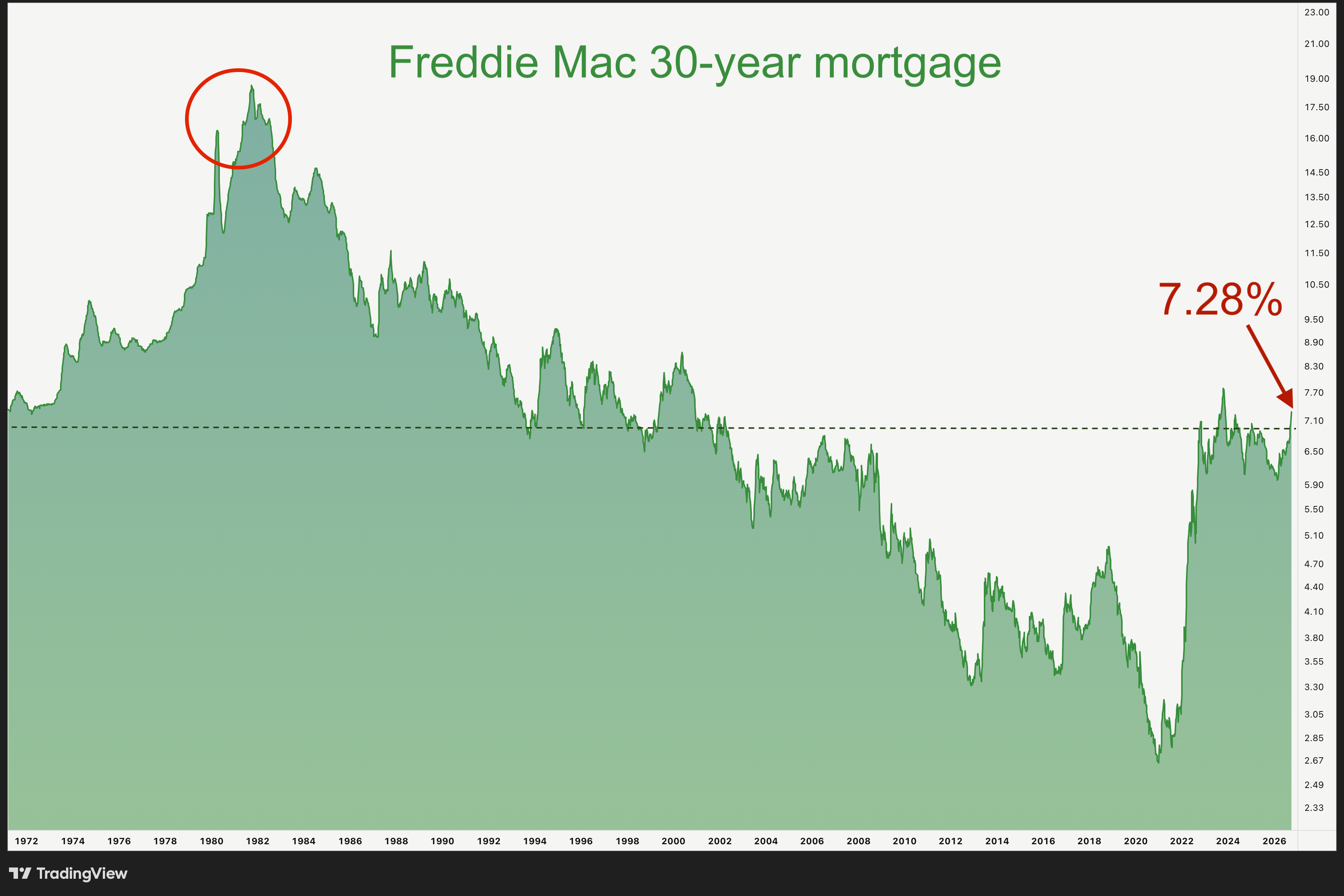
First the average 30-year mortgage crossed 16% in March of 1980, sat above 17% by the summer of 1981, and peaked at 18.63% that October.
Then if we draw a line at 7%, we see almost the entire chart before the spring of 2002 sitting above that level, with only brief dips below it in 1993, 1998 and 2001. That’s about 30 years of rates mostly above 7%.
So, was it really worse back then?
On the monthly payment, yes. Look at this chart.
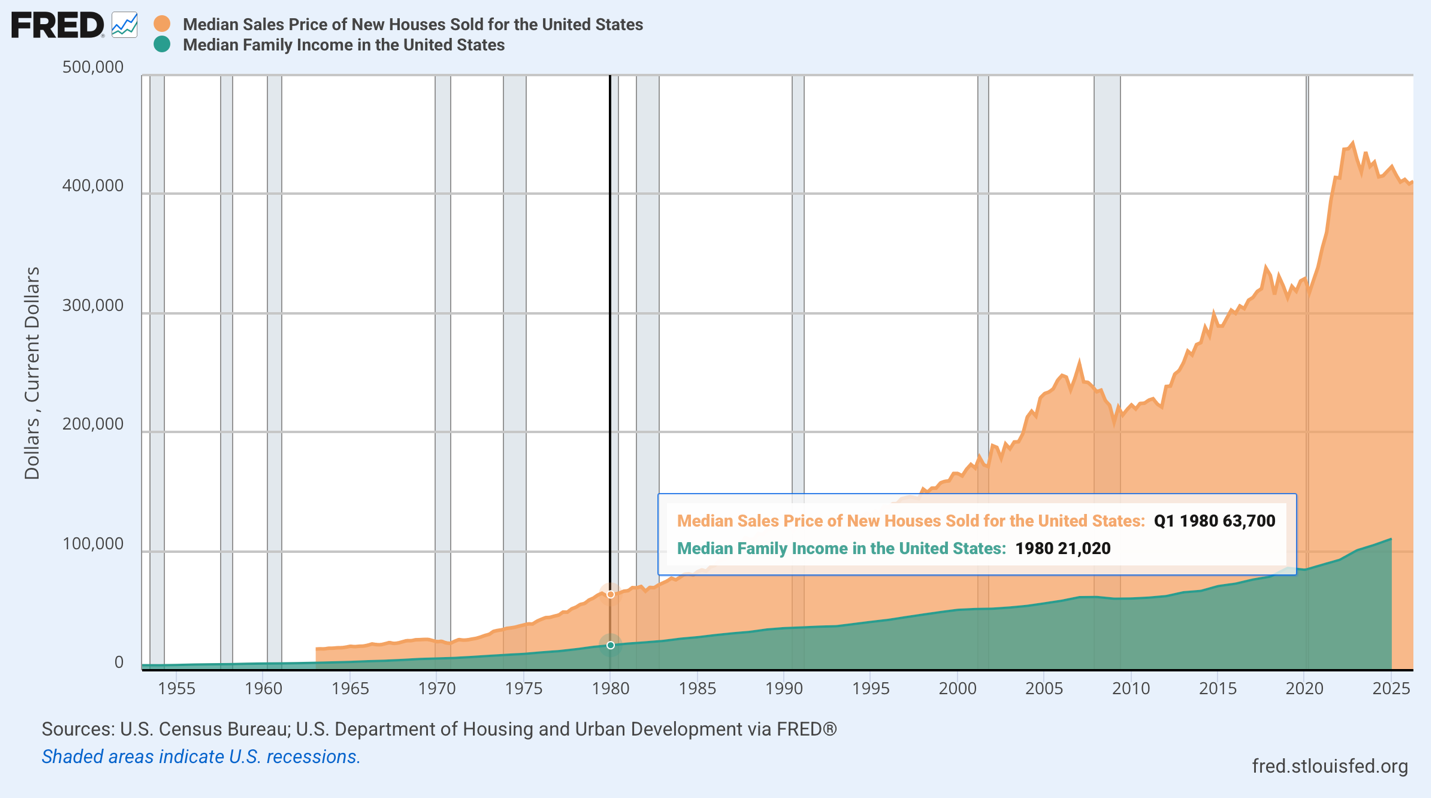
What we see here is that in 1980, the median new house sold for about $64,000, and the median family made about $21,000. Put 20% down at 16%, and your payment was about $690 a month.
That’s 39% of the family’s income. Ouch.
And, as of this spring, the median new house sold for about $411,000, and the latest census data shows the median family made about $110,500 last year. Same 20% down, at this week’s 7.28%, and you’re paying about $2,250 a month.
About a quarter of income.
But look at the price of that house. In 1980 it cost about three years of the family’s income. Now it costs closer to four.
You may now be asking, How exactly did we get here?
Once again we can thank our buddies at the Fed who instituted something called ZIRP, or Zero Interest Rate Policy. In response to the Great Financial Crisis and housing meltdown of 2008, the Fed held its rate near zero for seven years, from late 2008 to late 2015, then took it back to zero for two more starting in March 2020. Meanwhile, they bought trillions of dollars of bonds along the way (more on that in a bit).
And, like magic, mortgage rates fell under 3% in 2020 and 2021.
Thing is, most people shop for a house according to what they can afford as a monthly payment. And so, at 3%, the same monthly payment allows you to take out a loan about 60% bigger than you can at 7.28%.
It’s no surprise that all that cheap money went straight toward pricing. According to the Case-Shiller index, the gold standard for home prices, from February 2020 to June 2022 alone, home prices rose about 45%.
And even as rates have come back to 7%, prices have held up. They dipped about 5% into early 2023, recovered within months, and hit a new record this July.
You’ve heard the old realtor motto: “Marry the house, date the rate.”
Using that playbook, a buyer back then took a painful rate on a cheap house, then refinanced as rates fell for the next forty years. In contrast, a buyer today locks in a high cost of a house, with no promise that rates fall from here.
Which brings us to the question of, what is keeping mortgage rates up here?

Bottom line, mortgage rates take their cue from the 10-year Treasury, adding a premium for risk and loan duration. With the 10-year Treasury currently sitting at 5.28%, the 30-year mortgage rate is about 2 percentage points higher. That gap has averaged about 1.75 points since the early 1970s, and it has run anywhere from about 1 point to about 3.
So if we want mortgage rates to fall, one of those two factors has to come down, either the 10-year rate or the risk associated with the 30-year mortgage.
Since the 10-year is by far the bigger piece, we need to first ask, what would it take to bring the 10-year rate down?
Good question. Let’s get into that next.
What Would Bring the 10-Year Down?
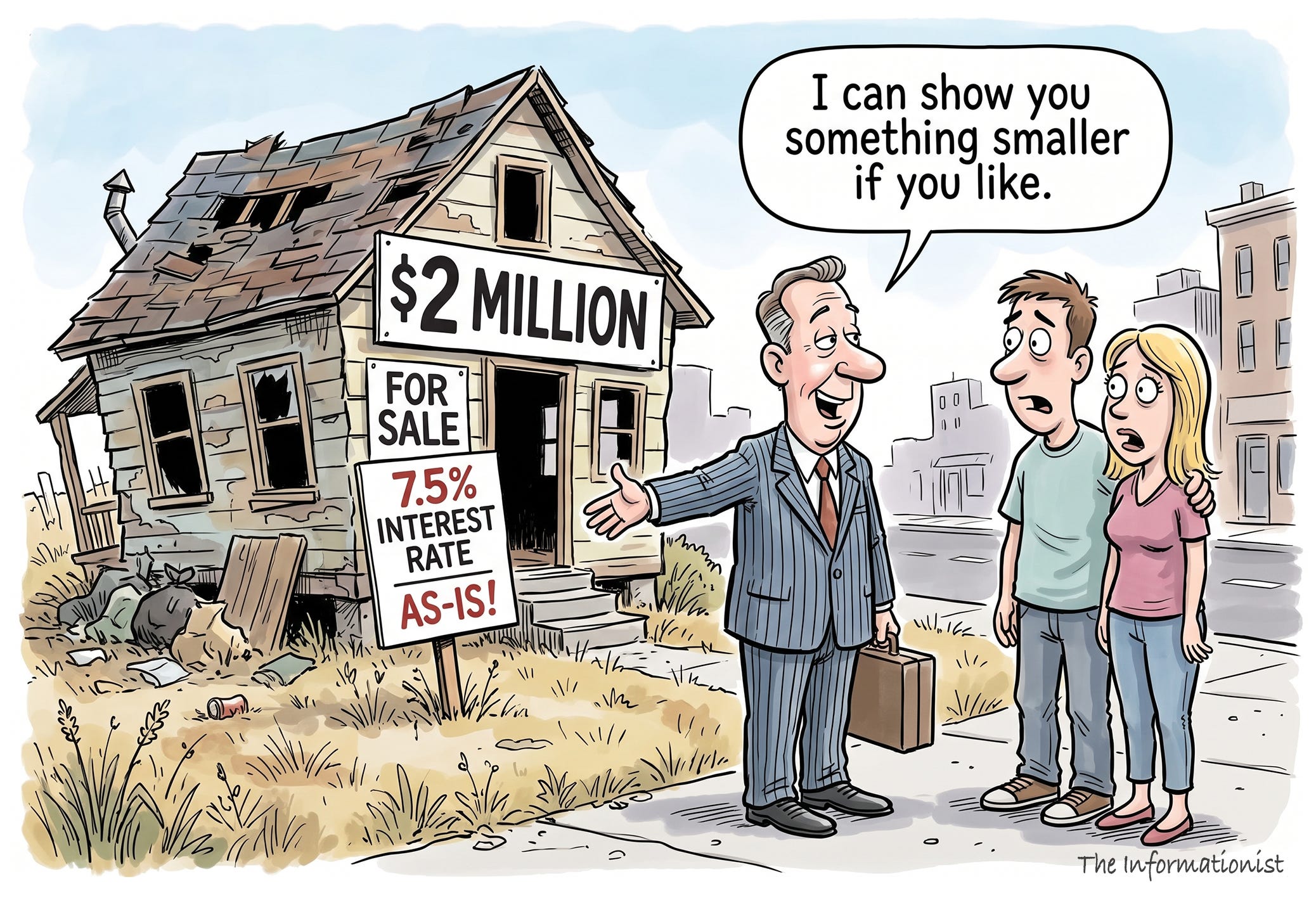
Let’s be honest, the mortgage rate we all really want back has a 3 or a 4-handle on it.
So what would it take to get us back there?
