

✌️ Welcome to the latest issue of The Informationist, the newsletter that makes you smarter in just a few minutes each week.
🙌 The Informationist takes one current event or complicated concept and simplifies it for you in bullet points and easy to understand text.
🫶 If this email was forwarded to you, then you have awesome friends, click below to join!
👉 And you can always check out the archives to read more of The Informationist.
Today’s Bullets:
🏦 What Is Private Credit, and Why Should You Care?
💣 The Dominoes That Started Falling
🔍 Why the Numbers Don’t Add Up
🛡️ What This Means for Your Portfolio
Inspirational Tweet:
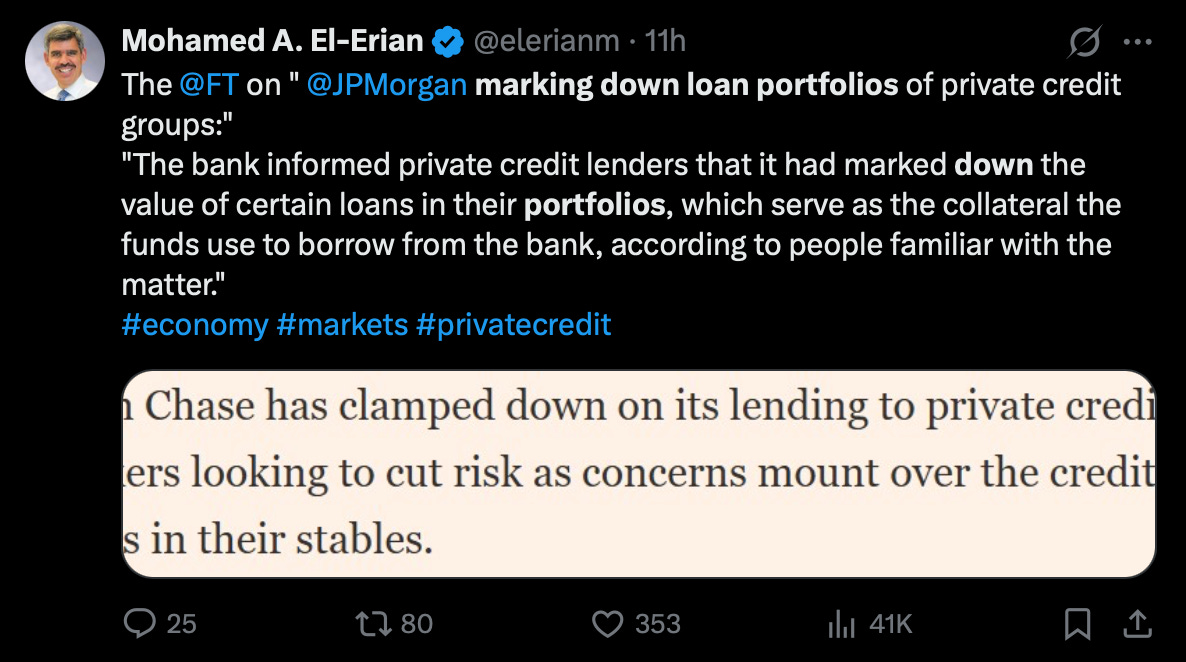
If you’re a normal everyday person, you probably don’t think about private credit too often, if at all.
And why should you?
That’s for your pension fund or 401(k) manager to worry about. Until this last week. Because you’ve probably noticed that it’s been all over the news, seemingly everywhere you turn. If the article is not about war, it’s about private credit.
But what exactly is private credit? Why is everyone talking about it all of a sudden? Why should you care? And most importantly, how could it possibly affect your own investments?
All good questions and ones that we will answer, nice and easy as always, here today.
So pour yourself a big cup of coffee and settle into your favorite seat for a look inside the private credit market with this Sunday’s Informationist.
Partner spot.
Most People Will Waste This Cycle
Bitcoin bear markets test your wits—and create opportunity for those prepared to act. Our new field guide, 21 Moves to Make in the Downturn, walks you through a clear, practical plan to steady your thinking, accumulate with discipline, and strengthen your long-term position while others lose focus.
Inside, you’ll learn:
How to orient your thinking around bitcoin’s long-term properties
Common psychological traps to avoid during market downturns
Practical accumulation strategies like dollar-cost averaging
Ways to optimize savings, retirement accounts, and idle capital
A small minority will quietly make the moves that matter. We wrote 21 Moves to Make in the Downturn for that minority. If you’re serious about building a position that survives the next decade, start here.
🏦 What Is Private Credit, and Why Should You Care?
Let’s start with the basics, shall we?
You’ve probably heard of private equity. Big firms like KKR and Apollo that buy entire companies, restructure them, and sell them for a profit. That’s private equity, a sector of investing with its own can of mark-to-market worms.
Private credit is different. It’s the lending side.
See, instead of buying companies, private credit funds lend money to them. Think of it as unregulated banks, operating in the opaque corners of the bankng world, and making loans directly to mid-sized businesses that can’t or don’t want to borrow from traditional banks.
This is why they’re often referred to as shadow banking.
It’s lending outside of the traditional banking system, beyond the reach of most banking regulations.
So why does private credit even exist?
Simple.
After super restrictive bank rules were enacted in the aftermath of the great financial crisis, fund managers saw an opportunity. They raised money from investors, from pensions, endowments, insurance companies, and wealthy individuals, and started making the loans that banks no longer would.
Higher interest rates. Flexible terms. And for the investors putting money in, attractive yields in a world where yields were close to zero.
Everybody won. The companies got their capital. The investors got their returns. The fund managers collected their fees.
And the market grew like black mold in a Houston basement.
FYI, I wrote all about shadow banking last fall. If you have not seen that newsletter or would like to revisit, you can find it here:

Today, including committed capital and leverage, the global market has ballooned to roughly $3 trillion. Larger than the entire global high-yield bond market.
Now here’s who’s actually in this market because this is where it gets personal.
Your pension fund is almost certainly allocated to private credit. If your 401(k) has an “alternative income” option, there’s a good chance it includes private credit. Life insurance companies are some of the biggest buyers. University endowments, too.
You may never have heard the words “private credit” before today.
But your retirement money has.
OK so far so good, right? Companies get loans. Investors get yield. What could go wrong?
Well, a lot of these funds were originally built with long lockup periods. You put your money in, it’s tied up for seven to ten years. The fund makes loans, collects interest, and when the loans mature, it returns your capital. The timelines match. Money goes in long. Money comes out long.
Makes sense.
But over the past few years, Wall Street got creative. They built a new kind of private credit fund. Perpetual funds. Evergreen funds. Names that sound like they’ll last forever.
And in a way, that’s the problem.
These funds have short lockups, sometimes just a year, sometimes none at all. After that, investors can request redemptions every quarter. There’s usually a cap, around 5% of the fund’s total value per quarter.
Sounds reasonable, right?
Here’s the catch. The loans inside these funds still last five to seven years. But unlike traditional funds, perpetual funds never stop lending. When an old loan gets repaid, the manager doesn’t hold that cash for redemptions. He recycles it into a brand new loan. More yield. More fees.
The wheel never stops spinning.
So now you have a fund full of five-to-seven-year loans that keeps making new five-to-seven-year loans, while promising investors they can leave every quarter through a 5% exit door.
When only a few people head for the door each quarter, the math works. The fund keeps enough cash on hand. Nobody notices.
But what happens when 7% want out? Or 9%? Or 14%?
The fund can’t call up its borrowers and say, “We need that $50 million back by Friday.” Those loans are locked. The cash isn’t there. It’s been recycled into new loans that won’t mature for years.
So the fund has two choices. Sell the loans at fire sale prices. Or shut the door.
It’s called putting up the gates.

When I wrote about private credit last fall, I flagged this structural mismatch. I said defaults could hit 5% if rates stayed high. They did.
But I also said contagion was unlikely.
I am now concerned about that last part.
Because over the past few weeks, the gates have started closing. And the names on the doors are unfortunately ones you know.
But the gates aren’t even the part that should worry you.
