

✌️ Welcome to the latest issue of The Informationist, the newsletter that makes you smarter in just a few minutes each week.
🙌 The Informationist takes one current event or complicated concept and simplifies it for you in bullet points and easy to understand text.
🫶 If this email was forwarded to you, then you have awesome friends, click below to join!
Full disclosure, and as many of you already know: I hold bitcoin and hard assets personally and professionally, and I sit on the board of a bitcoin treasury company, so weigh my opinion accordingly. Nothing here is individual advice, and I don't know your personal situation. If you have an advisor, these are conversations you should be having with them.
Today’s Bullets:
So, What Happened to the Pet Rock?
What Is JPMorgan Actually Predicting?
What’s the Catch?
Is JPMorgan Right About Debasement?
Inspirational Post:
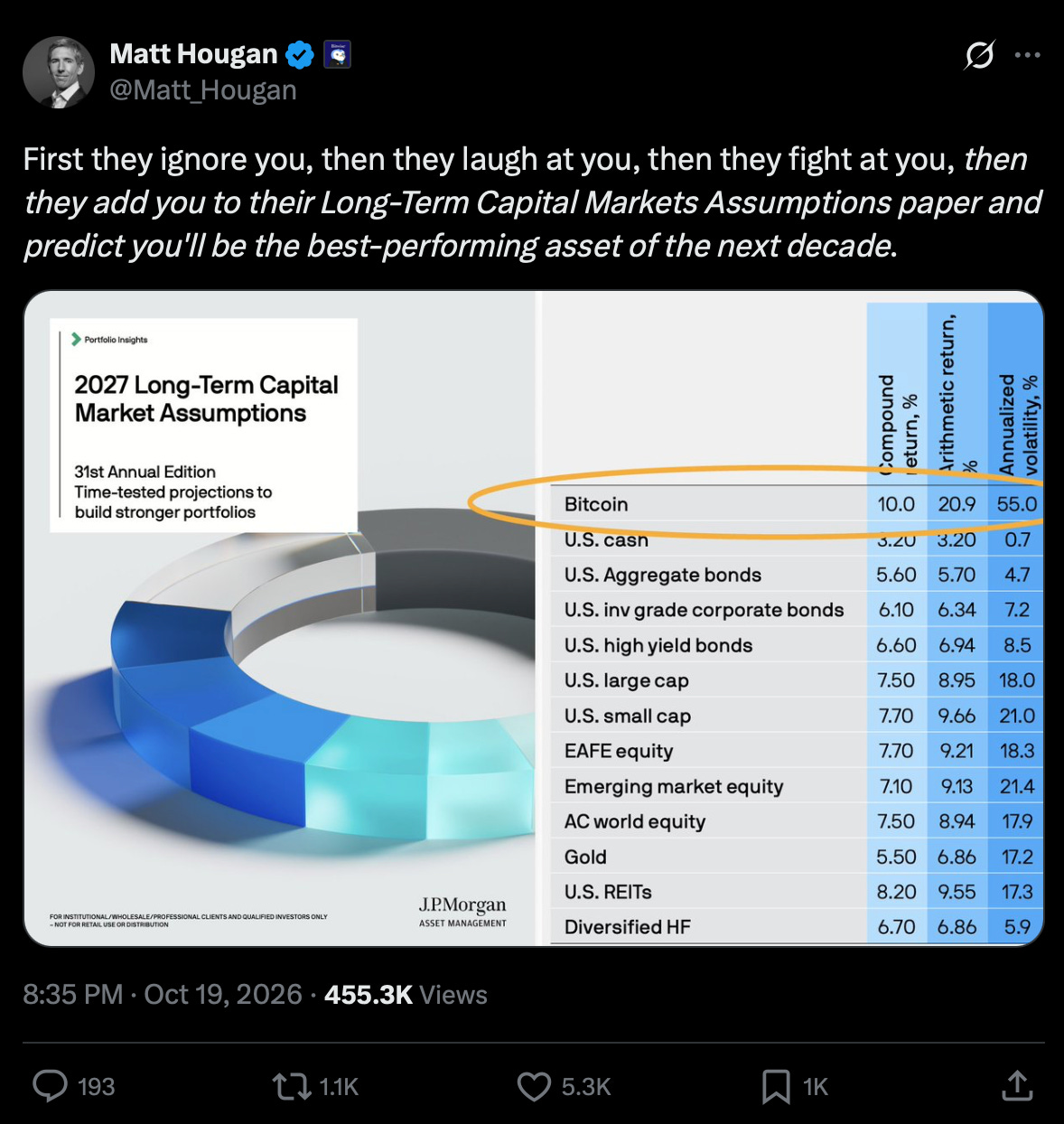
Well said, Matt. Aka, then you win.
Matt Hougan is the chief investment officer at Bitwise, a company that offers the Bitwise Bitcoin ETF (NYSE: BITB).
Like my own Bitcoin Opportunity Fund, Bitwise also benefits from the success of bitcoin and bitcoin-related companies. And so, when you see a research report from JPMorgan naming bitcoin as an asset, you take notice.
This one, JPMorgan’s Long-Term Capital Market Assumptions, is the forecast the bank’s asset management arm puts out every year to help its clients build their portfolios.
And for the first time in the report’s 31 editions, bitcoin was given its own forecast. One that has it coming out ahead of stocks, bonds, and even gold.
For those of you who have been reading my work over the years, you know this represents a major step in the evolution of Wall Street’s recognition of bitcoin.
In other words, we’ve come a long way.
It appears we have, anyway.
But before we jump to major conclusions and latch onto the table in Matt’s post, we need to do some critical thinking and analysis and ask some important questions first.
Like, did JPMorgan really just recommend bitcoin? What exactly is the bank predicting, and over how long? Has Jamie Dimon finally changed his tune regarding bitcoin? And most importantly, what does any of this mean for the portfolios of JPMorgan clients, as well as our own?
Good questions, each of them, and ones that we’re going to answer, nice and easy as always, right here today.
So pour yourself a big cup of coffee and settle into your favorite seat, as we read JPMorgan’s first-ever bitcoin forecast, and the fine print behind it, with this Sunday’s Informationist.
Partner spot

Recently, Ledger users lost funds after purchasing devices through a third-party reseller in a suspected supply chain attack. Ledger is advising recent buyers to hold off on setup, or to move funds to a new device with a new seed.
Like the Coldcard incident this summer, your takeaway should be this: eliminate all single points of failure. If your long-term bitcoin depends on one key, one provider, one location, or one person, then one failure is all it takes to lose everything.
Whether it be a supply chain attack, retirement attack, or even a heart attack: no single failure should put your bitcoin out of reach for you or your family.
Unchained built a short self-assessment to show you where you stand. It’s 3–7 questions, takes about three minutes, and highlights which dependencies deserve a closer look. The answer might not be what you think. Your answers are evaluated in your browser and are never stored.
Find your single point of failure →
So, What Happened to the Pet Rock?
To fully appreciate just how far JPMorgan has come, let’s go back to September 2017.
This is when Jamie Dimon, while speaking at a Barclays banking conference, called bitcoin a fraud. “It’s worse than tulip bulbs,” he said. “It won’t end well. Someone is going to get killed.”
And any JPMorgan trader caught trading it? He’d “fire in a second,” because “It’s against our rules and they are stupid.”
Not really much room for interpretation there.
Then, six years later, while testifying before the Senate Banking Committee, he said, “If I was the government, I’d close it down.”
Good thing he’s not the government.
That was in 2023, and my partners and I were living a version of that oppression while establishing our hedge fund. Because, during what came to be known as Operation Chokepoint 2.0, a number of the big banks were reluctant, and at times flat out unwilling, to facilitate wires in and out of our fund.
They were delayed, refused, and often returned without warning.
Why?
Because the fund has the word Bitcoin in its name.
Back to Dimon.
Perhaps everyone’s favorite comment from him came in January 2024 at Davos when he said, “[Bitcoin] does nothing. I call it the pet rock.”
Less than three years ago.
Now bitcoin is featured in a major JPMorgan report.
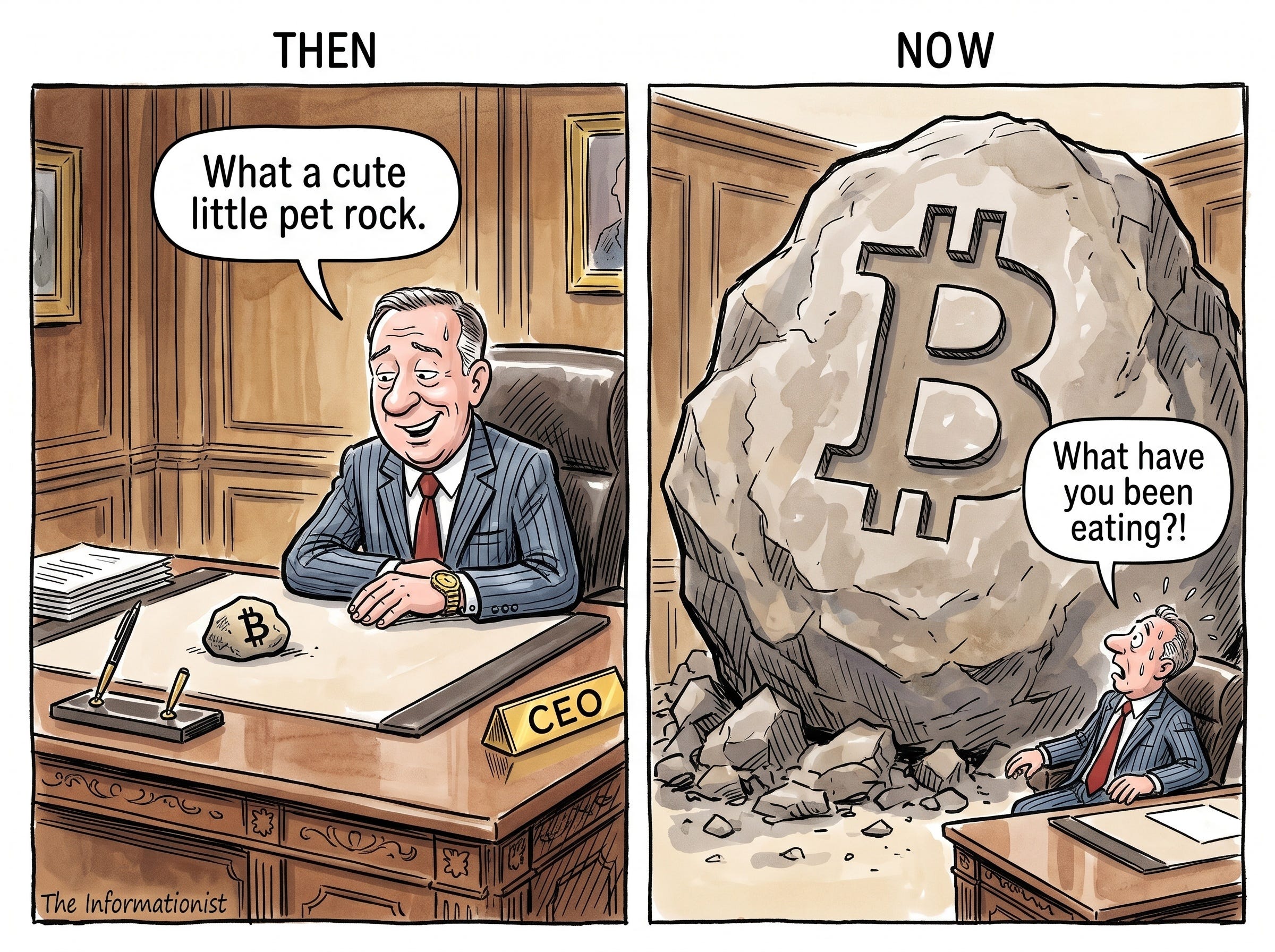
So what changed?
My guess is that his clients started asking about it. Because, the same month as the pet rock comment, BlackRock, Fidelity, and eight other firms launched spot bitcoin ETFs. Matt’s Bitwise fund was one of them.
And JPMorgan was involved from the start. Just three weeks after Dimon’s “close it down” line in the Senate, BlackRock named JPMorgan one of the authorized participants for its bitcoin ETF, the firms that help manage the flow of money in and out of the fund.
Bottom line, Wall Street money had started flowing into bitcoin, and JPMorgan wasn’t going to just sit by idly and not be involved in this new digital asset frontier.
And by May of 2025, at JPMorgan’s Investor Day, Jamie Dimon had a message for clients: “We are going to allow you to buy it. We’re not going to custody it.” And then, “I don’t think you should smoke, but I defend your right to smoke,” he said. “I defend your right to buy bitcoin.”
Still not exactly a ringing endorsement from the longtime skeptic.
But Dimon knows an opportunity when he sees it. And as the business kept evolving, by last October, Bloomberg reported that JPMorgan would let its institutional clients use bitcoin as collateral for loans.

Two months later, Bloomberg reported the bank was exploring bitcoin trading for those same clients.
Meanwhile, when asked about bitcoin at a Fortune conference last October, Dimon waved off any answer with, “Then that’s all I’m going to read about in the headlines.”
In other words, no comment.
Watch what they do, not what they say, right?
Because no matter what Dimon says to reporters or at conferences, JPMorgan has begun to build a business around the clients who want it.
This new report comes from the corner of that bank that helps its clients decide what to own: its asset management arm.
So, most importantly, what exactly did the report say, and what are they predicting for bitcoin?
What Is JPMorgan Actually Predicting?
Let’s talk about the row that Matt circled in his post above, and why each of those three numbers is so important.
