

✌️ Welcome to the latest issue of The Informationist, the newsletter that makes you smarter in just a few minutes each week.
🙌 The Informationist takes one current event or complicated concept and simplifies it for you in bullet points and easy to understand text.
🫶 If this email was forwarded to you, then you have awesome friends, click below to join!
Full disclosure, and as many of you already know: I hold bitcoin and hard assets personally and professionally, and I sit on the board of a bitcoin treasury company, so weigh my opinion accordingly. Nothing here is individual advice, and I don't know your personal situation. If you have an advisor, these are conversations you should be having with them.
Today’s Bullets:
The AI Selloff
Warsh’s New Monetary Medicine
Selloffs That Stop the Fed
Which Wins: Markets or Data?
Inspirational Post:
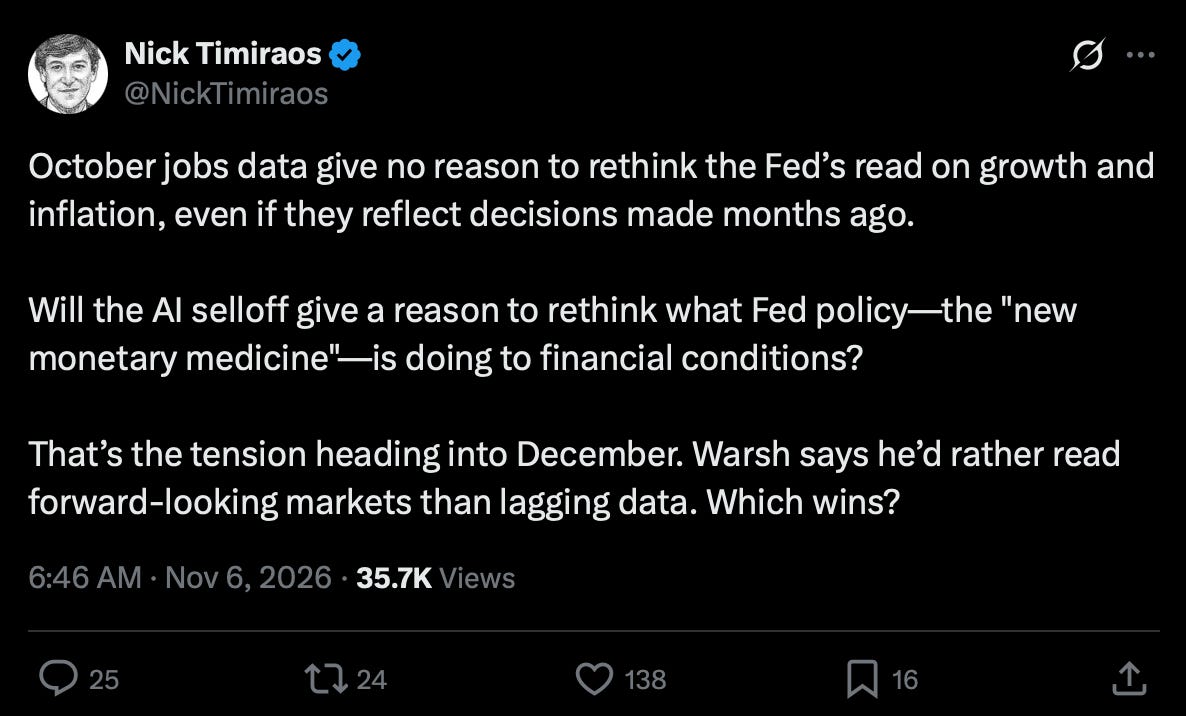
In the wake of the midterm election Democratic sweep, along with an AI-driven market slide which arguably began weeks ago, plenty of us have questions about where all this leaves the Fed.
Nick Timiraos from The Wall Street Journal covers the Fed, and he asks one question that’s on many of our minds.
Will markets drive Fed policy going forward?
Excellent question.
After all, as Nick points out, new Fed chair Kevin Warsh has said he’d rather read forward-looking markets than wait on lagging economic data.
Market data is getting muddy, though.
And since its last meeting, several Fed officials have suggested more hikes will be needed. After the hike in September, traders still expect another hike in December.
On one side, we have stubborn inflation and jobs data telling the Fed to keep going. On the other side, we have a stock market that’s beginning to crack, with AI stocks leading the way down.
So, where does this leave the Fed?
Before answering that, we have to answer other questions first.
Like, what’s really driving the recent AI selloff, and how did the election results exacerbate it? What exactly is Warsh’s “new monetary medicine,” and how is the stock market possibly part of it? And how sharp of a market selloff is necessary to stop the Fed in its tracks?
Good questions, each of them, and ones that we’re going to answer, nice and easy as always, right here today.
So pour yourself a big cup of coffee and settle into your favorite seat, as we assess the steadfastness of the newly chaired Fed, with this Sunday’s Informationist.
Partner spot

Coldcard entropy bug, Ledger supply chain attacks, and now a $6B Binance hack?
We just launched the Bitcoin Security Stress Test so you can explore those scenarios before they happen. A stolen seed phrase. A house fire. An exchange that freezes withdrawals. Your heirs trying to recover your bitcoin without you. Pick a custody setup, throw disasters at it, and watch what survives.
Compare six ways to hold bitcoin: exchanges, spot ETFs, singlesig, singlesig with a passphrase, DIY multisig, and Unchained collaborative custody. See how the same incident plays out across different models.
Put your storage decisions to the test: change where devices and backups are kept, switch paper seeds to metal, or break individual components to uncover hidden dependencies.
Understand the recovery path: follow each incident step by step to see what’s affected, whether you can still access your bitcoin, and what recovery requires.
Start with the setup closest to yours. Then test the situation you’re least prepared for.
Find your single point of failure. Run the stress test →
The AI Selloff
Let’s go back a number of weeks, to before the election, when the slide in AI stocks started.
That was mid-October and a hot inflation number put another Fed rate hike squarely back on the table. As a result, AI stocks began to sell off.
Then we got earnings season, where Google and Amazon told investors to expect even larger AI bills, and chip stocks took it on the chin.
A lot of this reportedly comes down to shortages. Chips, energy, and various other inputs are becoming more expensive, and companies can’t raise prices quickly enough to keep up.
In other words, it seems the AI boom has an inflation problem of its own.
Of course, we talked about how all of this gets financed back in August.

Fast forward to Monday this past week. Even before the election, the Nasdaq 100 was already in correction.
A day later, Democrats swept both the House and the Senate, including a Senate seat in Texas. And in the Texas governor’s race, Gina Hinojosa beat Greg Abbott, the first Democrat to win it since Ann Richards in 1990.
Some of you who aren’t hyper-focused on hyperscalers might be wondering why a governor’s race would matter so much to AI stocks.
Well, Texas is where a big chunk of the data center buildout is supposed to happen. Wells Fargo estimates that more than a quarter of all planned US data center capacity sits in the Lone Star State.
And the newly elected Texas governor, Hinojosa, campaigned on pausing new data centers. On Thursday, she told CNN the state needs to “stop what we are doing with data centers” until new protections are in place.
Now, before we get hyperbolic here, in truth, Texas had already begun tapping the brakes. Abbott paused new data center hookups to the grid back in August, pending a state audit.
Still, the knee-jerk reaction was visceral. On Thursday, the Nasdaq 100 dropped 6.4%, its steepest one-day fall since March 2020.
Ouch, indeed.
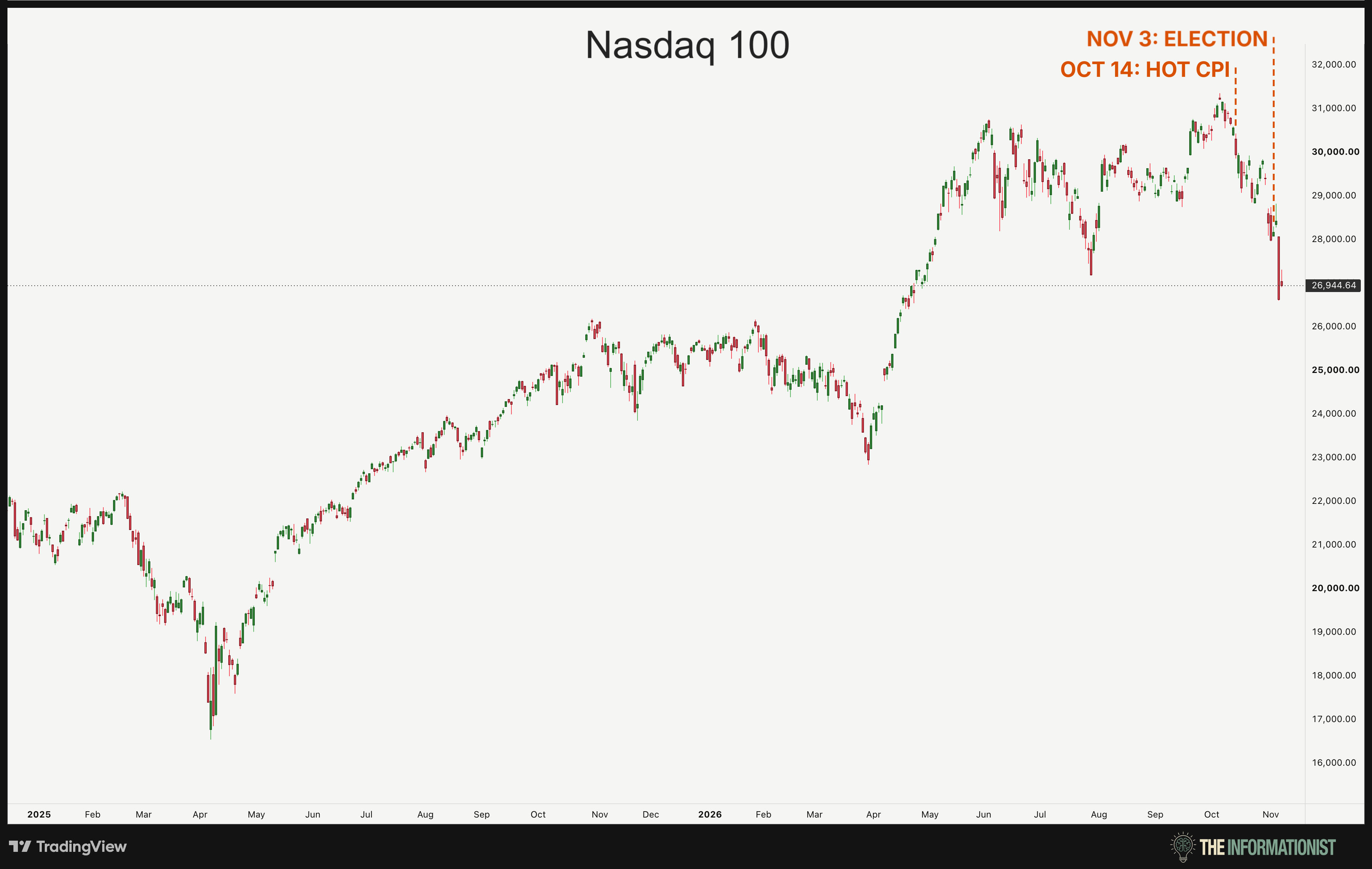
We’ve had two waves of selling. The first was about costs and rates and the impact on all the borrowing needed for the AI buildout. The second was about whether the buildout gets built at all.
And this, in turn, puts Warsh in an interesting spot.
One may even say a pickle.
In other words, does the stock market falling help him? Or does it just create a new problem for the Fed?
Warsh’s New Monetary Medicine
To figure out whether a selloff helps or hurts Warsh, we’ll take a look at a phrase he used at his last press conference, the one that Timiraos mentioned above.
New monetary medicine.
Sounds intriguing, doesn’t it?
