

📶 Welcome to The Informationist. Each week I take you inside the decisions that move markets and make sense of the forces at work.
✅ One topic, exposed and explained, so you can make sharper decisions with your own money.
➡️ If this was forwarded to you, you have good taste in friends. Join 45,000+ readers here.
Today’s Bullets:
The Case for Spending Every Last Dollar
Who Ends Up Holding the Promise
The Last Company to Finance Its Own Customers
It Doesn’t Stop With the Names You Know
How I’m Weighing It
Inspirational Tweet:
If you’re anything like me, you’ve stopped feeling the numbers lately. You’ve become numb to them.
A hundred billion here. Half a trillion there. A deal announced on a Friday that would have been the largest in corporate history a decade ago, and by Monday it’s barely a memory. Heck, I read this stuff for a living, and even I find myself skimming past the headline figures to get to what actually happened.
Lately, though, more and more people have started asking where all those numbers actually come from.
It goes something like this. The biggest companies in AI have been investing in each other, lending to each other, and buying from each other, all at the same time. Nvidia puts money into a company that turns around and buys Nvidia chips. A cloud provider borrows billions to build data centers for a customer Nvidia also owns a piece of. Round and round it goes.
They’re calling it circular financing, and the worry is simple enough. If the same dollars keep turning up at more than one stop, demand can look a whole lot stronger than it really is.
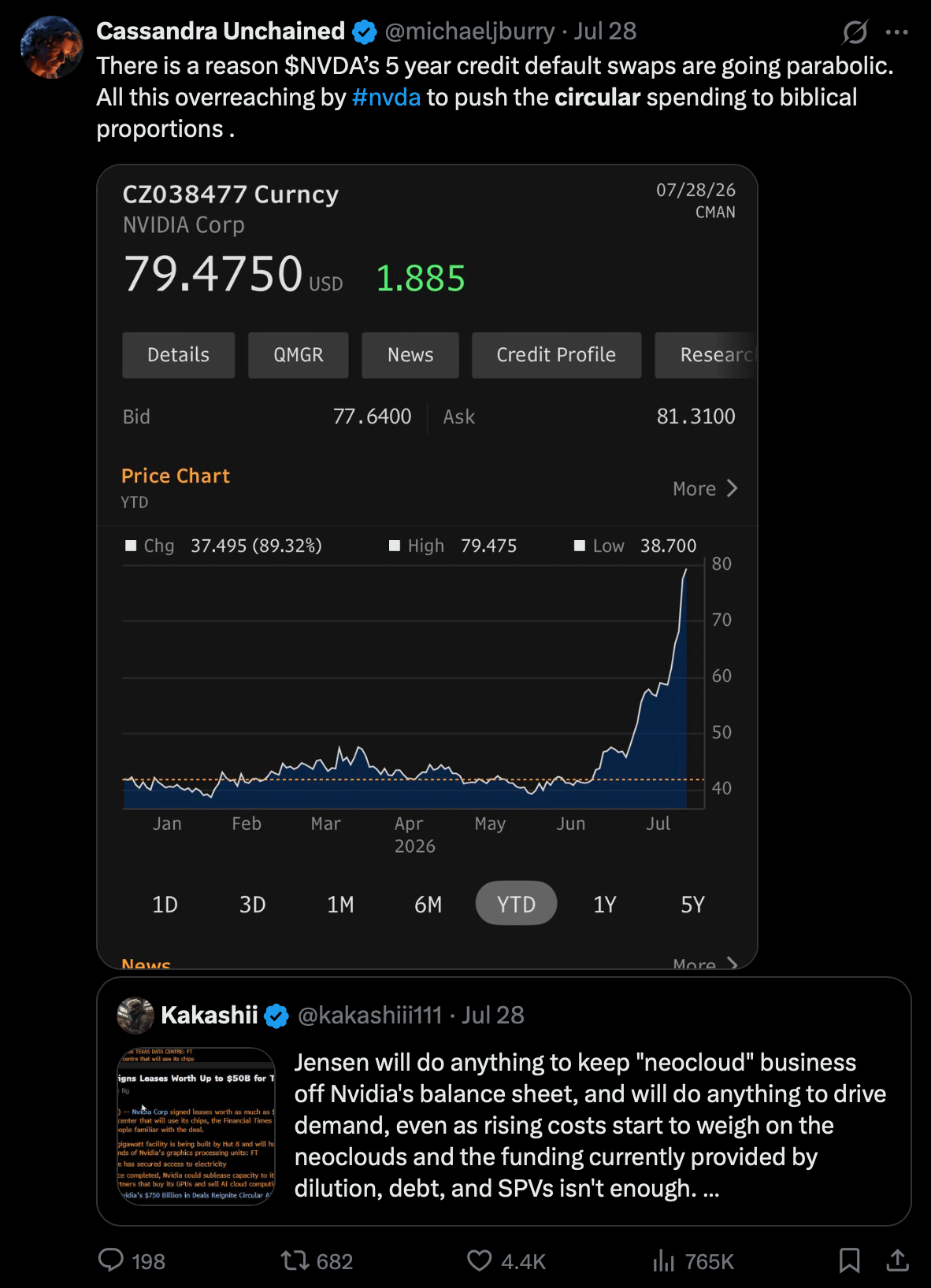
Which brings us to the post above.
The one from Michael Burry, with a Bloomberg chart of what it costs to insure Nvidia’s debt against default for five years.
Sound familiar?
Exactly. Burry is the one who called the housing bubble, and they made a whole movie about how he made billions buying insurance against a massive default on all those mortgages.
Now he’s pointing straight at the same type of insurance and saying that Nvidia has overreached and pushed the circular spending to biblical proportions.
Maybe.
Merely writing about circular financing is one thing, but paying real money, every single year, to insure against it is quite another.
And somebody is doing exactly that.
So is he right? Is this the most expensive capital cycle of our lifetime, or is it the smartest one? Are these companies doing something wrong, or is this simply what a boom looks like from the inside while it’s still working? And why should any of it matter to somebody who doesn’t own a single AI stock?
All good questions, important ones. And ones we are going to answer, nice and easy as always, right here today.
Because of the way these companies are tangled up in one another, there’s some machinery in this one. So to keep it easy to follow, you’ll find a short version at the end of every section.
So pour yourself a big cup of coffee and settle into your favorite seat, for a clear look at who is actually on the hook in the AI build-out, with this Sunday’s Informationist.
Partner spot
Wealthy families might not be leaving their bitcoin to a will. They could be putting it in a trust. Here’s why:
A will goes through probate. Probate is public, slow, and exactly where you don’t want a record of your bitcoin holdings sitting. Trusts skip all of it, and it’s a standard practice for wealth succession.
The Inheritance Boot Camp gives you that same structure. Our team with deep bitcoin expertise guides you through the key complexities.
They know estate structure, they know bitcoin, and they will tell you exactly what you need to do and in what order. You make the decisions, while they guide you through the process.
Here is what that looks like in practice:
Map your current situation and surface the gaps you didn’t know you had
Build a succession structure tailored to your assets and your family
Create a trust and draft estate documents with language that actually accounts for bitcoin.
Set up and fund a trust vault with your heirs legally documented.
You can’t control the price of bitcoin, but you can control your legacy today.
Learn more about the Inheritance Boot Camp
The Case for Spending Every Last Dollar
Before we go anywhere near what could go wrong, the bull case deserves a solid hearing. Because the case for spending this money is a strong one, and the people making it are putting their own capital behind it.
Start with the simplest fact in the whole story.
The demand is real. Right now, today, and more of it than anybody can serve. Every company in this business says the same thing, which is that they cannot build capacity fast enough to meet what customers are already asking for. Andy Jassy said it out loud on Amazon’s call Thursday night, that even after raising his spending plans again, he still won’t have enough to go around.
The man is apologizing for a shortage.
And yes, somebody is getting paid for all of it.
Nvidia generated roughly $48 billion of free cash flow in a single quarter. Not revenue, free cash. The money left over after every bill is paid and every investment is made, sitting right there for shareholders. In three months.
Now notice what Nvidia never has to do. It ships the racks, it collects the money, and the question of whether that hardware ever earns a return belongs to somebody else entirely.
Let’s turn our attention to Oracle.
A company most people still file under “databases” is now sitting on $638 billion of contracted future business, more than four times what it had a year ago. If even half of that converts into revenue, it goes down as one of the great corporate reinventions of our lifetime.
Then there’s CoreWeave, which is where a lot of those Nvidia chips actually end up. It buys them, racks them in data centers, and rents the computing power out to AI companies on long-term contracts.
And it has pulled off something nobody had managed before.
It took loans backed by graphics chips, an asset most lenders wouldn’t have touched three years ago, mind you, and got that paper rated investment grade. As a result, its borrowing costs came down substantially.
How?
By ring-fencing. The chips, the customer contract and the data center lease all get put into a separate company, so the lender is lending against the contract instead of against CoreWeave. Same assets, same operator, and a credit rating six notches higher.
It helps that more than 70% of its contracted business now sits with investment-grade customers, which is to say customers extremely likely to pay.
Now, about that phrase we keep hearing.
Circular financing.
If you separate them out, one by one, every single arrangement in this story is ordinary. A supplier taking a stake in a customer happens constantly, in every industry, and always has. A company disclosing an enormous contracted backlog is complying with an accounting rule that requires it. And lending against a contracted stream of payments is what project finance has done for a hundred years.
None of it requires a villain.
Which brings me back to a number.
On September 22 of last year, Nvidia and OpenAI announced that Nvidia intended to invest up to a hundred billion dollars.
You read that right. One hundred billion. With a capital “B”.
At least ten gigawatts of systems. With the money going in progressively, as each gigawatt got deployed. That headline then set the tone for everything that followed, and it is still the figure people point at when they describe this tight relationship.
Two months later, Nvidia filed its quarterly report with the SEC.
In it, the company disclosed its total investment commitments. Every commitment, to every counterparty on earth, added up.
Six and a half billion dollars.
Five of which was Intel.
OpenAI appears in that filing once, described as a letter of intent with an opportunity to invest.
Whoa, whoa, whoa. What?
What happened to the $100 Billion, with a capital B?
Well, in February, talking to reporters in Taipei, Jensen Huang put it about as plainly as a chief executive ever puts anything.
“It was never a commitment.”
The short version: The demand is real, the money being made is real, and every one of these arrangements is perfectly ordinary on its own. But the number that started this entire conversation, the hundred billion dollars, turned out to be an intention rather than an obligation, and Nvidia’s own filing said so two months later.
Which leaves one question worth the rest of your Sunday. If that number was never binding, which ones are?
