

✌️ Welcome to the latest issue of The Informationist, the newsletter that makes you smarter in just a few minutes each week.
🙌 The Informationist takes one current event or complicated concept and simplifies it for you in bullet points and easy to understand text.
🫶 If this email was forwarded to you, then you have awesome friends, click below to join!
🍁 Through Monday at midnight Pacific, a full year of The Informationist is $150 instead of $250, locked in for as long as you stay subscribed.
Full disclosure, and as many of you already know: I hold bitcoin and hard assets personally and professionally, and I sit on the board of a bitcoin treasury company, so weigh my opinion accordingly. Nothing here is individual advice, and I don't know your personal situation. If you have an advisor, these are conversations you should be having with them.
Today’s Bullets:
What Happened at Wednesday’s Auction?
Who’s Going to Buy All These Bonds?
Is There a Way Out?
Is There a Safe Haven?
Inspirational Tweet:
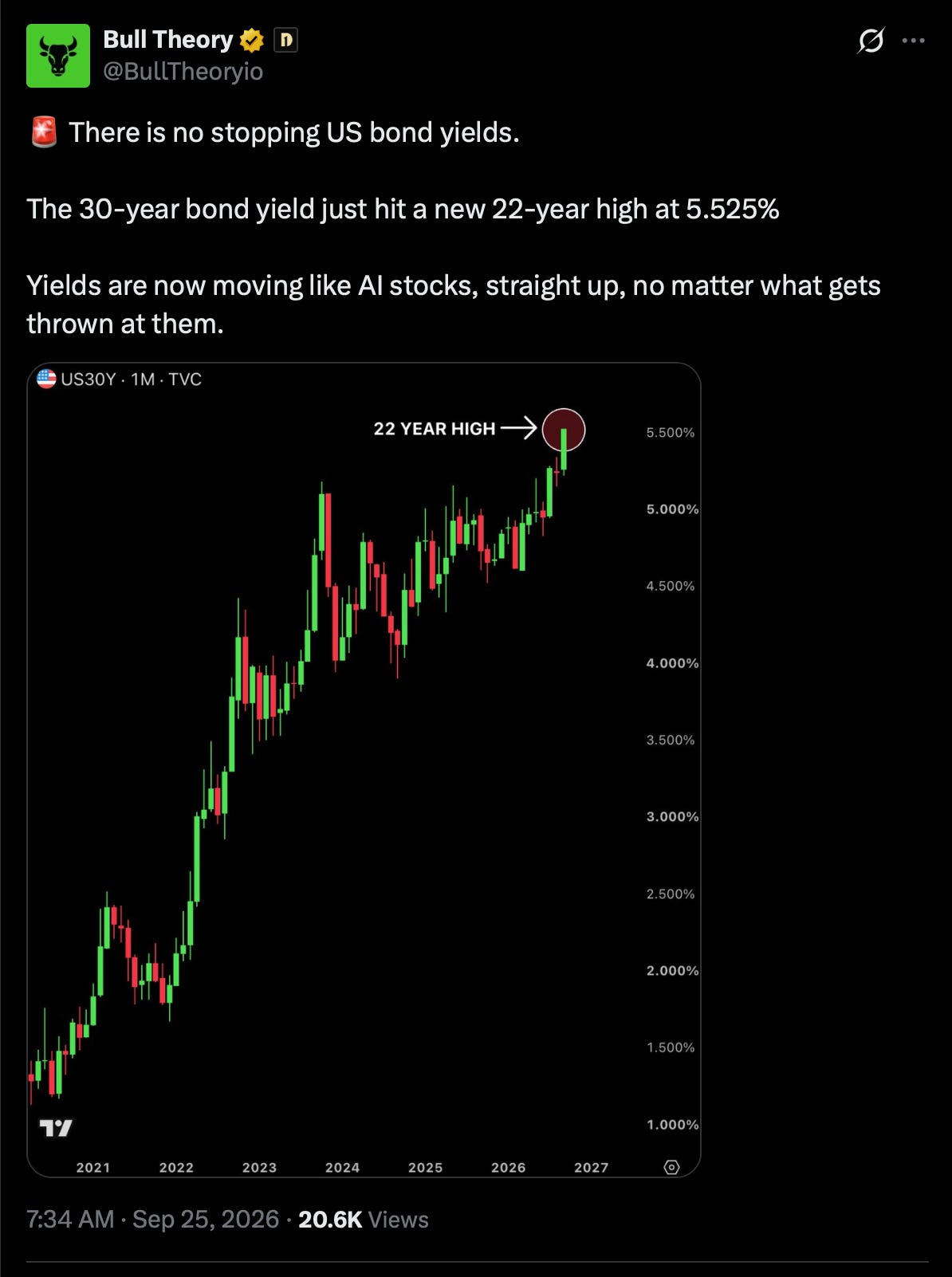
What a week for bonds, indeed.
If you’ve been paying attention to markets or had the news on this week, you’ve likely seen quite a bit of chatter about interest rates and how yields on Treasuries have gone up in nearly a straight line the past few days.
Inflation worries.
A hawkish Fed about to raise rates again.
Deficits. War. The price of oil.
There’s no shortage of reasons analysts and pundits are giving for the violent move in yields this week.
What seemed to really pour fuel on the move, though, was a terrible 5-year Treasury auction in the middle of the week.
Another auction the next day, this time for the 7-year Treasury, was not much better.
But are these the reason for the move in bonds, or are they signs of a greater disruption underneath all of it?
And if so, just how high are rates about to go? Is there, as Bull Theory puts it, “…no stopping US bond yields”? Or can the Fed and/or the Treasury do something about it? Either way, what does this all mean for our mortgages, savings, and the money we’re counting on for retirement?
All good questions, important ones that we’re going to answer, nice and easy as always, right here today.
So pour yourself a big cup of coffee and settle into your favorite seat, as we work through what is going on with bond yields and where they’re headed, with this Sunday’s Informationist.
Partner spot

Ask ten bitcoiners how to secure your bitcoin savings and you’ll get ten different answers.
Hot wallet. Cold wallet. Singlesig. Multisig. Passphrase. No passphrase. Dice. No dice.
Meanwhile, the institutional class waves all of it away. In their view, the ETFs are essentially custody solved.
Both camps are missing the point. One ignores that you yourself could be the single point of failure. The other cheers for multiple layers of counterparty risk.
There’s a better way.
Join Unchained’s Tom Honzik and Stephen Hall for a live session on how to get the peace of mind of institutional-grade security without abandoning the properties that make bitcoin worth owning in the first place. Explore thoughtful self-custody built around human relationships, professional guidance, and planning that survives you.
October 6 at 11am CT · Online · Free to attend
Register now → sign up for live session
What Happened at Wednesday’s Auction?
If you’ve never followed a Treasury auction before, no worries, it’s pretty simple.
When the government needs cash, and it always needs cash, the Treasury sells new notes and bonds at auction. Investors bid for how much they want and the yield they’re demanding, and the Treasury fills the order from the lowest yield up until everything is sold.
That last accepted yield, the stop-out, is what every winning bidder gets.
There are three things we can look at to see how it went.
The first is the tail. See, new notes trade before the auction in something called the when-issued market. Then during the actual auction, if the Treasury ends up paying a higher yield than that, the difference is known as the tail. A large tail means the Treasury had to pay more than expected to find enough buyers.
The second is the bid-to-cover. This is just the ratio of dollars that showed up to the auction versus the dollar amount of Treasuries the government needed to sell. And so if $80 billion of bids showed up at auction and the government sold $40 billion of bonds, then the bid-to-cover would be 2.
The third is the type of bidders who actually bought. Indirect bidders, mostly foreign buyers and hedge funds. Direct bidders, mostly institutional buyers like pension funds and endowments. And primary dealers, the large banks that must bid at every auction and end up taking whatever is left after the other bidders are filled.
I’ve written about Treasury auctions extensively before and you can find a more complete explanation here, if you want to understand them better.

Okay so, what went wrong Wednesday?
First, the Treasury sold $70 billion of 5-year notes with a tail of 3.1 basis points (a basis point is one hundredth of a percent). This was significant because the average of the last six 5-year auctions tailed by just over half a basis point.
Second, the bid-to-cover (BTC) was just 2.21, the lowest we’ve seen since December 2018.
Third, indirect bidders took just 54% of the auction, the smallest share in about five years, leaving the dealers on the hook for almost 16%.
And finally the yield the Treasury had to pay was 5.033%, the highest yield for a five-year auction since June 2006.
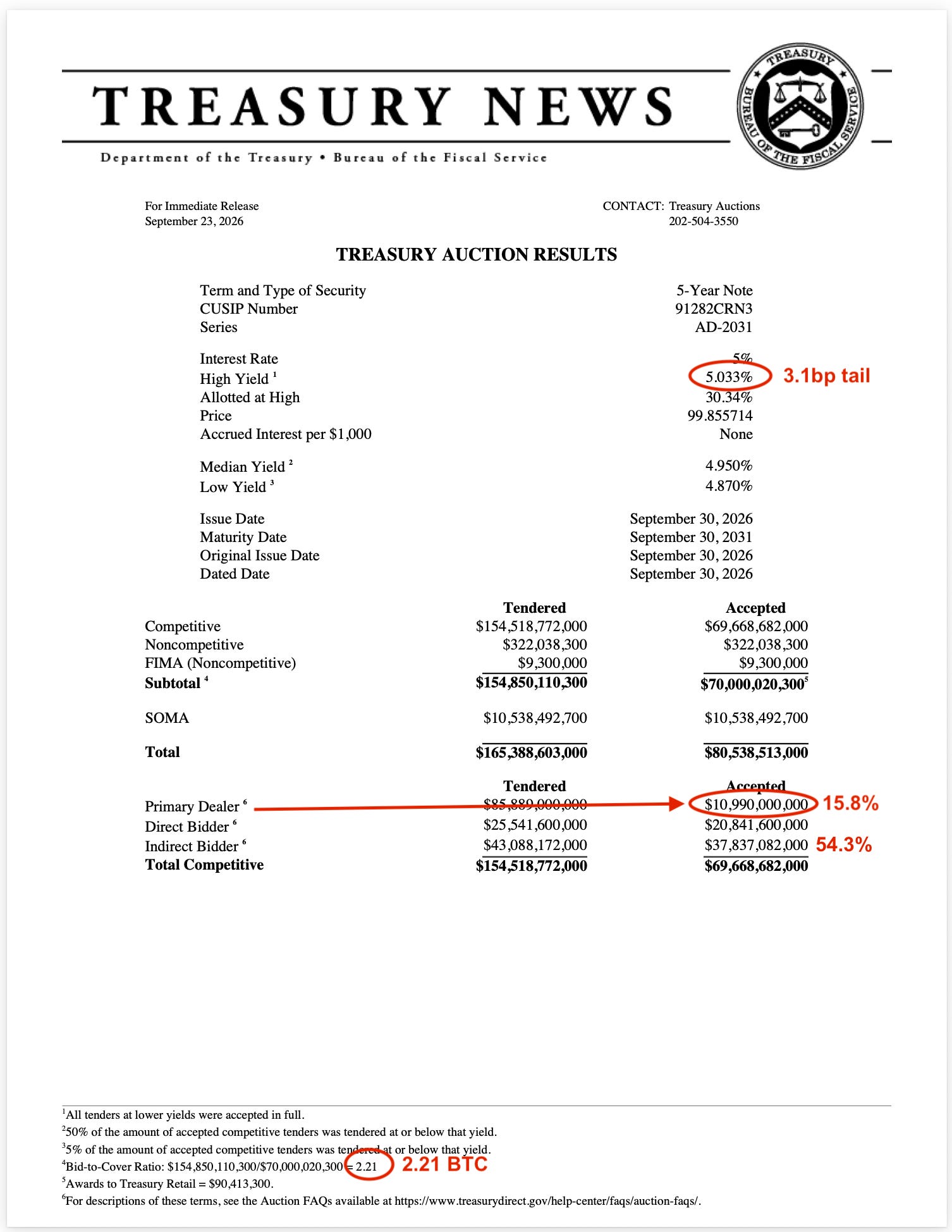
Put it this way, the last time the government paid that much to borrow for 5 years, there was no such thing as an iPhone.
Yields had already jumped that morning when a survey of US businesses (the PMI) showed costs rising at the fastest pace in four years. The auction then took them to the highs of the day, and the 10-year closed at 5.11%, its highest since 2007.
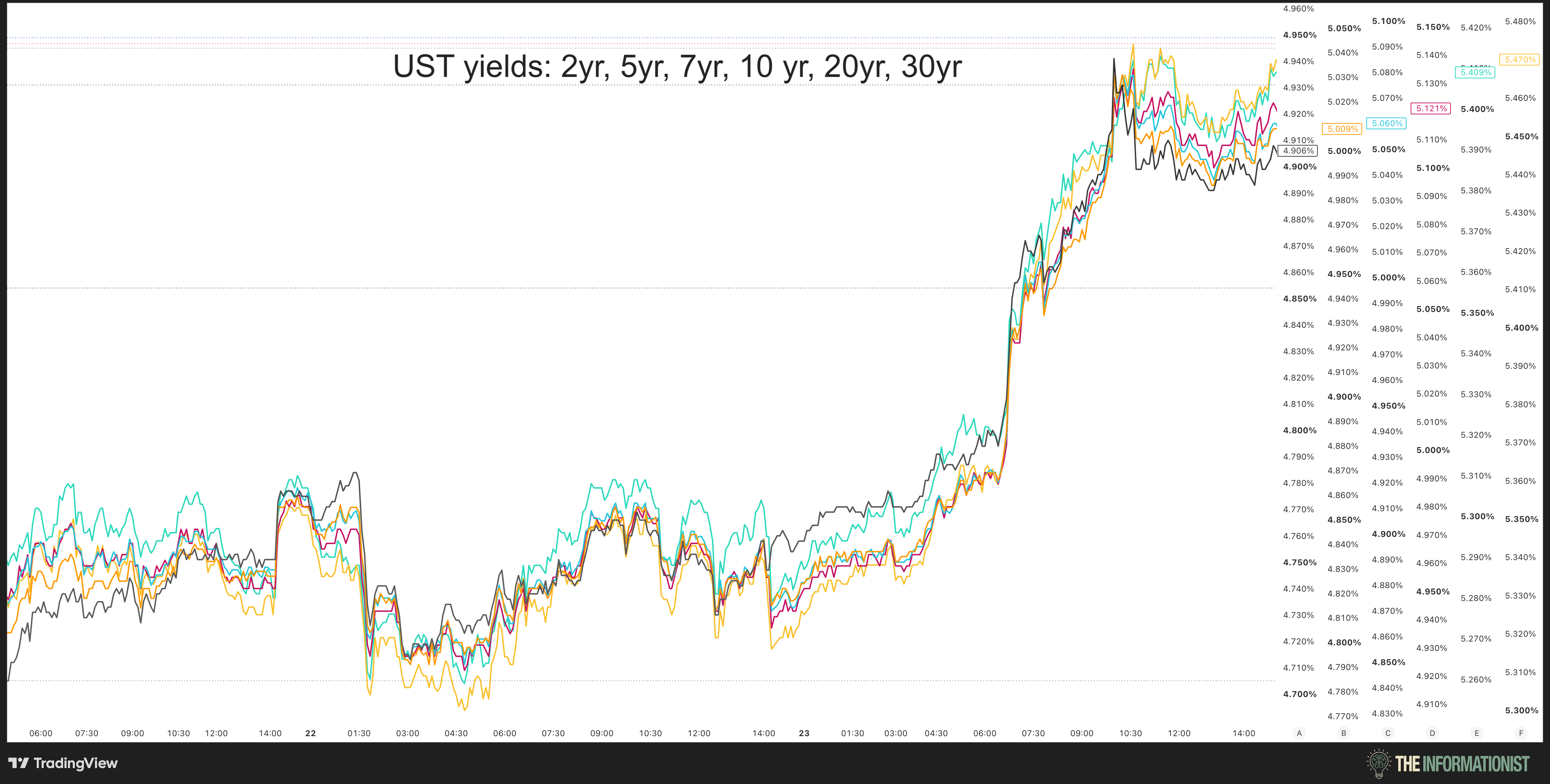
Then Thursday, we got the 7-year auction. That one cleared the highest yield since that maturity was reintroduced in 2009.
Some of you may remember the question that we were asking back in August. Is that a rate problem, or a supply problem?
I would say this week was a little bit of both. Wednesday's survey, and oil jumping again Thursday after Iran threatened to expand the war, keep pressure on inflation and, hence, on the Fed. But the auctions definitely told us something about supply, too.
Because it seems that every single week the Treasury has to answer the same question over and over again.
Who the heck is going to buy all these bonds?
Good question, let’s talk about that.
Who’s Going to Buy All These Bonds?
Well, on Thursday the Treasury did try buying some of them itself.
