

✌️ Welcome to The Informationist. I take you inside the decisions that move markets and simplify them for you, in a few minutes each week.
🙌 One big topic, exposed and explained, so you understand the forces at work and can make better decisions with your own money.
🫶 If this was forwarded to you, you have awesome friends. Join 45,000+ readers here.
Today’s special issue is sponsored by Plan B, Katie’s firm (now part of CitizenX). As many of you already know, I only put my name next to people I’d actually use, and accordingly, on this one I’m a client myself: I’m working my own citizenship case with Katie and her team right now. Everything below is my own view, in my own words. I’m not a lawyer or a tax advisor, so take this as a way to think about the subject, not as legal advice for your situation.
Today’s Bullets:
🔋 The concept of flag theory
🧮 The Sovereign Individual thesis
💰 Citizenship by investment
🧬 Citizenship by descent
🧭 How to actually start, and what to watch for
Inspirational Tweet
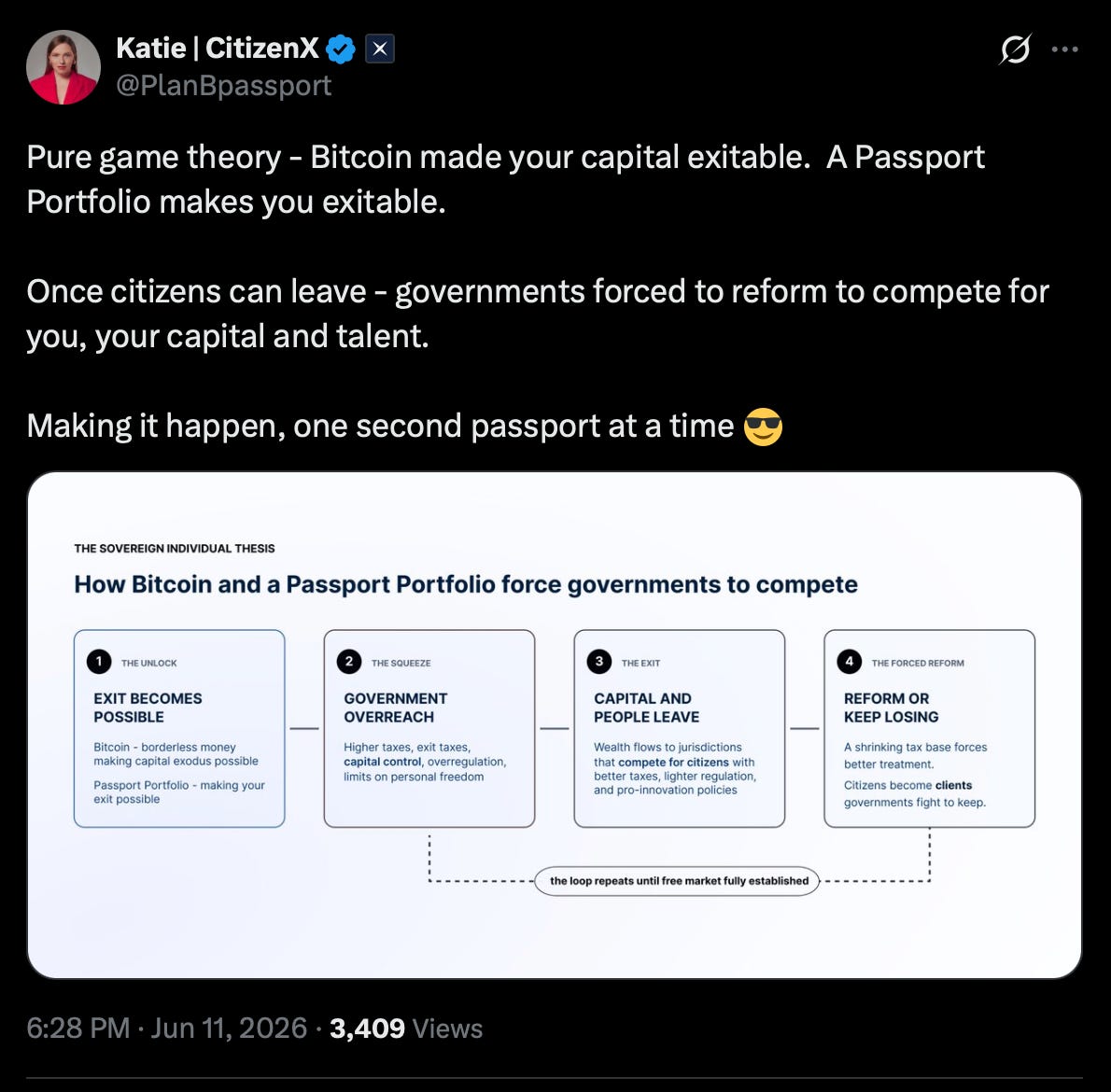
That’s the whole argument in two lines, and it comes from Katie herself. Bitcoin made your capital exitable. A second passport makes you exitable.
Once people can actually pick up and leave, governments have to compete to keep them, their capital, and their talent. Keep that thought, because it’s exactly where we are headed today.
Working in institutional finance, I spent a good part of my career learning how governments behave when money gets tight. I watched it from hedge fund desks, and I’ve written about it here for years.
When the bill comes due, they print, they freeze, they inflate, and they quietly reach into accounts that were never as private as people assumed.
You already know all of this. It’s why you hold your own keys.
Awesome, you’ve hedged your money against a single government. But that still leaves a gaping wide hole of vulnerability, and a serious question:
Have you hedged yourself?
Your physical presence. Your legal identity. Your right to be somewhere, to travel, to leave.
The same logic that drew you toward Bitcoin points straight at your passport. Unfortunately, most people never spend a single minute on it.
So that is exactly what we are going to fix today, nice and easy, as always.
So, pour yourself a big cup of coffee, settle into your favorite seat, and let’s talk about flag theory, jurisdictional arbitrage, and the very practical business of a second passport.
🔋 The Concept of Flag Theory
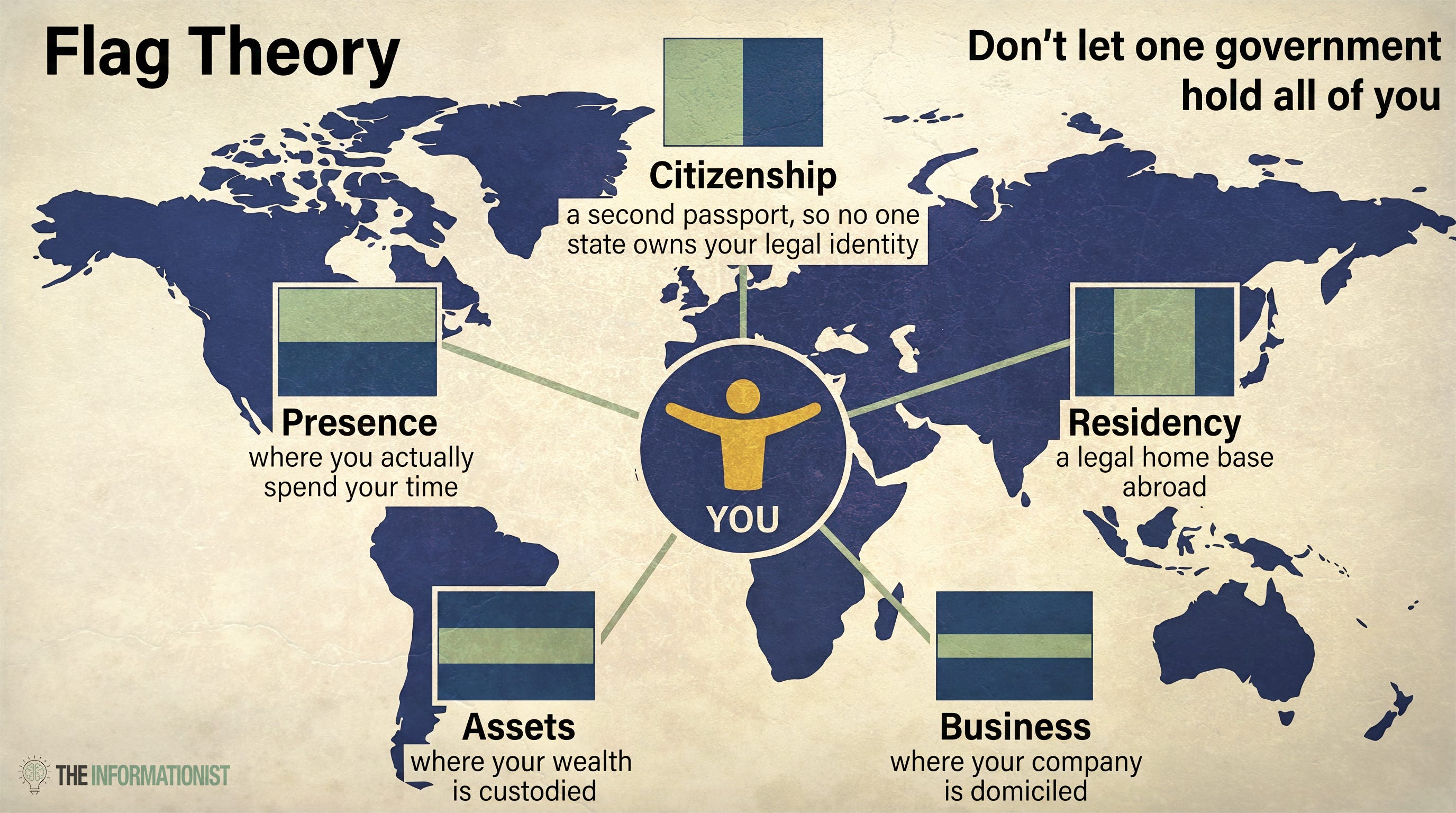
Jurisdictional arbitrage is one of the more elegant ideas to come out of the classical-liberal tradition. The premise is almost embarrassingly simple.
Concentrating your entire life inside a single country is a concentrated risk. And like any concentrated risk, it can be diversified.
You already run your money this way. You wouldn’t hold one stock, in one currency, at one custodian, and call it a portfolio.
So why would you hold your citizenship, your residency, your assets, and your family’s future all in one jurisdiction, subject to one government’s decisions?
Flag theory says you shouldn’t. The idea is to plant your ‘flags’ in different countries, so no single government controls all of them.
A flag can be a second citizenship, a residency somewhere else, a business domicile, where your assets sit, even where you spend your time. Plant them thoughtfully, and no single authority holds the whole of you.
For most of the twentieth century, this was a game of privilege reserved for the genuinely rich, the people with family offices and lawyers on three continents.
The good news for all of us is that’s the part that has changed, and changed fast.
Before we get to how, we should take a peek at the book that saw all of this coming. It also happens to be the closest thing our world has to a founding text.
🧮 The Sovereign Individual Thesis
The Sovereign Individual was written by James Dale Davidson and Lord William Rees-Mogg, and published in 1997. If you’ve read it, you know exactly where I’m going. If you haven’t, I urge you to move it up your list.
Put simply, in 1997, the Internet was barely a consumer product. Smartphones didn’t exist. ‘Cryptocurrency’ was not a word anyone used in a serious sentence.
And yet the authors argued that cryptographic technology would eventually let individuals hold and move value entirely outside the reach of any government.
Unseizable, uninflatable, unprintable.
They described the essential properties of Bitcoin roughly eleven years before Satoshi published the white paper in 2008.
Their larger argument is the part that matters for today. Throughout history, whoever controls the dominant form of violence controls taxation, and by extension, governance.
Gunpowder empires displaced feudal lords. Industrial nation-states displaced the gunpowder empires. Each transition rewired who held power, and how much they could extract from ordinary people.
The Information Age, they said, would trigger the next transition. When value becomes digital and decentralized, governments lose their monopoly over it.
And when that happens, the relationship between citizen and state begins to invert. Governments have to compete for citizens, rather than the other way around.
That simple concept right there is the whole ballgame.
Today, you’re born into a country and become, legally, its subject. You didn’t choose it. You don’t negotiate with it. You mostly just comply, because the alternative has always been expensive, complicated, and for most people, effectively impossible.
The thesis says that changes.
Countries that treat productive people well will pull in capital and talent. Countries that overtax, overreach, and abuse will watch both walk out the door.
You can see the early innings of this right now in the UK, where the end of the non-dom regime has sent a wave of high earners looking for the exits. Capital and talent are mobile. They vote with their feet.
And this is not only a UK story. Look at what the policymakers themselves are circulating.
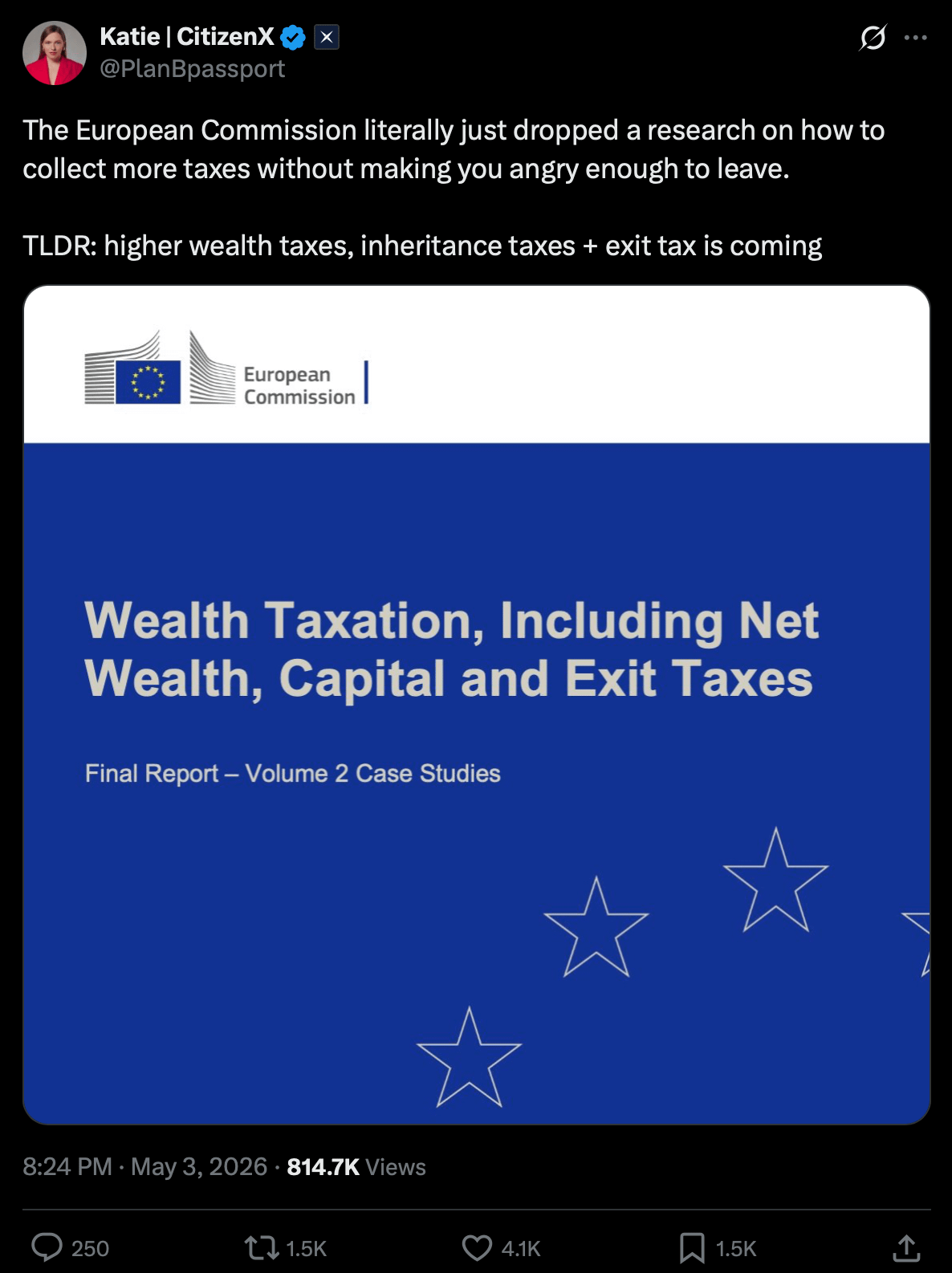
That’s the European Commission, on paper, studying how to raise wealth taxes, inheritance taxes, and exit taxes without making you angry enough to leave.
When the people who run the system are openly workshopping how to tax your departure, the departure itself becomes the thing worth protecting.
This is exactly what Bitcoin was built to do for money. And it is exactly what a growing number of people are now doing with their legal identity.
Which brings us to the practical part, and the two doors most people choose to walk through.
💰 Citizenship by Investment
Citizenship by investment, or CBI, is the direct one. You make a government-approved contribution, you pass a background check, and you receive a second passport, legally and above board.
It is, quite literally, a market for jurisdictions.
Let’s review the lay of the land, without the sales gloss. Roughly a couple of dozen countries now offer a straight path to citizenship through investment.
The five Caribbean nations that pioneered the modern industry are still the value end of the market. Dominica starts around $200,000 as a donation, with Grenada, Antigua and Barbuda, St. Lucia, and St. Kitts and Nevis running from roughly $230,000 to $250,000. Timelines run from about five months in St. Kitts to well over a year in a couple of the others. Move up-market and Turkey grants citizenship on a $400,000 real estate investment.
At the far end, El Salvador rolled out a program that grants citizenship for a one-time $1 million contribution paid in Bitcoin or a stablecoin, capped at 1,000 people a year. If you want a signal for where all of this is heading, a sovereign nation pricing its passport in sats is a loud one.
The reason people in our world care has nothing to do with the beach. It is optionality.
With CBI, you can actually choose a jurisdiction that fits your goals: visa-free travel, a stable legal system, sensible tax treatment, a place your family could land on short notice.
In other words, you’re no longer stuck with the single hand you were dealt at birth.
In essence, CBI is the Sovereign Individual thesis showing up in the real economy. It turns the relationship between nations into something that behaves like a market, where citizens become clients that governments have to compete to keep.
From there, the game theory takes care of the rest.
🧬 Citizenship by Descent
Citizenship by descent is the other door, and it is the one that might already be open without your knowing it.
Somewhere back in your family line, a grandparent or great-grandparent may have left you something you have never claimed: a legal right to citizenship based on bloodline. If you are eligible, you already hold the right.
You’re simply claiming a passport that was arguably yours by birth.
The tradeoff is that you do not get to choose the country. It was chosen for you a century ago, by wherever your family emigrated from. But if the lineage lines up, the price is mostly paperwork and patience rather than a six-figure contribution.
Italy has long been the most famous example, and this is where I have to update the old story, because the rules just changed.
For years, Italy effectively had no generational cutoff, as long as the bloodline was unbroken. That era is over.
In a reform that took effect in May 2025, Italy now generally limits citizenship by descent to people with an Italian parent or grandparent, plus a ‘genuine link’ test. Plenty of people who would have qualified a year ago no longer do.
That shows how quickly these doors can narrow. If you think you have a claim somewhere, the calendar is not your friend.
Beyond Italy, Ireland offers one of the most accessible routes for anyone with an Irish-born grandparent, through the Foreign Births Register. Poland, Germany, Croatia, and Lithuania, among others, carry meaningful descent provisions of their own.
The work itself is genealogical: birth records, church documents, civil registries, official papers from a country your family may have left generations ago.
It is tedious, and it is exactly the sort of thing worth handing to specialists who do it every day.
I know, because I am going through it myself right now with Katie’s team, and yes, it is every bit as tedious (for them, not me) as it sounds.
🧭 How to Actually Start, and What to Watch For
Before you get excited and start googling island real estate, let me put on my CFA hat and give you the part the glossy brochures tend to leave out.
If you are a US citizen, a second passport does not get you out of the IRS. The United States is one of only two countries on earth that taxes its citizens on worldwide income, no matter where they live.
A second passport buys you options: a place to go, a way to travel, a hedge against any single government having total say over your life. It does not, on its own, lower your tax bill.
The only way an American steps fully off the US tax rolls is to renounce citizenship, and the government charges an exit tax on the way out for anyone above certain thresholds. So anyone who pitches you a passport mainly as a tax dodge is either confused or aggressively selling you on partial information.
Or worse, suggesting you commit tax fraud. Avoid those people like the plague.
Instead, I would treat a second passport the way you treat the Bitcoin in your treasury: insurance and optionality, held for the day you are grateful to have it.
As you can imagine, the firm you work with matters enormously. This is a field where real professionals and real charlatans stand suspiciously close together.
The programs themselves are legitimate and government-run. But the process runs through applications, due diligence, source-of-funds documentation, and genealogical research, and mistakes there are slow and expensive.
You want people who do this every single day.
Which is the honest reason I partnered with Plan B for today’s issue. Katie built the firm specifically for people who already think in terms of self-custody and sovereignty, and it is now part of CitizenX. They handle both doors, investment and descent, and they are the team I trusted with my own case.
If you’ve been meaning to look into this for years and never started, consider this your nudge. Katie’s team put together a page just for Informationist readers, where you can see which door actually fits your situation and book a no-pressure call to walk through it with someone who does this every single day.
Or schedule a free 1-on-1 call with Katie here:
And tell them James sent you. 😉
I truly believe that Bitcoin and a second passport are two of the most important pillars of individual sovereignty, and I am not willing to skip either one. That’s the entire idea behind flag theory.
Do not let any single government hold all of you.
Simple as that.
That is it for today. I hope you come away a little sharper on flag theory, the Sovereign Individual thesis, and the very practical ways real people are applying these ideas to their own lives right now.
If it got you thinking, forward it to someone who would want to think about it too.
Talk soon,
James ✌️
Custody and sovereignty debates are useful as risk maps. Cross-asset, what usually matters first is how capital and liquidity reprice around the constraint.
Nice article. For those who want to read it and understand it. I read the Sovereign Individual years ago, mind blowing. I already was a bitcoiner. I think you could add as an example Panama, pensionado program visa. Exceptional for europeans, no taxes at all, temporary residency in one week, permanent after 6 months. No obligation to live there , one dat every two years suffices. Unfortunately this advantage does not apply to US citizens (as correctly explained in this article).