

✌️ Welcome to The Informationist, the newsletter that makes you smarter about money in just a few minutes each week.
🙌 One topic. Exposed and explained so you can make better decisions with your money. Like a simple walk down Wall Street.
🫶 If this was forwarded to you, you have awesome friends. Join 45,000+ readers here.
Today’s Bullets:
🚬 Who Was Paul Volcker?
🔨 The Night the Fed Got Serious
⚖️ Why 1980 Let Him Do It
🔒 Why Today Won’t Let Anyone Do It
📉 Investment Implications
Inspirational Tweet:
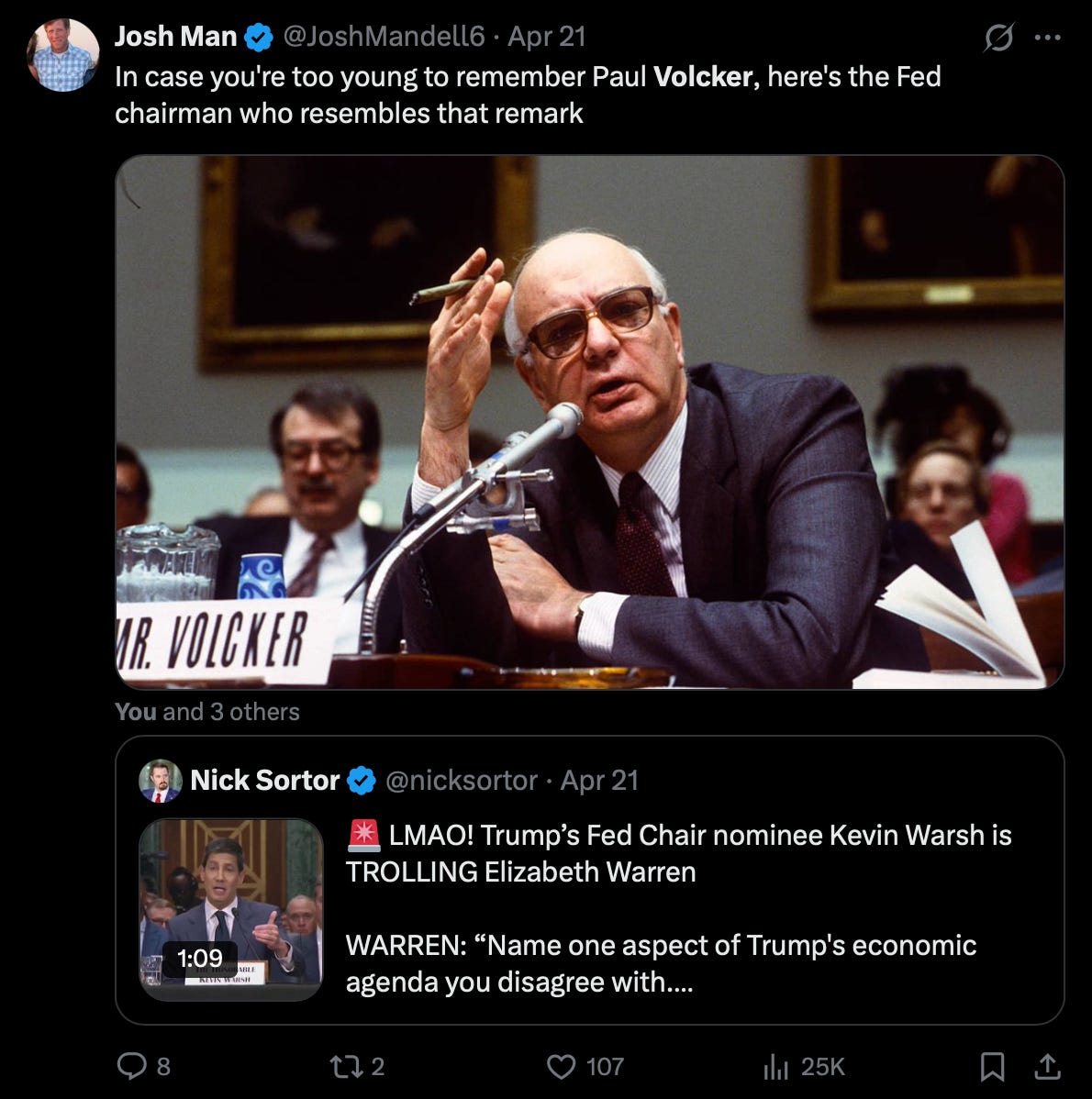
Josh, always one for a good jab. And this one landed nice and square for good reason.
Because last week, Kevin Warsh sat before the Senate Banking Committee. The cameras rolled. The questions started. And Elizabeth Warren unleashed her usual unhinged tirade of accusations before the newly nominated Warsh could finish a single sentence.
Ah, yes. The Senate Confirmation Hearings. Pomp, circumstance, and full stage theatrics on display for the world to see. But even with the Warren verbal tornado, a different theme arose and caused more questions than answers from armchair analysts.
In short, is Warsh merely a Trump “sock puppet”, as Warren suggested, or would he be the new Volcker?
Because that’s the split right now. On one side, Democrats and the usual critics insisting he’s a political hire, picked for loyalty, ready to slash rates the moment the White House calls. On the other, a growing chorus of market voices hope he’s something else entirely. A tough, independent inflation fighter in the mold of the man who once saved the dollar.
Two sides. One nominee. Opposite conclusions.
But to even know what “the new Volcker” means, you have to know what the old Volcker actually did.
Which brings us to the questions. Who was Paul Volcker? What did he really do? And could anyone, Powell, Warsh, or the next person in line, do it again today?
All good questions, and ones we will answer, nice and easy as always, here today.
So pour yourself a big cup of coffee and settle into your favorite seat for a candid look at the most famous Fed Chair in American history, and why his shoes may be harder to fill than anyone thinks. It’s time for this Sunday’s Informationist.
Partner spot
Are we in a typical four-year-cycle bear market with more downside to come, or will 2026 prove to be a deviation from the multi-cycle trend? James Check is back to break down what onchain data is revealing about the path into this downturn and how this market compares to prior ones.
Join Checkonchain and Unchained for a live presentation and Q&A exploring what signals matter most right now and how investors are thinking about positioning through uncertainty. Register to attend and receive early access to The Bitcoin Checkpoint report.
When: May 5 · 3PM CT · Live online · Free to attend
🚬 Who Was Paul Volcker?
Picture this.
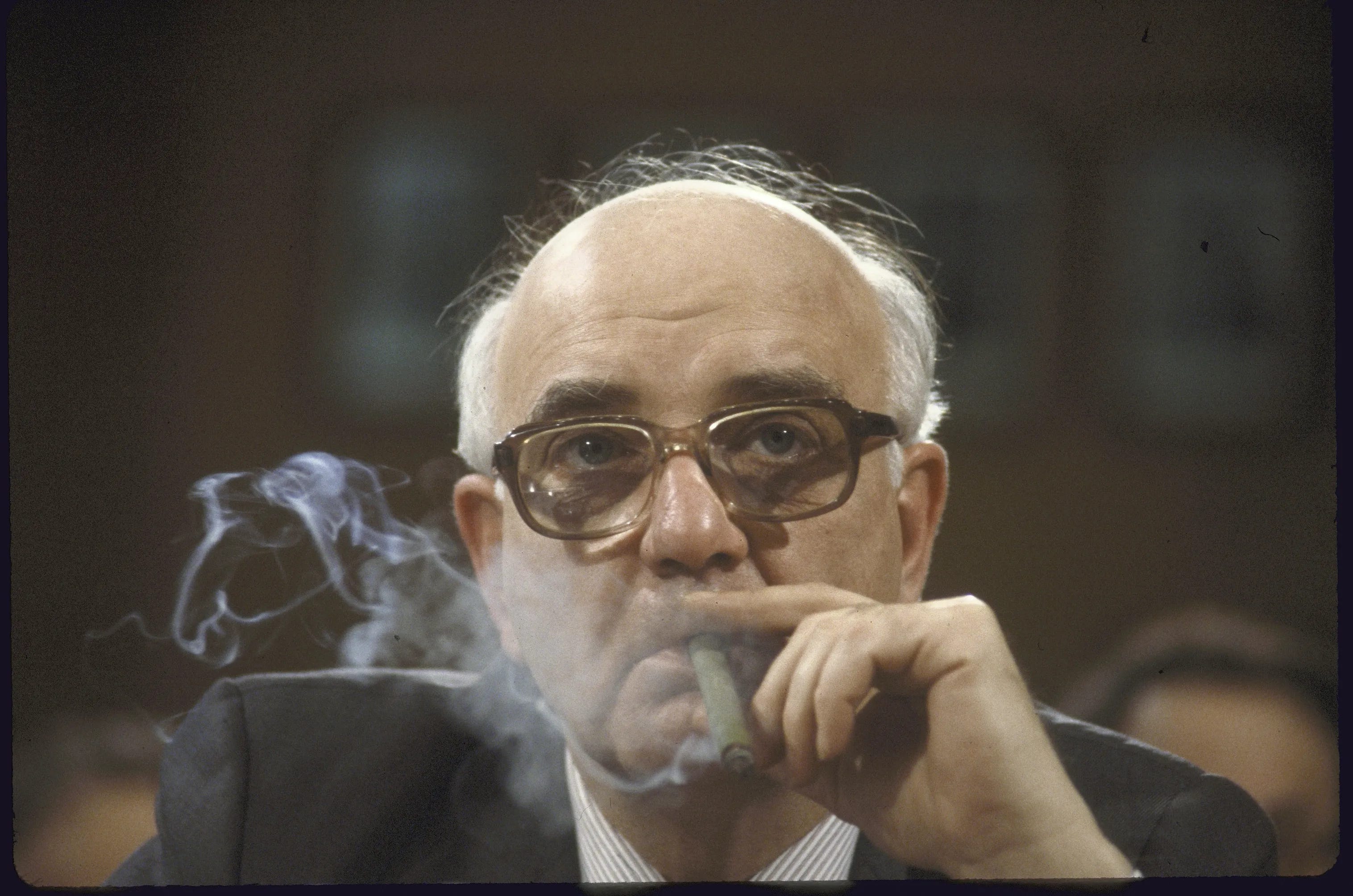
It’s August 1979. A six-foot-seven man in a rumpled suit walks into the Federal Reserve building carrying a cheap cigar. Not a Cuban. Not a custom-rolled anything. A drugstore special.
His shirt collar curls up like a corn chip.
His shoes are as dull as an old wallet.
This is the man about to save the American economy.
Or destroy it. Depending on who you ask.
Paul Volcker didn’t look, act, or sound like a central banker. Born in Cape May and raised in Teaneck, he carried small-town sensibility rather than big city wisdom into the most powerful financial office on Earth.
Don’t get me wrong, he was educated. Maybe overeducated, for God’s sake.
Princeton for undergrad. Harvard for grad school. London School of Economics after that. But ask anyone who worked with him, and they’ll tell you the fancy degrees never quite took. He stayed stubborn, blunt, and allergic to nonsense his entire career.
And by 1979, America needed exactly that kind of man.
The Country Was Breaking
Let’s paint the scene, shall we?
Inflation was running at 11% and climbing. Gas lines stretched around the block. A gallon of milk cost more than it did the month before. And the month before that. Americans were losing faith in the dollar itself.
President Jimmy Carter had a serious, and growing, problem.
His Fed Chair, a genteel economist named G. William Miller, wasn’t cutting it. The markets didn’t respect him. Inflation didn’t listen to him. And the dollar was dropping against every major currency like it was a penny stock.
Carter needed someone the markets would take seriously.
He needed a bulldog.
So in July 1979, he called Paul Volcker into the Oval Office. Volcker was then the President of the New York Fed. He’d spent decades in Treasury, in banking, in and out of Washington. He knew where the bones were buried.
Carter offered him the job.
Volcker, being Volcker, didn’t jump at it. He told the President directly. If you want me, you’re going to get tight money. You’re going to get pain. You’re going to get an independent Fed that doesn’t answer to the White House.
Carter agreed.
And one of the great political miscalculations in American history was set in motion. Because the tight money Volcker was about to deliver would help cost Jimmy Carter his presidency.
But save the dollar.
The Man Behind the Cigar
Here’s what we need to understand about Volcker the human being.
He was cheap. Infamously cheap. His suits were rumpled. His apartment in Washington was small and cramped, a rental he kept while his wife stayed in New York for her health. He commuted home on the Eastern shuttle on weekends.
The cigar was an Antonio y Cleopatra, $1.20 for a drugstore six-pack. He smoked them throughout the day, much to the irritation of every senator and journalist who had to share a room with him. The Washington Post once published an op-ed calling his cigar habit “hideous.”
Volcker did not care.
He didn’t golf. He didn’t hobnob. He didn’t give speeches for six-figure fees.
Looking straight at you, Lizzy Warren.
No, Volcker wasn’t into any of that old money, old world social play.
Instead, Volcker liked to fish.
That was his thing. Fly-fishing, quietly, on rivers from Montana to Maine. Often alone.
When the Fed’s Kansas City branch was looking for a permanent home for its annual economic symposium, they picked Jackson Hole, Wyoming, in 1982. Specifically because the fly-fishing might draw Volcker out of the Washington heat. The Jackson Hole conference, now the most-watched annual Fed event, exists because of his hobby.
From the Volcker era to Powell, it’s become the main boondoggle for the annual Fed gathering ever since.
What He Actually Believed
Volcker had one economic conviction that guided everything he did.
Inflation was the cruelest tax.
Yes, my good sir. Yes it is.
And not metaphorical theft. Real theft. Every percentage point of inflation stole from savers, from workers on fixed wages, from retirees, from anyone who’d done the right thing and held dollars. He saw it as both a moral and economic failure of the government.
In his confirmation hearing, he told the Senate Banking Committee a line that should be etched on the Fed building itself.
“We will have to call the shots as we see them.”
That was it. No dressing it up. No hedging. Just a warning to everyone listening that the new Fed Chair wasn’t going to play politics. He was going to do what the data told him to do.
And what the data was telling him, in August 1979, was this.
It was about to get ugly. Like, Newark, New Jersey landfill ugly.
🔨 The Night the Fed Got Serious
Flash forward a few months, to October 6, 1979.
A Saturday.
The Federal Reserve doesn’t typically do anything on Saturdays. The markets are closed. The phones are quiet. Bankers are at their country clubs, economists are with their families, and the Eccles Building in Washington is mostly empty.
But not this Saturday.
Paul Volcker had just returned from Belgrade, where he’d attended the annual IMF meetings. And for three straight days, European finance ministers had hammered him about the same thing.
The dollar. It was collapsing.
Down 12% against major currencies since 1976. Foreign central banks were selling Treasuries. Investors were piling into gold, which had doubled in twelve months and would peak at $850 an ounce by January, the most violent flight from a reserve currency since the breakdown of Bretton Woods.
Volcker flew home with that message ringing loud and clear in his ears.
He landed on a Thursday. By Saturday, he’d called a secret, unscheduled FOMC meeting.
And at 6:00 PM that evening, with the sun going down over the Eccles Building, he walked into a press conference that would change the course of American economic history.
The Saturday Night Special
Here’s what Volcker announced that night.
