

📶 Welcome to The Informationist. Each week I take you inside the decisions that move markets and make sense of the forces at work, in a few minutes.
✅ One topic, exposed and explained, so you can make sharper decisions with your own money.
➡️ If this was forwarded to you, you have good taste in friends. Join 45,000+ readers here.
A quick note before we begin.
The Monday piece some of you have followed as “What I’m Watching” has grown into something that deserves its own name and its own standing. As of this week it is The Informationist Radar: a full second issue, every Monday morning, before the market opens.
Think of it as the forward-looking companion to this one. Where Sunday’s letter explains the force that just moved the market, the Radar gets you ready for the week ahead, my read on what’s set up, what could break it, and where I think the tape turns. And so, The Informationist has two issues per week now. One to understand what just happened, one to be a step ahead of what’s coming. Premium subscribers get the Radar in full every Monday, and I’ll say a bit more on that at the end today.
Today’s Bullets:
The Chart Everyone’s Posting
Follow the Cash, Not the Hype
We’ve Seen This Movie Before
A Transfer of Cash Is a Transfer of Risk
You Own This Whether You Meant To or Not
Inspirational Tweet:
Artificial intelligence is everywhere we look right now, and if it all feels like a lot, that is because it is.
It is in our work and our kids’ homework. It is in every earnings call, every other headline, every third post in our feeds. Everyone you know has a take, half of those takes contradict each other, and it is genuinely hard to tell what is real, what is hype, and what any of it means for you and your money.
So here is the one piece of this we can actually get our arms around.
Most of what makes AI so overwhelming is unknowable right now, even to the people building it. Whether the machines outrun us, whose job is safe, which of these apps is still standing in five years. Fair enough. The money, though, leaves a trail. We can see, close to the dollar, where it is going, who is spending it, and how it is quietly reshaping the markets that hold your retirement.
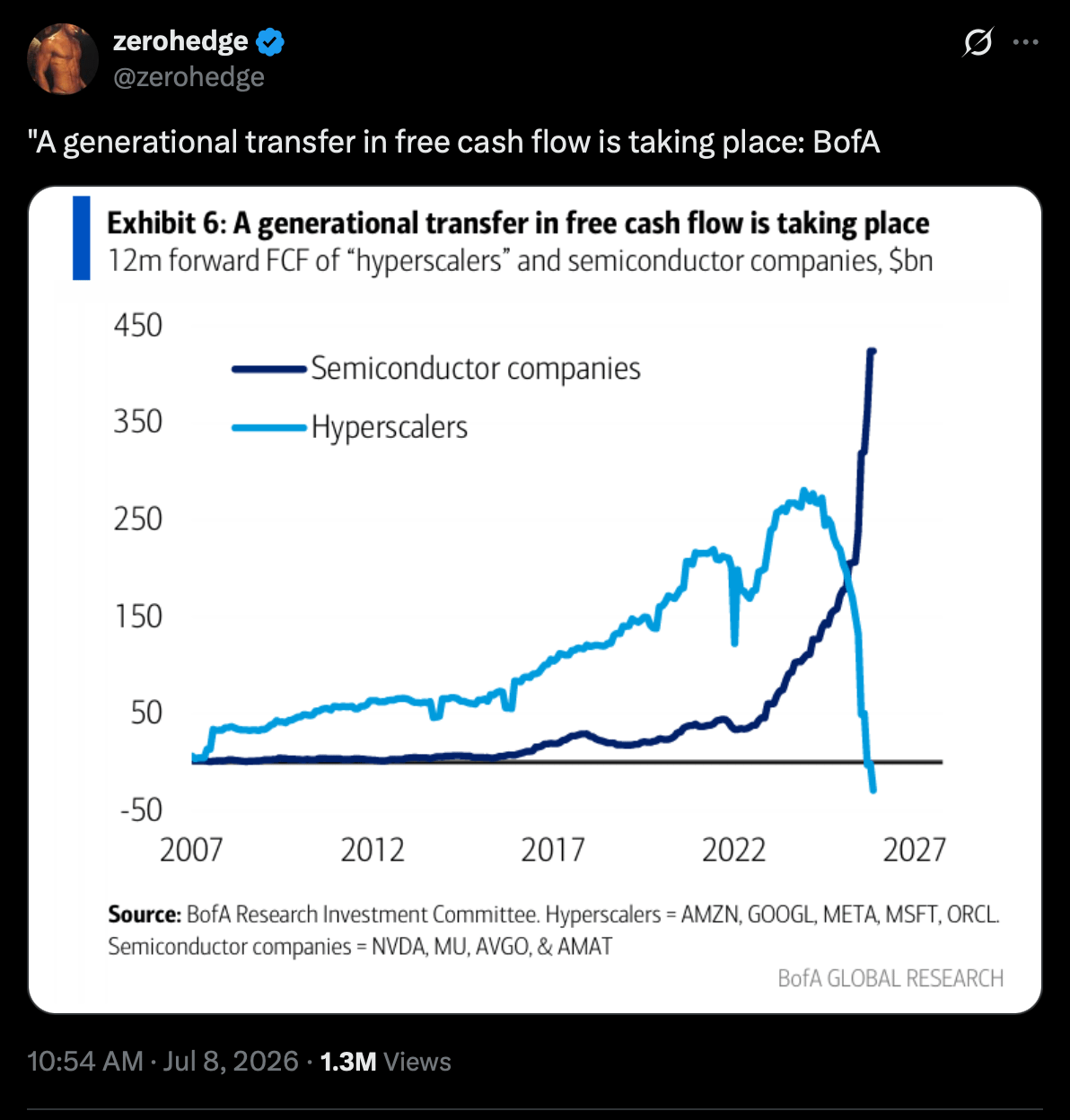
And this past week, one chart put that money trail in sharp relief.
That light blue line breaking down on the right edge is the combined free cash flow of five of the largest companies in the American market. It marks the greatest run of corporate cash generation in history, and it is rolling over hard, even as the companies behind it stay as profitable as they have ever been.
So where did all that cash go? Who is quietly getting rich on the other side of that line? Is this the smartest capital bet of a generation, or the top of a cycle we have watched end badly before? And why does any of this reach into your own portfolio, even if you have never bought a single AI stock?
All good questions, important ones. And ones we are going to answer, nice and easy as always, right here today.
So pour yourself a big cup of coffee, and settle into your favorite seat, for a clear look at where the money is really going in the AI boom, with this Sunday’s Informationist.
Partner spot
You’ve spent years thinking about what happens to the dollar. Have you spent any time on what happens to your bitcoin after you are gone?
Most bitcoin holders think they have an inheritance plan, but they don’t.
Knowing where your keys are isn’t a plan. Neither is telling your spouse the seed phrase. And the will your attorney drafted years ago might not account for any of it. Bitcoin inheritance isn’t just a technical problem, but a legal one too. Your heirs need both the keys and the legal authority to actually use them.
There’s a quick way to find out how exposed you actually are. Get your free bitcoin inheritance readiness score in under 2 minutes.
The Chart Everyone’s Posting
So let’s read this thing together, because it’s actually far less complicated than the noise around it would suggest, and once it clicks, you will see how it applies to plenty of other situations.
It comes down to cash. In a world drowning in AI narratives, cash is the one thing that we can anchor to, so that is what we are going to follow.
Start with what these five companies used to be.
For fifteen years, Amazon, Microsoft, Alphabet, Meta, and Oracle were the closest thing capitalism has ever built to a money-printing press.
How?
Their asset-light businesses, software and ads and services, threw off cash with almost no effort. At the peak, the five of them together generated roughly a quarter of a trillion dollars a year in free cash flow.
Not revenue, free cash: the money left over after every bill is paid and every investment made, sitting right there for shareholders.
That was the whole bull case for owning them, and it held for a decade and a half. Own the toll booths of the digital economy, and the tolls just pile up.
Now look back at the chart and the light blue line plummeting on it.
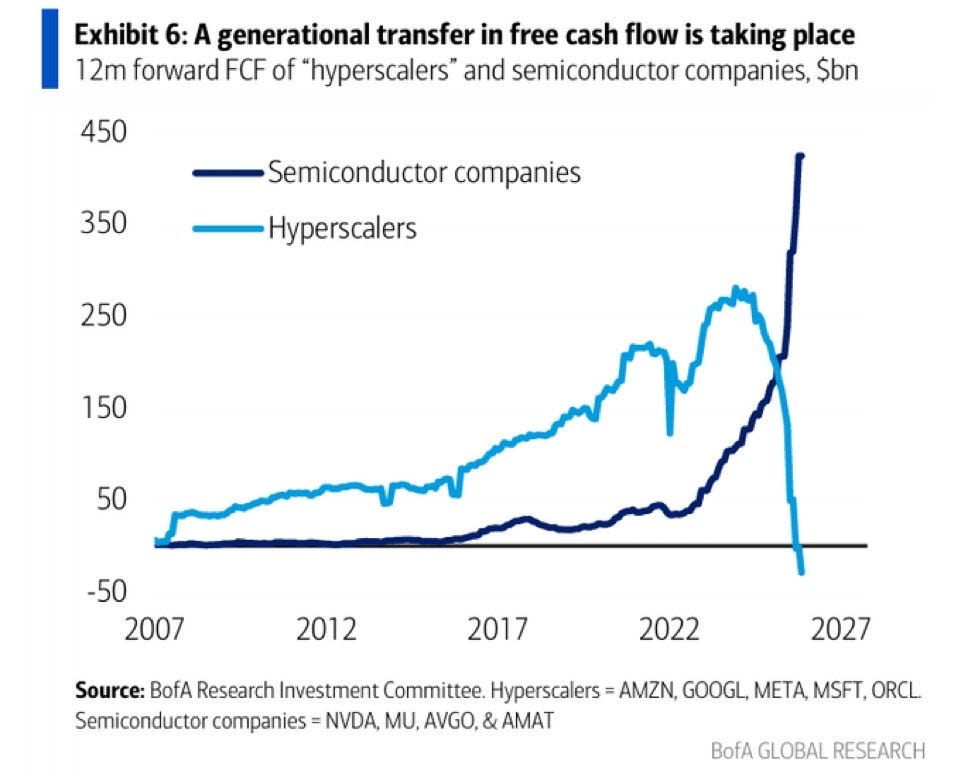
On the path these five are on, their combined free cash flow crosses zero this year, for the first time in fifteen years.
What changed is that the AI buildout arrived, and all five decided, at once, to bet the house on it. The four largest alone are pouring $725 billion this year into chips, servers, and data centers, and the figure is still climbing. Over seven hundred billion dollars, in a single year, from four companies.
In other words, the greatest cash machines ever built have become the greatest spenders ever recorded, almost overnight.
And that money went somewhere specific.
Straight down the supply chain, to the companies that sell the gear, the semiconductor makers, Nvidia, Micron and the rest. Their cash flow is running the mirror image of the hyperscalers’, climbing toward the $400 billion mark and still rising. One line falls off a cliff, the other rockets higher, and it is the same dollars changing hands.
That is what Bank of America meant by a generational transfer in free cash flow. The richest companies in the world are quietly handing their crown to their own suppliers.
And since these are the biggest names in the market, the ones sitting at the top of nearly every index fund and 401(k) in the country, this is unfortunately not some distant or inconsequential Wall Street drama. It’s absolutely impacting the accounts that hold your retirement, whether you chose to bet on them individually or not.
Which is why this chart was shared all over the place this week, and why the internet promptly split into two camps talking past each other.
One side sees catastrophe, the cash machines finally breaking.
The other sees genius, one of the boldest land grabs in corporate history. Both are staring at the same falling blue line and reaching opposite conclusions.
But the good news is that with just a simple understanding, you can look at this same chart and make perfect sense of it yourself. It comes down to how the cash actually moves, line by line.
Once we define that piece, the rest of the picture just falls into place.
