

📶 Welcome to The Informationist. Each week I take you inside the decisions that move markets and make sense of the forces at work.
✅ One topic, exposed and explained, so you can make sharper decisions with your own money.
➡️ If this was forwarded to you, you have good taste in friends. Join 45,000+ readers here.
Today’s Bullets:
What Eighty-Seven Billion Dollars Bought
What’s Actually in the War Chest
The Door They Didn’t Use
What Broke a Year Ago
What Would Actually Turn It
Inspirational Tweet:
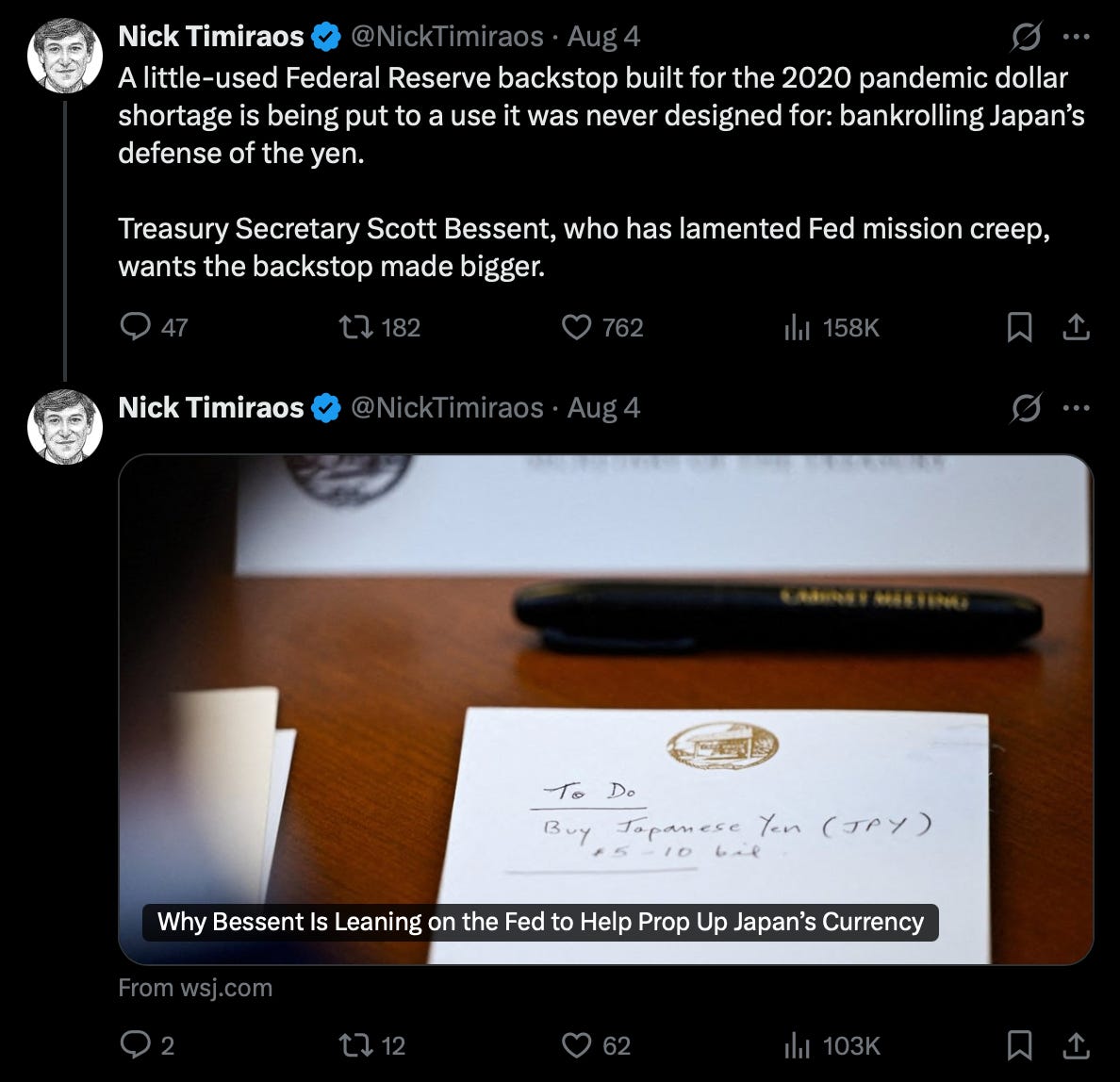
If you’ve been plugged into the markets this last week, you’ve likely gotten a large dose of reporting about the United States Treasury joining the Bank of Japan to prop up the yen.
A full-scale drama worthy of a B-grade Hollywood movie, complete with public accusations and conflicting reports about what exactly was done and why.
We even got suspicious photos, like the one above.
That’s a photograph of the Treasury Secretary’s notepad.
That’s right. A Reuters photographer snuck a snap of it at a Cabinet meeting at Camp David a week ago Friday. Written out by hand, sitting face up on the table, in a room full of cameras.
To Do. Buy Japanese Yen. $5 to 10 billion dollars.
Seems a bit careless for a man who ran money for a living, doesn’t it? Well, I have a theory about how a note like that ends up right in the line of fire of a Reuters lens, and we’ll come back to that.
For now, read the headline Nick Timiraos superimposed over it.
Prop up? Leaning on the Fed?
That’s about as pointed as it gets from a reporter who has covered this beat for twenty years and one who doesn’t need hyperbole to get attention.
Bessent’s answer came the next morning. He called Timiraos a stenographer posing as a journalist.
High drama indeed.
But what exactly are we talking about here, and why? What did the Treasury, the Fed, and the Bank of Japan actually do last week? Was all of it orchestrated by Scott Bessent, and if so, what was he really after?
And for those of us on the ground, investing our own portfolios and our clients’, the one that matters most: what does a yen falling out in Tokyo have to do with the rate on your mortgage?
All good questions, important ones. And ones we are going to answer in full, right here today.
But don’t worry, we’ll keep the acronyms to a minimum and all the concepts crystal clear for you, as always. There’s some serious, and important, financial plumbing in this one, though, just like last week, and you’ll find a short version at the end of every section.
So pour yourself a big cup of coffee and settle into your favorite seat, for a candid look at what that note on the table actually set in motion, with this Sunday’s Informationist.
Partner spot

Reduce risk in your bitcoin setup
The recent Coldcard incident is a good reason to review how your bitcoin is secured. If you already self-custody and want to eliminate your reliance on a single device, Unchained can help.
A multisig vault requires multiple keys to move bitcoin. When those keys are stored on different devices, a problem with one device does not give an attacker everything needed to spend the bitcoin.
Throughout the Coldcard incident, Unchained has been helping hundreds of Coldcard users on their platform move bitcoin into new vaults, review their setups, and make informed decisions about what to do next.
Strengthen Your Setup is Unchained’s Premium Service Suite for bitcoin holders who want to upgrade to collaborative multisig. Across multiple one-on-one sessions, a dedicated bitcoin expert guides you through creating your first vault and provides advanced security training.
You leave with a fully configured vault, a tested recovery plan, and a setup reviewed by a bitcoin expert.
If you use a Coldcard or hold your bitcoin in a single device and have questions about what to do next, or know someone who does, contact Unchained.
Strengthen your setup with Unchained
What Eighty-Seven Billion Dollars Bought
Before we get to the why, let’s tackle the what immediately, because the reporting on this has been all over the place.
Start with what Timiraos was referring to.
A Federal Reserve facility built for the dollar shortage of 2020, being used for something it was never designed to do. And a Treasury Secretary who has spent years complaining about the Fed wandering outside its lane, asking for that facility to be made bigger.
Meanwhile, I had the yen up on my screen Thursday, it’s one of the things that’s pretty much always on my screen, and I watched it fall five full yen in about an hour. Not over a week or even a day. In an hour. That was Tokyo on its own, spending more than anybody has ever recorded spending in a single day on a currency.
By that evening it had given back half of it.
So they went at it again on Friday, and this time the NY Federal Reserve came along, the first time our two countries have bought yen together since 1998. Somewhat more effective, that one held longer. It’s coming back now too. And then Friday morning a negative jobs report landed, nobody spent a dollar, and the yen moved more in twenty minutes than the entire rescue managed all week.
Now let’s put some numbers on it, because they’re genuinely hard to keep track of mentally.
Thursday, Tokyo is estimated to have spent about $53 billion. Friday, roughly another $34 billion. Call it $87 billion in two days to move one exchange rate.
Before we continue, a note on those figures. They’re estimates only, worked out by watching the Bank of Japan’s accounts vs. what the money brokers expected. Japan’s Ministry of Finance doesn’t confirm the actual number until the end of this month. But if they hold up, Thursday was the largest single day any country has ever spent defending its own currency.
Here’s the thing, though.
Japan already broke that record once this year. On April 30, during the Golden Week holidays when the market is thin and a shove goes a bit further, the Ministry of Finance spent 6.28 trillion yen, about $40 billion, in a single day. They confirmed it last week, all-in they spent nearly twelve trillion yen.
Yowzers.
Three months later the yen was weaker than when they started, and they had to do it again. Even bigger.
Which brings me back to that notepad.
Look at when it happened. Thursday’s money had already come and gone, half the move surrendered before dinner. Friday morning, a Cabinet meeting, cameras in the room, and a handwritten note facing up on the table telling the world the United States is about to buy yen.
Huh. Isn’t that interesting?
Here’s how I read it.
A hedge fund lifer knew exactly what he was doing. Telling the market what you’re about to do is free. Actually doing it costs money. If the note moves the tape on its own, you may never have to spend that money. Or maybe just have to spend less.
Traders front-run you, the yen rallies, and it cost you a note pad and some highly legible chicken scratch.
Still, whatever that note was meant to do, the US went ahead and spent the money the same day
So, let’s check in on the yen now, see what happened and where it all stands.
The yen went into last week near 164 to the dollar, the weakest in forty years. At its best moment through intervention it touched 155.4.
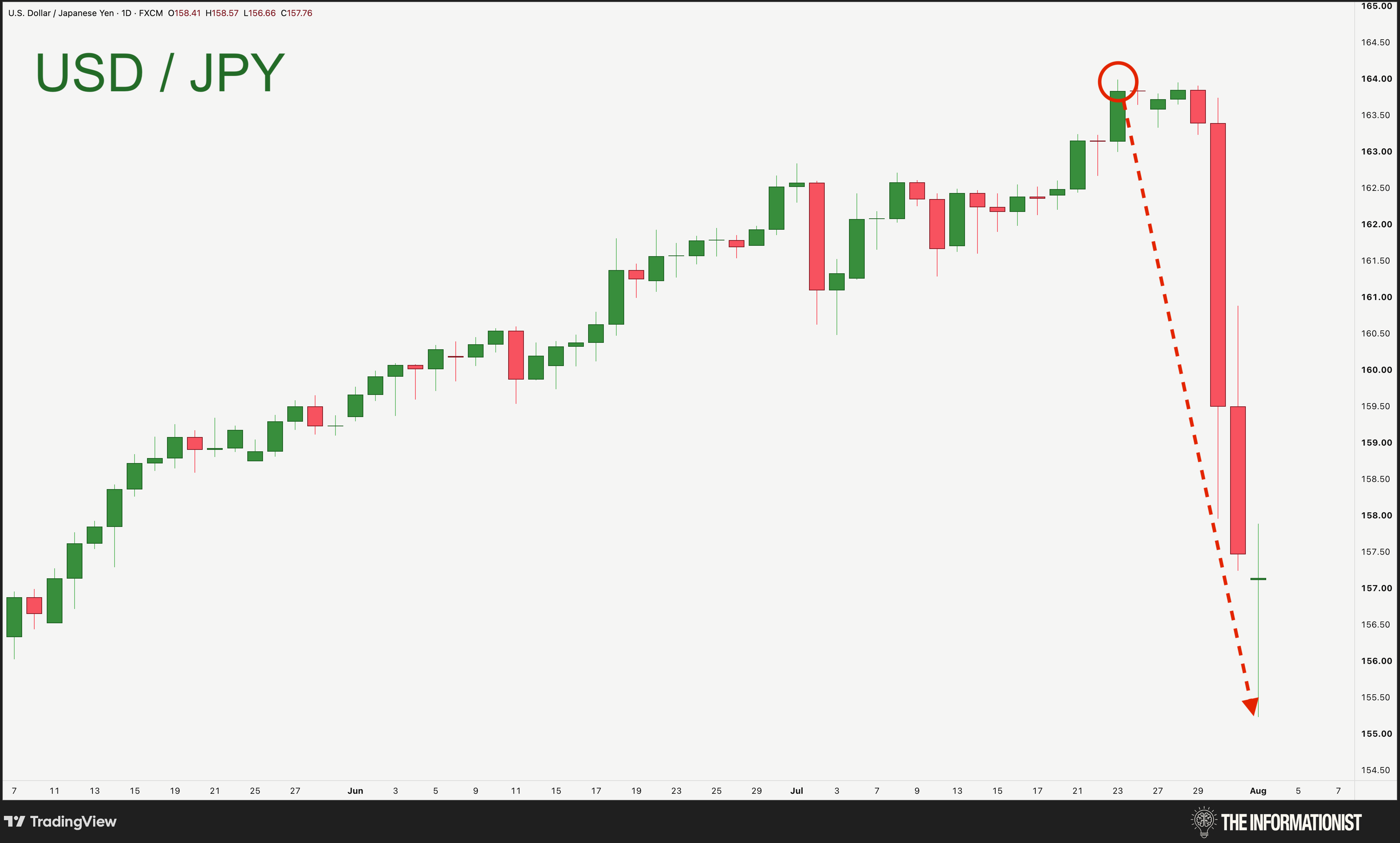
As I write this it’s back at 157.76, which means roughly a quarter of everything eighty-seven billion dollars bought has already been handed back. Before Friday’s jobs number it was up at 158.60, or closer to forty percent.
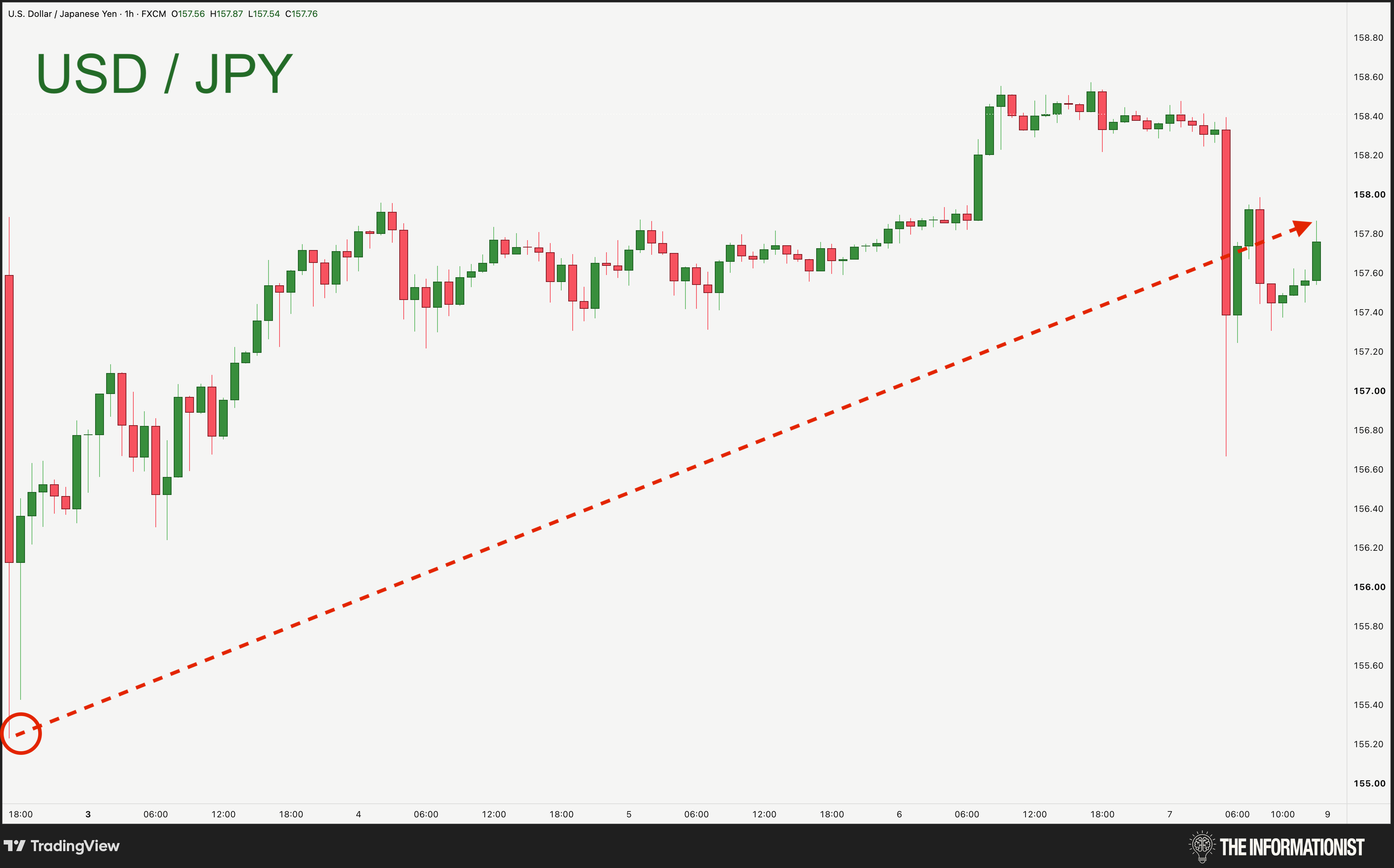
Five trading sessions. That’s what the most expensive currency defense on record has purchased so far.
Which leaves the question I keep circling, and it’s the one the rest of this letter is going to answer.
If two governments can spend that kind of money and move a price for less than a week, then what is actually setting that price? And why couldn’t the two of them, together, with the largest checkbook anybody has ever brought to a currency, hold it?
The short version: Japan and the United States spent more money defending the yen last week than anyone has ever spent defending a currency, and just over a week later a good chunk of it has already unwound. A jobs report that cost nobody anything moved the yen further in one morning. When the biggest check in history buys you five days, the price isn’t being set by the check.
What’s Actually in the War Chest
So the United States went out and bought yen.
But with what, exactly?
Sounds like a pretty simple question, right? Especially for the US Treasury that sits on all those dollars at its instant disposal.
Well, it turns out it wasn’t so simple after all.
