

✌️ Welcome to the latest issue of The Informationist, the newsletter that makes you smarter in just a few minutes each week.
🙌 The Informationist takes one current event or complicated concept and simplifies it for you in bullet points and easy to understand text.
🫶 If this email was forwarded to you, then you have awesome friends, click below to join!
👉 And you can always check out the archives to read more of The Informationist.
Today’s Bullets:
The Number Behind the Number
6% Club: The Club You Don’t Want to Join
A Doom Loop Update
What It Means for Your Money
Inspirational Tweet:

Ray Dalio has been talking about something that should honestly be getting a lot more attention than it has recently.
He laid out a simple target. A number that the US deficit needs to hit to avoid what he calls a debt crisis. And then he listed three levers that could get us there.
Simple enough. Except for one problem.
When you look at where that number actually is right now, and where it’s headed, you realize those three levers will not be enough. In fact, it’s not even close.
And the consequences of that? They touch everything. Your savings. Your mortgage. Your retirement. And if you’re still trying to build those things? It matters even more.
And this morning’s GDP report? It just made the math even harder.
So what is Dalio’s target? What’s the number everyone should actually be watching? And what does all of this mean for the US dollar and your money?
All great questions that deserve serious consideration and answers, ones that we will sift through, nice and easy as always, here today.
So pour yourself a big cup of coffee and settle into your favorite seat for a look at the number that nobody’s watching closely enough with this Sunday’s Informationist.
Partner spot

The cracks in the foundations of money are becoming harder to ignore. Persistent deficits, rising debt, and central bank behavior are quietly reshaping how investors think about preservation and risk.
In my latest report, The Debasement Trade, I walk you through:
Why debasement is structural, not cyclical
How inflation and financial repression challenge familiar portfolios
Why gold tends to move first—and bitcoin often moves further
You can download the report here:
🫣 The Number Behind the Number
You’ve probably seen the charts. US national debt held by the public just crossed $32 trillion. That’s about 100% of GDP. The total including intergovernmental holdings? $38.6 trillion.
Big numbers. Scary numbers. And they get a lot of attention.
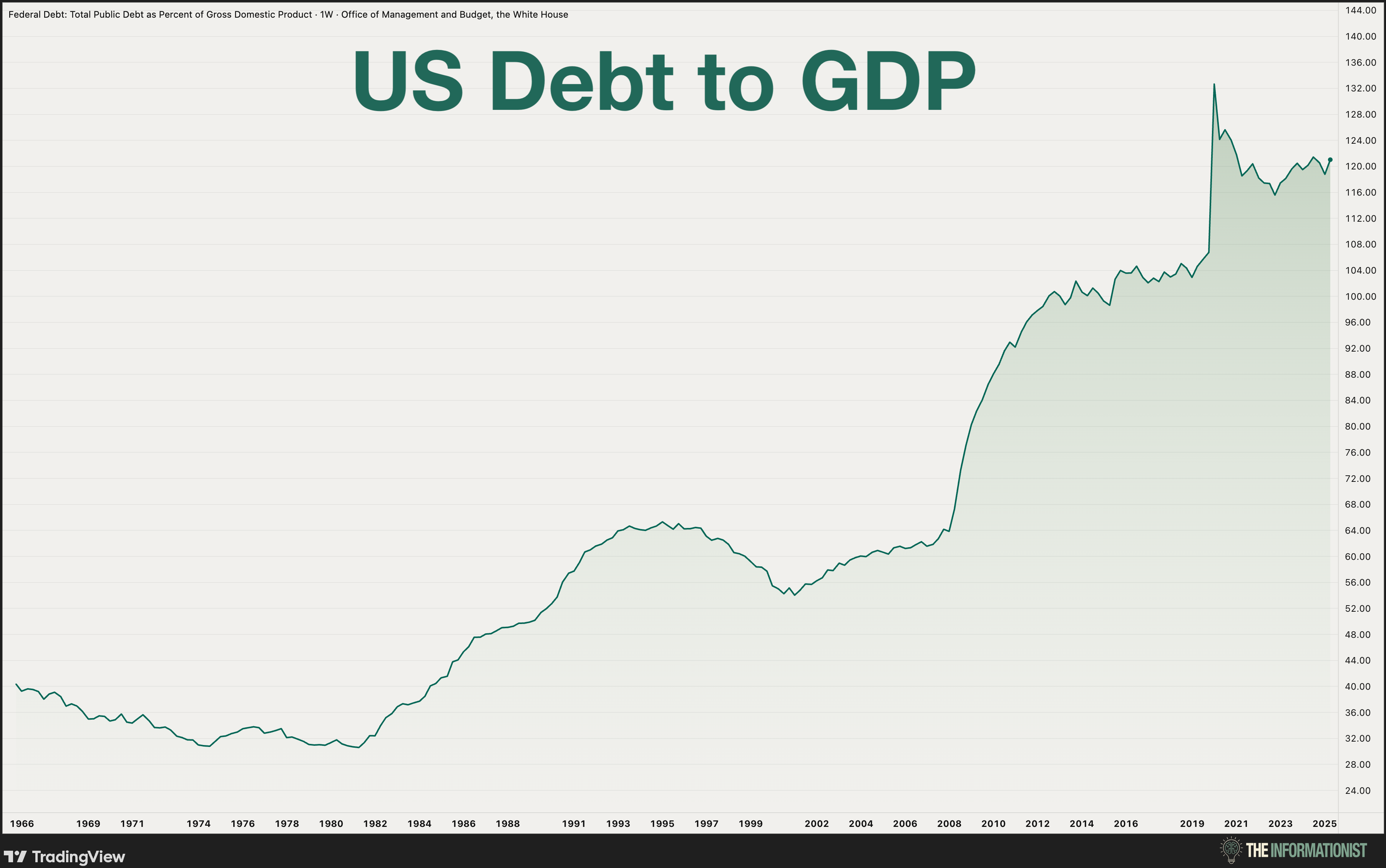
And by the way, even that $38.6 trillion actually, severely understates the problem. When you add in unfunded liabilities for Social Security, Medicare, and Medicaid, the total obligation is over $175 trillion. The real mountain of debt may be more than four times what we’re counting.
But there’s a number behind that number. One that tells a much more urgent story.
Let me explain.
Debt-to-GDP tells you the size of the pile. How much has accumulated over the years. And yes, it’s a big pile. But it’s a snapshot. It tells you where you are at one moment in time.
What it doesn’t tell you is how fast the pile is growing. Whether it’s accelerating or slowing down. Whether the trajectory is getting better or worse.
For that, you need the deficit. Specifically, the deficit as a percentage of GDP.
Think about it like your credit card statement.
The balance is what you owe. A big balance is bad, but what really tells you if you’re in trouble? The monthly charges. How much *new* debt you’re adding each month relative to your income.
Or think of it like this:
The debt is the odometer, which tells you how far you’ve driven.
The deficit is the speedometer. It tells you how fast you’re going right now.
And right now, the speedometer is pinned.
The US ran a $1.83 trillion deficit in fiscal year 2024. That’s 6.3% of GDP.
Fiscal year 2025 came in at $1.78 trillion. About 5.8%.
And fiscal 2023? 6.2%.
Three straight years at or near 6%. Double Ray Dalio’s target.
The 50-year average? 3.8%. We’re running at more than 150% of the historical norm.
Now, you might be thinking, “OK, that sounds bad, but hasn’t the US run big deficits before?”
Yes it has. But never like this.
And to show you what I mean, let me introduce you to what we call the 6% Club.
