

✌️ Welcome to The Informationist, the newsletter that makes you smarter about money in just a few minutes each week.
🙌 One topic. One deep but simple dive. Exposed and explained so you can make better decisions with your money.
🫶 If this was forwarded to you, you have awesome friends. Join 45,000+ readers here.
Today’s Bullets:
🎰 From Scratch-Offs to Super Bowls
📱 The Explosion
🫥 The Line That Disappeared
💵 The Question Behind All of It
Inspirational Tweet:
You’ve seen it. Everywhere, all around us.
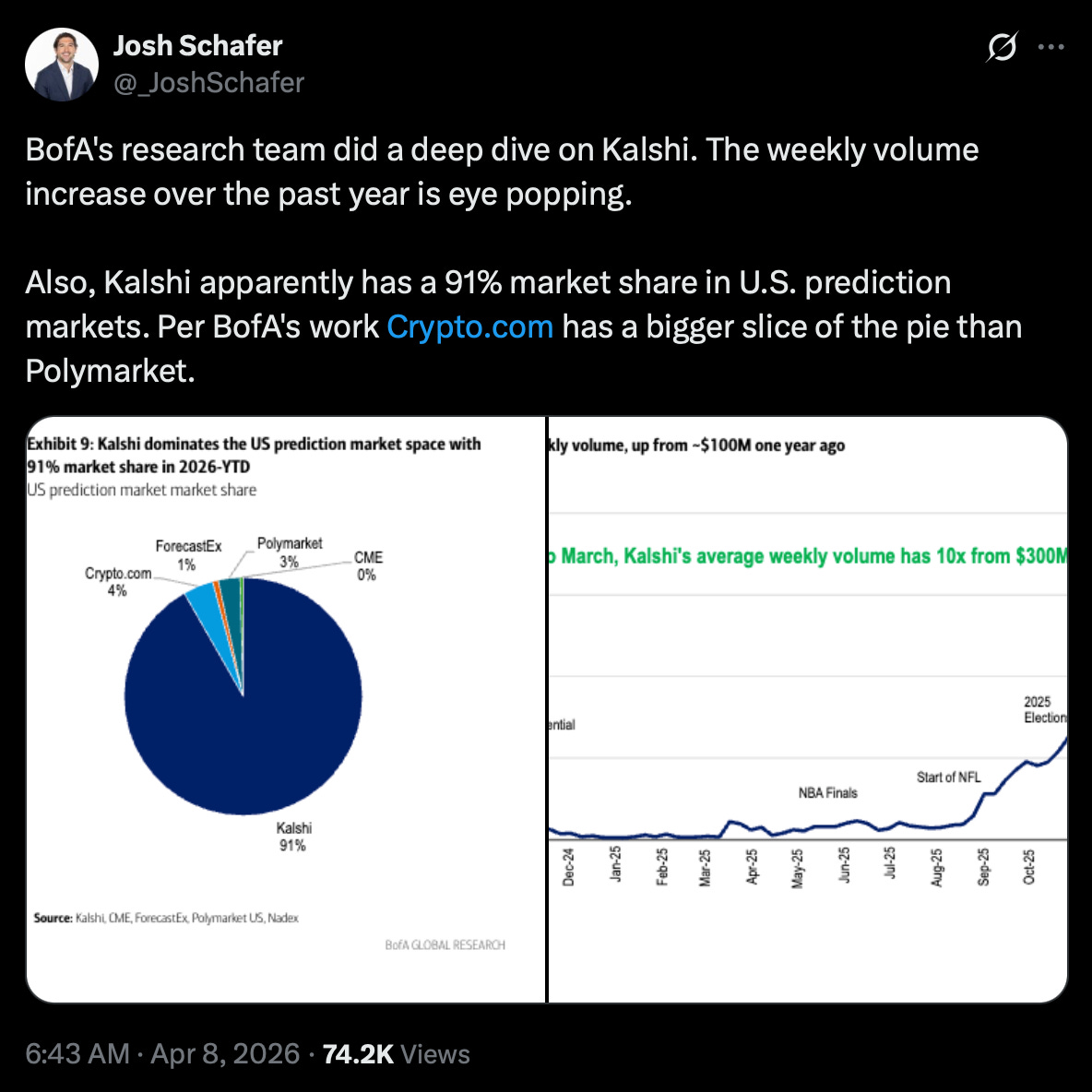
The DraftKings ad before kickoff. The FanDuel promo during the podcast. Your Uber driver checking a Final Four parlay at a stoplight. Your buddy on Kalshi betting on the number of views of a MrBeast video.
Betting used to be something you only did in Vegas or Atlantic City. Maybe at the gas station, scratching a ticket while the guy behind you waited for a pack of Marlboros. Now betting is on your laptop, or worse…your phone, in your pocket, all day long.
And it happened so fast. Like quicker than a tax hike in California fast.
So what’s going on? How did we become a country where betting went from a weekend vacation to an all-day habit? What’s actually driving it? And what does this explosion tell us about the way money works right now?
Great questions that deserve serious consideration and answers, ones that we will sift through, nice and easy as always, here today.
So pour yourself a big cup of coffee and settle into your favorite seat for a walk through America’s love for wagers with this Sunday’s Informationist.
Partner spot
The Downturn Advantage
Bitcoin’s volatility is its advantage. For long-term investors, volatility creates opportunities to build and refine positions over time. Mark Moss recently joined Unchained to explore how bitcoin fits into long-term strategy, and how downturns can be used to position more effectively.
The discussion covers:
How bitcoin’s volatility can support long-term accumulation
Why the current environment is putting pressure on traditional approaches
How to think about downturns as opportunities for more intentional positioning
Download the recent collaborative report from Mark Moss and Unchained, Retire Off Bitcoin: The Freedom Investor’s Guide, to access both the report and the full event replay.
🎰 From Scratch-Offs to Super Bowls
The year is 1972, and a nuclear engineer named Mike Kent got bored at work.
He was testing reactor designs at a Westinghouse facility in Pennsylvania, feeding punch cards into a mainframe computer. One day, he decided to use that computer to rank the strength of his company’s softball teams. Then he tried it on college football. Then the NFL.
He started comparing his computer’s predictions to the odds from local bookmakers. Guys named Primo and Bobo. It worked. He was winning.
By 1979, Kent quit his job, stuffed $100,000 cash into a brown paper bag, and drove to Las Vegas.
That’s how sports betting worked in America for most of its history. You had to physically go somewhere. You had to carry cash. You had to know a guy. Or a guy who knew a guy. There was friction everywhere, and that friction was the guardrail.
The only exception?
State lotteries.
Governments had quickly figured out that people will pay a voluntary tax if you package it as hope. A $2 Powerball ticket. A scratch-off at 7-Eleven. Today, 45 states run lotteries.
And look at the result.
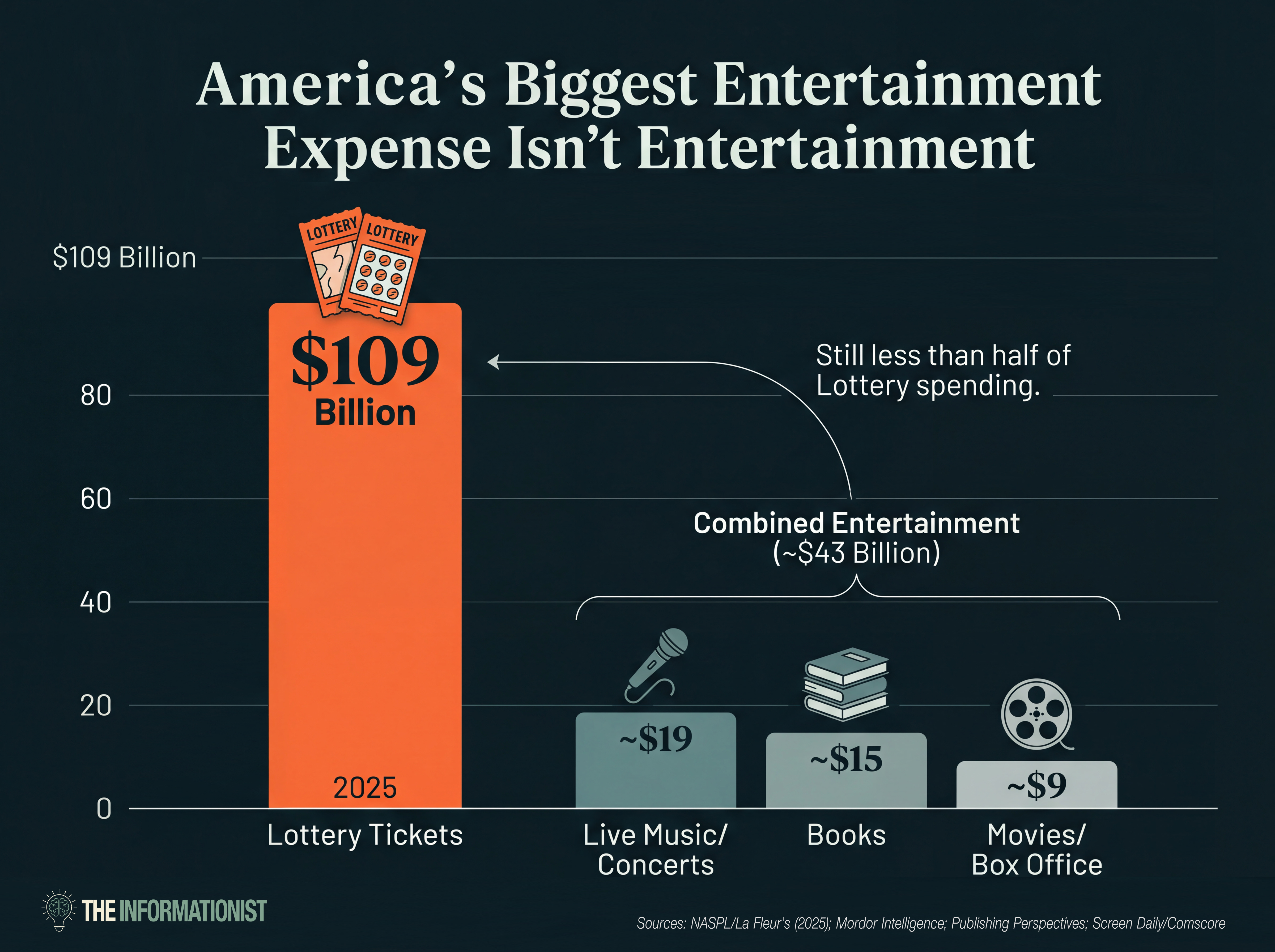
Americans spent $109 billion on lottery tickets last year alone. More than they spent on concerts, movies, and books combined.
Ooof.
Still, the lottery was always slow money. Buy a ticket, wait for a drawing, lose, buy another one. The casinos were faster but still required a trip. Vegas. Atlantic City. The tribal gaming halls that popped up across 29 states after the Indian Gaming Regulatory Act of 1988.
All of it required you to show up.
But all that changed on May 14th, 2018.
Because that’s the day the Supreme Court struck down a federal law called PASPA that had banned sports betting in every state except Nevada. The ruling in Murphy v. NCAA told states they could legalize sports betting themselves.
That they did. Fast.
Sadly, Mike Kent died in a quad bike accident later that same year. The man who started it all with punch cards and a paper bag full of cash never saw what came through that door.
Last year, Americans wagered $167 billion on sports. Fifteen times what they bet the year the Supreme Court opened the door. And that doesn’t even count prediction markets, zero-day options, or crypto.
Something is driving all of this. And it isn’t just big companies or better technology.
Oh, it’s something much more troubling. Much worse, in a way.
