

✌️ Welcome to The Informationist, the newsletter that makes you smarter about money in just a few minutes each week.
🙌 One topic. Exposed and explained so you can make better decisions with your money. Like a simple walk down Wall Street.
🫶 If this was forwarded to you, you have awesome friends. Join 45,000+ readers here.
DISCLOSURE
As many of you already know, I co-manage the Bitcoin Opportunity Fund, and I sit on the board of Strive Inc (NASDAQ: ASST), a Bitcoin treasury company. The fund and I personally own Bitcoin, along with shares and securities of several companies that are known as Bitcoin Treasury Companies, including Strategy (MSTR), and Strive (ASST).
And none of what follows is investment advice. I cannot tell you what to do with your money, and I never will. Everything here is for education, and for thinking a little more clearly about the world. The decisions are yours. Do your own work, and where it counts, talk to your own advisor.
Now, let’s get to it.
Today’s Bullets:
🔋 What the Power Law Actually Is
🧮 The Math Behind the “Support” Line
📉 Where the Floor Really Sits (And What a Wick Below It Means)
🤔 How I Use the Power Law (And What I See at $60K Bitcoin)
Inspirational Tweet:
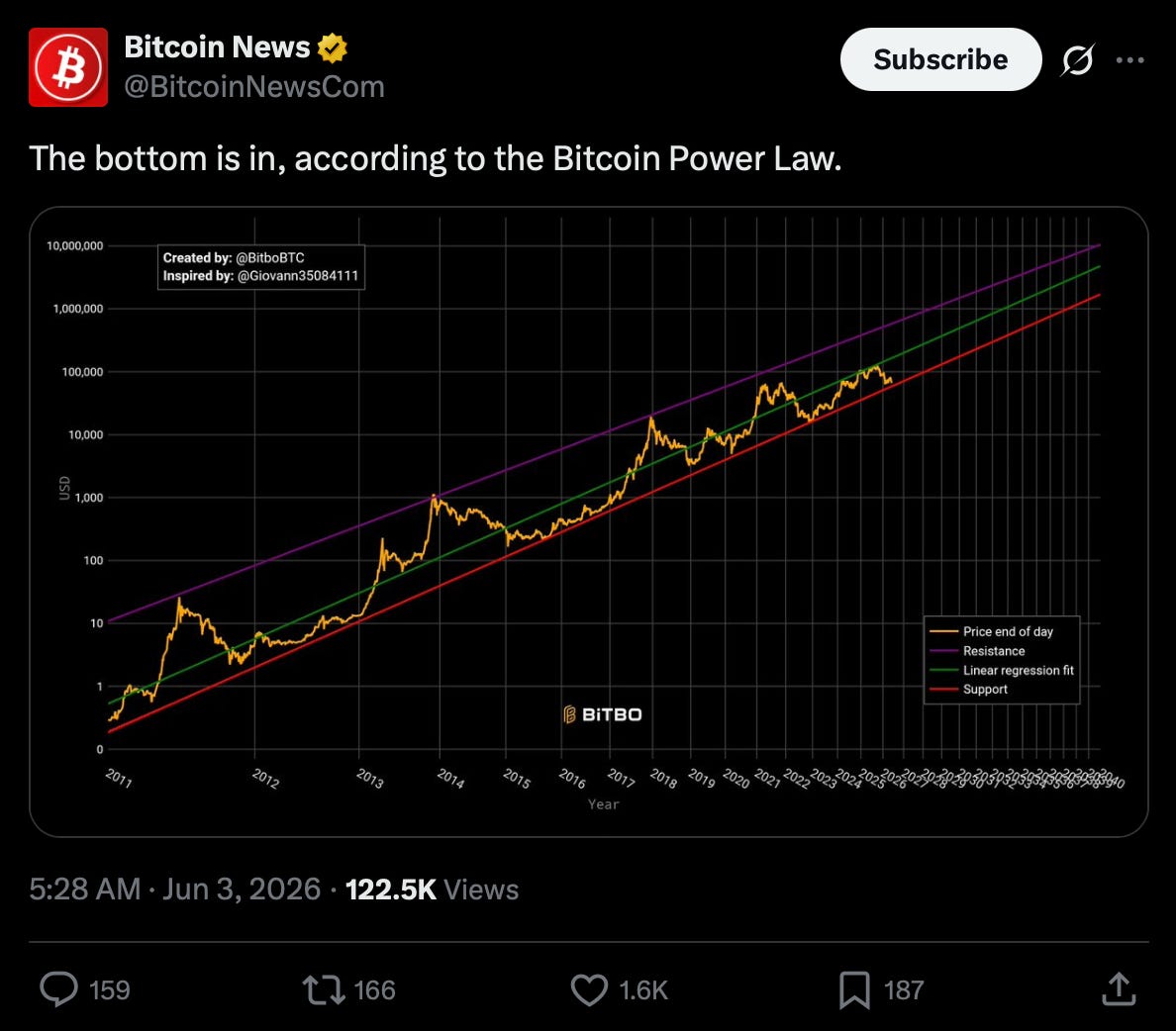
“The bottom is in.”
That went out to the timeline a couple of days ago, right before this latest leg down.
That kind of bold call can wind up looking prophetic or foolish. Of course, the comments on that post are polarizing, either in support or with criticism. The worst of them exclaim that the Power Law just snapped.
It’s broken, totally invalidated or just about to be...
The one important mathematical floor under this whole asset has finally given way.
So which is it?
I was watching my screen Friday afternoon when Bitcoin printed a five handle for the first time since February. Fifty-nine thousand, one hundred and eleven dollars. It clawed its way back over sixty within minutes, and as I write this it sits at $61K, down over 3% on the day and more than half off the high it set last October.
Ouch, indeed.
Now, there is no shortage of ways to think about where Bitcoin “should” be. S-curves. Exponential adoption curves. Stock-to-flow, may it rest in peace. Metcalfe’s law. Rainbow charts. Take your pick.
But there is one model I keep coming back to, year after year, drawdown after drawdown. If you’ve been following me, you’ve heard me talk about it before.
The Bitcoin Power Law.
And the question burning up my feed today, the one filling my inbox, the one maybe sitting in the pit of your stomach right now, is a simple one.
Has the Bitcoin Power Law been broken?
Some say we are testing the floor. Some say we have already fallen through it. Either way, the same fear hangs over all of it. If the Power Law fails, the long-term map a lot of us have been navigating by is suddenly worthless.
So is it true? Has sixteen years of almost eerie consistency finally cracked? And if Bitcoin is sitting here at sixty grand, scary as that feels, what is the model actually telling us about where we are and what comes next?
All good questions. And ones we are going to answer, nice and easy as always, here today.
So pour yourself a big cup of coffee and settle into your favorite seat for a clear-eyed look at the one Bitcoin model I trust, and whether today’s sell-off broke it, with this Sunday’s Informationist.
Partner spot

After 17 years, bitcoin is still widely misunderstood. You get it, but what about the bitcoin blind spots you don’t know you have?
Unchained just released Rethink Bitcoin → a free interactive course covering the protocol, savings, custody, and network effects across 12 lessons and 21 interactive figures. This is the kind of thing you wished existed when you were learning, and the new best resource for those just beginning the journey.
For the friend or family member who won’t sit through 12 lessons, we partnered with Atlantic Re:think to make a short film for the curious featuring Natalie Brunell, Natalie Smolenski, and our CEO Joe Kelly. Not the crypto story. The bitcoin story.
🔋 What the Power Law Actually Is
Pull up a normal Bitcoin price chart and it looks like an emergency room EKG. Spikes. Crashes. Flatlines. Then off it goes again. Sixteen years of what appears to be pure chaos.
Now change one thing. Take that same chart and compress the price axis onto a logarithmic scale.
I know, I know. Before your eyes glaze over with the thought of math on a Sunday morning, just stick with me for a moment
The Log Scale
A log scale simply measures percentage moves instead of dollar moves.
Here’s the easiest way to think about it. On a normal chart, every tick up the price axis represents the same number of dollars. So Bitcoin going from $100 to $1,000 looks like a tiny blip at the bottom of the screen. Bitcoin going from $10,000 to $100,000 looks like a gigantic spike. Both are 10x returns, but the second one looks massive compared to the first one.
Like so:
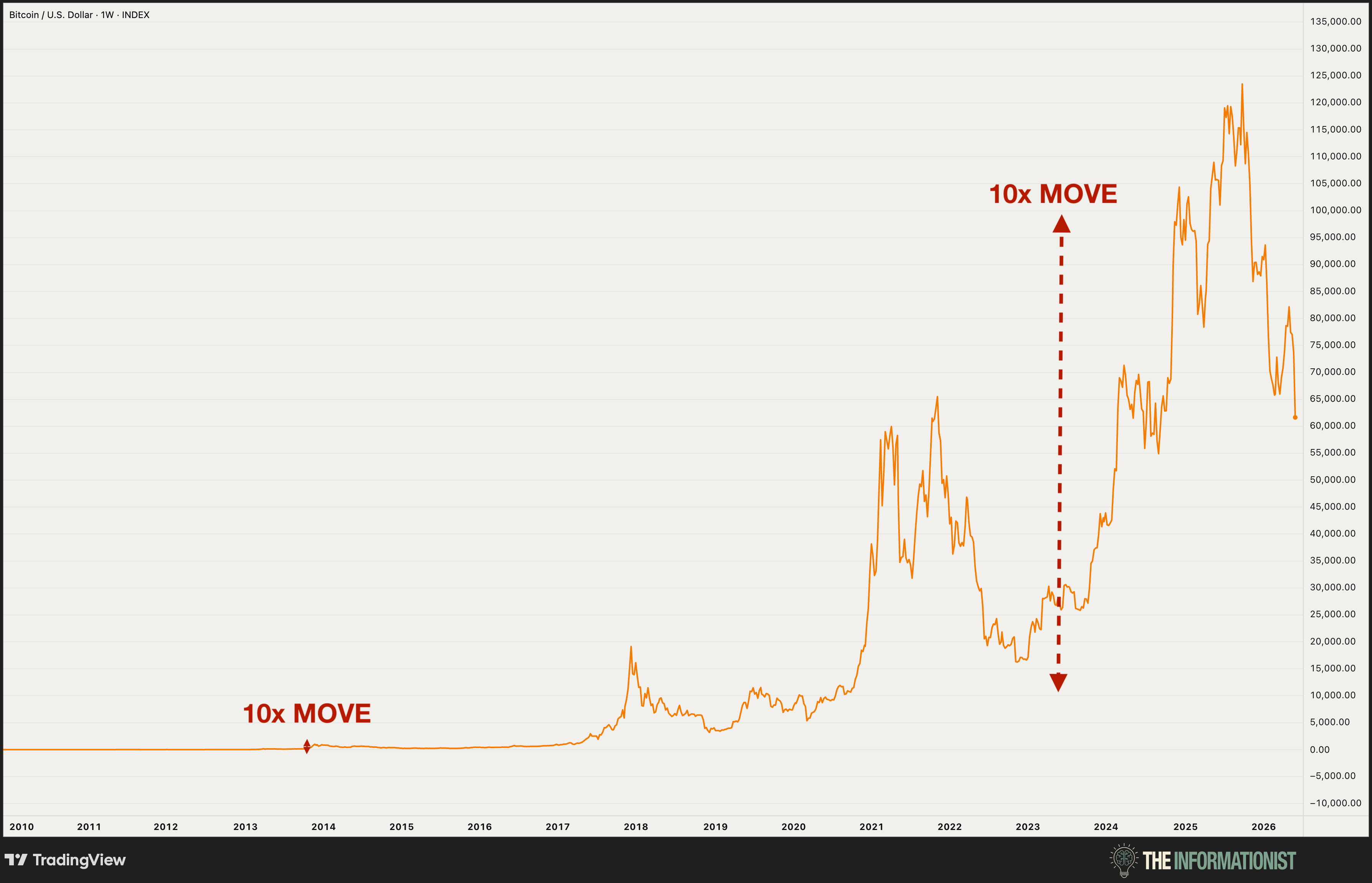
And yeah, like a patient waiting for a heart transplant.
Log scale corrects for that.
Every step up the axis represents the same percentage gain. Bitcoin going from $1 to $10 covers the same vertical distance as Bitcoin going from $10,000 to $100,000. Because to your wallet, they were the same thing. You multiplied your money by ten either time.
When we switch that chart to log scale, the whole picture changes. Now it's measuring percentage moves, the way your wallet actually feels them.
Like so:
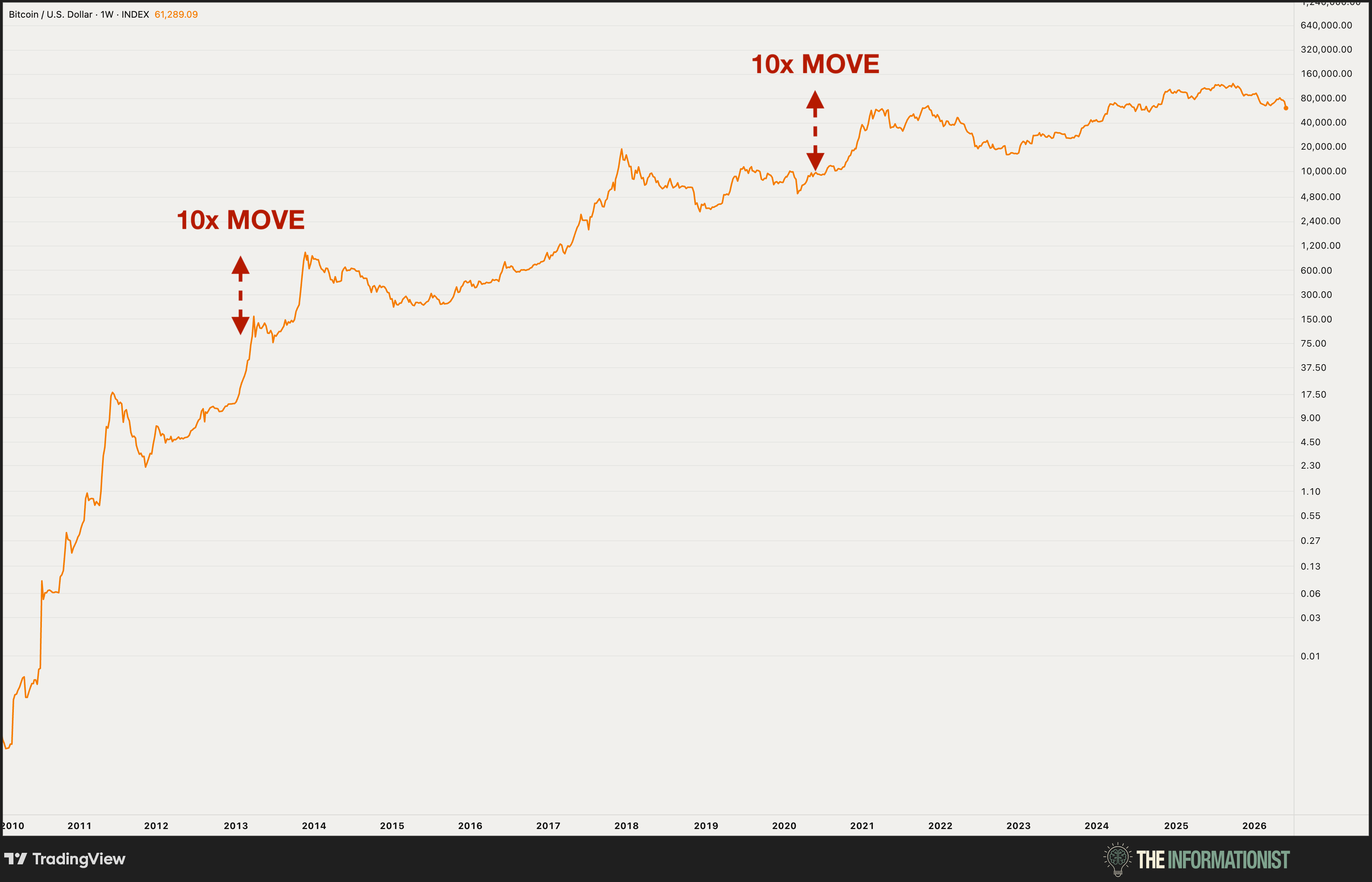
By switching to log scale, the chaos starts to settle.
And then, when you plot time on the x-axis in log scale too, all that violence resolves into something almost calm. A price chart that seems anchored to a single straight line, climbing up and to the right.
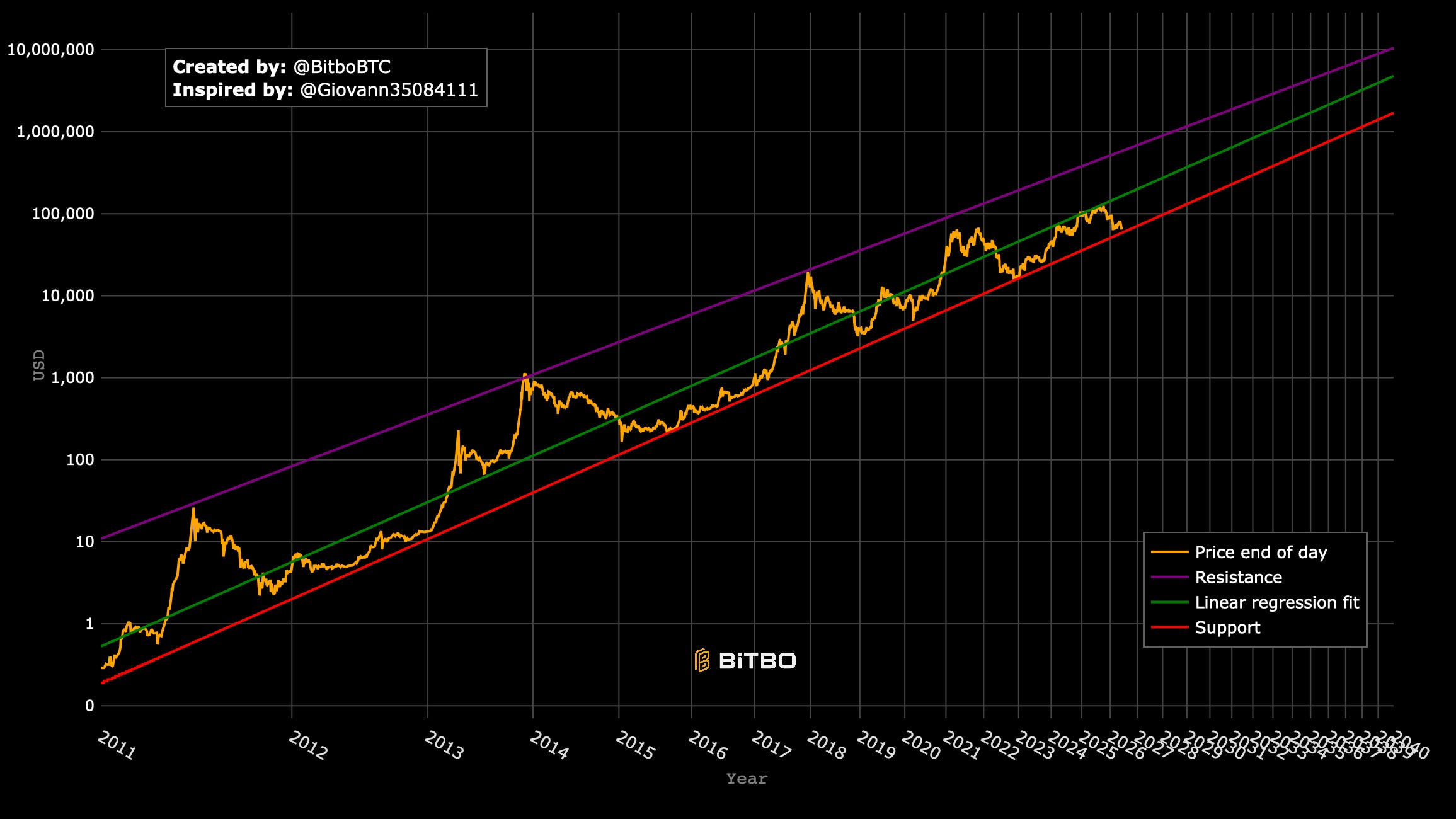
That is the Bitcoin Power Law.
All that mania and volatility falls into line along a single rising trend, with a tightness that is incredibly rare in financial markets.
There’s a number we use to describe how well a line fits the data, called R-squared. Most market “models” would kill for an R-squared of 0.7. Bitcoin’s Power Law sits north of 0.95, across sixteen years and six orders of magnitude of price.
In plain English: for all the drama and declarations of death, Bitcoin has been climbing the same staircase the entire time.
The math is simple to state.
Price grows in proportion to time raised to a power, somewhere around the sixth. You do not need to love algebra to feel the point. Bitcoin’s price has scaled with its age in a strikingly regular way, the same way a lot of things in nature do.
And that is the part that hooked me years ago. The physicist who formalized this, Giovanni Santostasi, showed that the same kind of pattern shows up all over the natural world. The way a city’s infrastructure scales with its population. The way an animal’s metabolism scales with its body size. Bitcoin, it turns out, behaves less like a stock and more like a growing network. Or a growing organism.

Why? One word. Adoption.
As more people, more companies, and now even governments come to hold Bitcoin, the network grows, and the price grinds its way up that long, predictable curve. And every single time it has crashed, and it has crashed violently, again and again, it has eventually fought its way back to the line.
Incidentally, I broke this all down in a full issue back in 2024, charts and all. If you want the deep version, it’s right here: What is The Bitcoin Power Law?
For today, hold onto one thing above all else. The Power Law is a long-term trend. A map of the path Bitcoin has walked, and the gravity it keeps falling back toward. Next Tuesday lives somewhere else entirely.
Which brings us back to the question setting the whole timeline on fire.
That straight line, the one Bitcoin has more or less tracked for sixteen years, is the Power Law. One line. A trend. So when everyone screams that we are “breaking support,” the first thing to nail down is what that “support line” even is. Is it part of the Power Law at all, or something somebody bolted on top of it?
Because the answer is what separates an ordinary Bitcoin scare from a real emergency. It decides whether sixty grand is Bitcoin standing on the floor or falling clean through it, where that floor actually sits, and whether the one model so many of us navigate by is truly cracking, or doing precisely what it has done for sixteen straight years.
So let’s settle it.
