

✌️ Welcome to the latest issue of The Informationist, the newsletter that makes you smarter in just a few minutes each week.
🙌 The Informationist takes one current event or complicated concept and simplifies it for you in bullet points and easy to understand text.
🫶 If this email was forwarded to you, then you have awesome friends, click below to join!
Full disclosure, and as many of you already know: I hold bitcoin and hard assets personally and professionally, and I sit on the board of a bitcoin treasury company, so weigh my opinion accordingly. Nothing here is individual advice, and I don't know your personal situation. If you have an advisor, these are conversations you should be having with them.
Today’s Bullets:
How Much of September Was Oil?
How Does a Barrel of Oil Get Into Everything?
What Happens Between the Producer and the Shelf?
When Will the Price of Oil Come Down?
Inspirational Post:
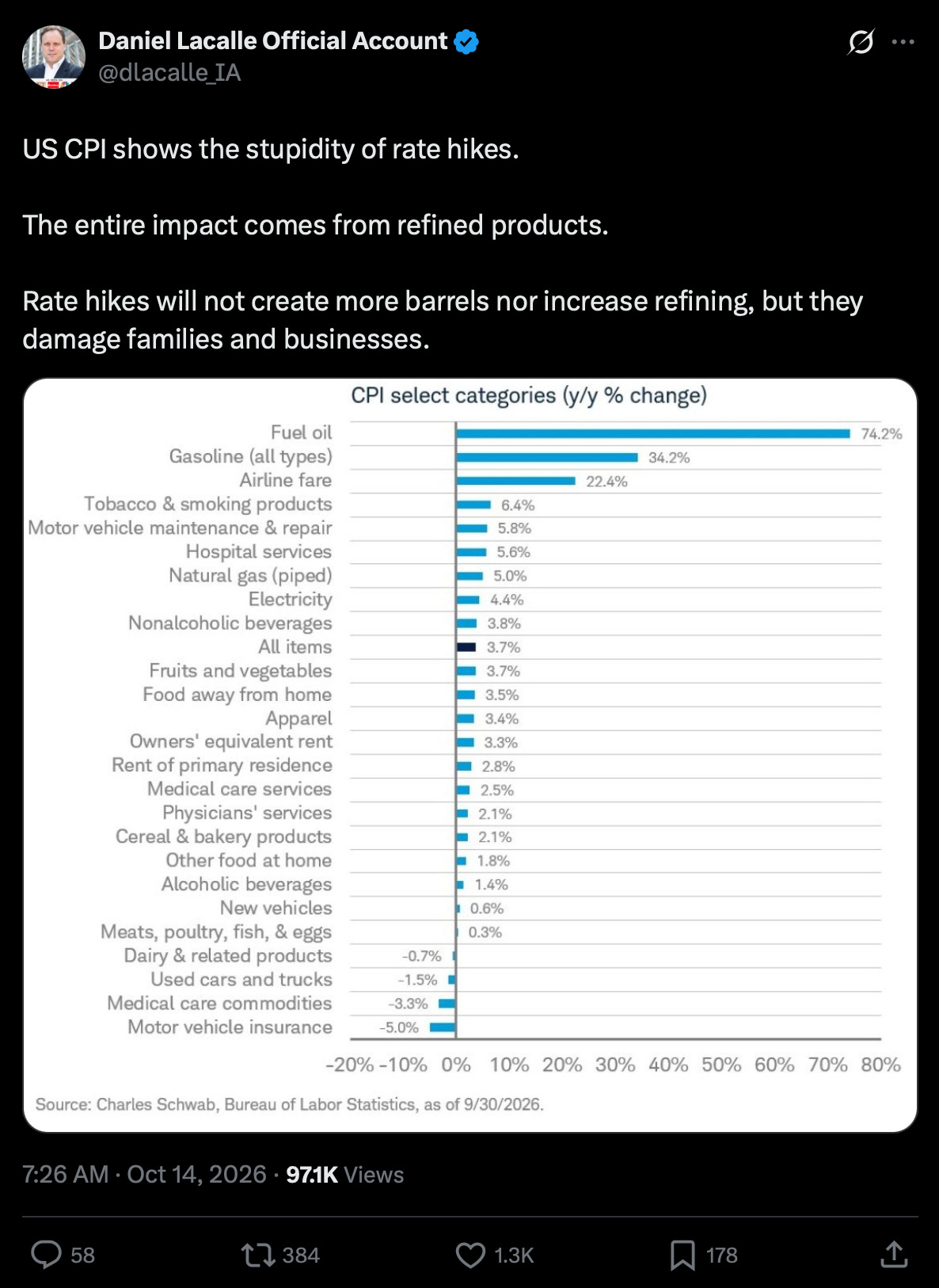
Quite an eye-popping chart, this one. Fuel oil, up 74.2% over the past year. Gasoline, up 34.2%. Airfare, up 22.4%.
Each of these is directly related to the price of a single barrel of oil.
And of course, if you filled up your tank this past month, paid a heating bill, or booked a flight lately, you’ve been impacted by that barrel, too.
Heck, I looked to book a flight from Vegas to Miami last week and the best price I found for a direct flight came in at about $1,100. If memory serves, that’s about $300 more than last year.
In any case, Daniel Lacalle’s point in today’s Inspirational Post is that the Fed raising rates in the face of rising energy costs is nonsensical. I mean, unless the Fed starts drilling for or refining oil, there’s not much they can do to bring down the price of energy.
And so it begs the question, just how much impact does the price of oil have on the price of everything? How exactly does the price of a barrel end up in a plane ticket, or a pound of beef? Also, why are businesses warning that more price increases are on the way? And most importantly, when will the price of oil come down, and will the prices we pay for everything else come down with it?
All good and important questions, and ones that we’re going to answer, nice and easy as always, right here today.
So pour yourself a big cup of coffee and settle into your favorite seat, as we sort through how the price of a barrel of oil snakes its way from the gas pump to the checkout line, with this Sunday’s Informationist.
Partner spot

Recently, Ledger users lost funds after purchasing devices through a third-party reseller in a suspected supply chain attack. Ledger is advising recent buyers to hold off on setup, or to move funds to a new device with a new seed.
Like the Coldcard incident this summer, your takeaway should be this: eliminate all single points of failure. If your long-term bitcoin depends on one key, one provider, one location, or one person, then one failure is all it takes to lose everything.
Whether it be a supply chain attack, retirement attack, or even a heart attack: no single failure should put your bitcoin out of reach for you or your family.
Unchained built a short self-assessment to show you where you stand. It’s 3–7 questions, takes about three minutes, and highlights which dependencies deserve a closer look. The answer might not be what you think. Your answers are evaluated in your browser and are never stored.
Find your single point of failure →
How Much of September Was Oil?
On Wednesday, the Bureau of Labor Statistics (BLS) published the consumer price index (CPI) for September, showing prices rose 0.6% for the month.
Extrapolating a full year, that would put prices on pace to be up 7.4%.
Ouch.
Question is, how much of September’s jump can be attributed to the price of oil?
It’s easier to think about these things in terms of dollars.
For example, let’s take $100 worth of spending for a household.
Of the $100, the BLS counts about $7 of it as energy, i.e., gasoline, heating oil, electricity, and natural gas.
Yet that $7 was responsible for about two-thirds of higher costs in September. And most of it was due to gasoline.
Yikes.
If you’ve been to the pump lately, you are well aware of this increase. A gallon of regular averaged $4.33 last week, versus just $3.06 a year ago.
Thank God I don’t live in California, where the regular average last week was $6.10, up $1.65 over the last year.
But, remember, it works both ways.
When oil prices dropped back in June, overall CPI actually fell that month.
So Lacalle has a point about where September’s jump came from, as his post’s graphic showed.
Look at this chart.
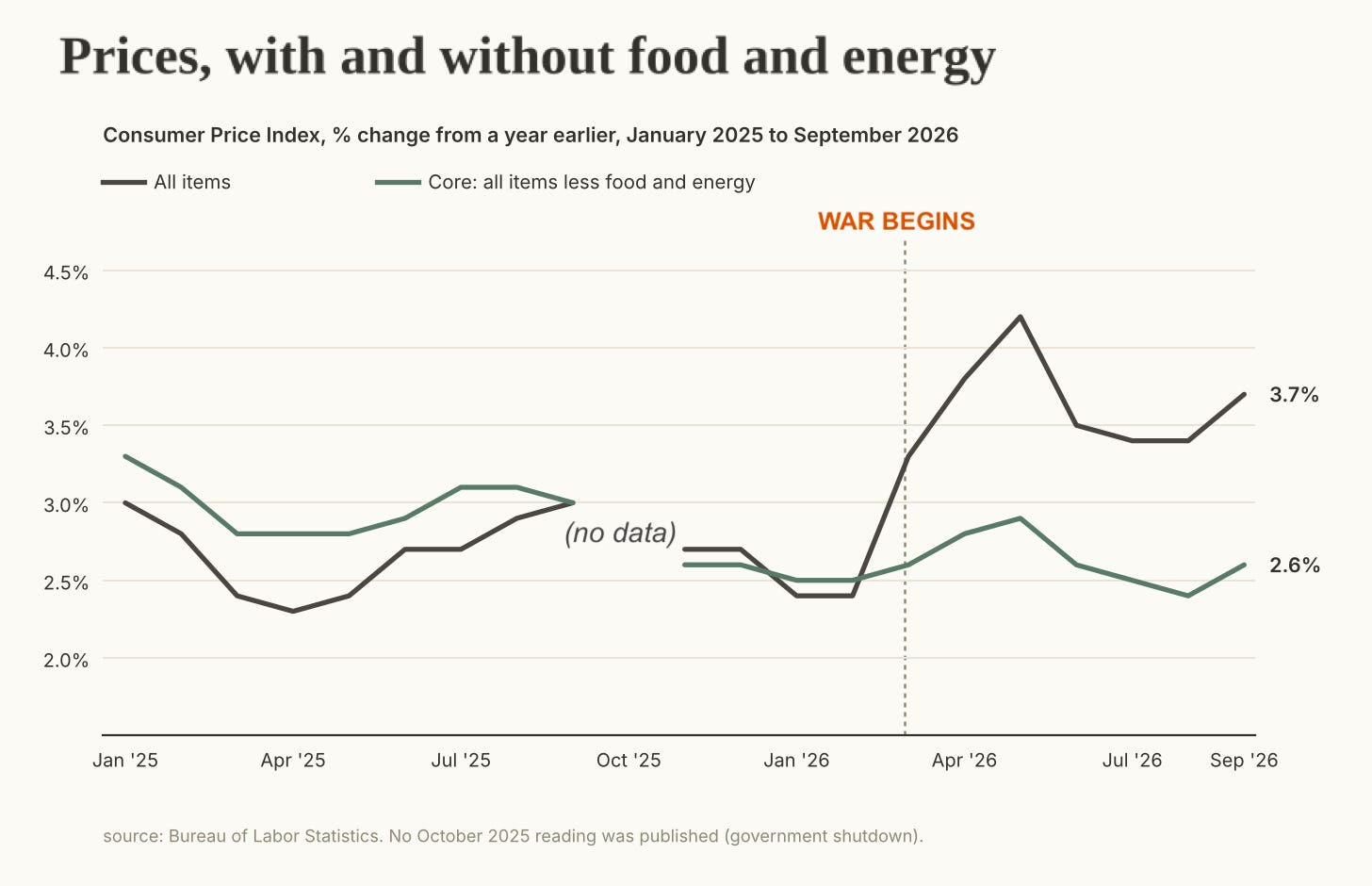
When we strip out food and energy, aka the core CPI, the remaining prices are up 2.6% over the past year, about the same as in February, before the war began.
In my opinion, this is the number we should be focused on, because it suggests that oil has, so far, had little impact on the price of everything else.
Which brings us to an important question.
If businesses are paying so much more for fuel, how, and most importantly, when will this increase find its way into the price of everything else?
How Does a Barrel of Oil Get Into Everything?
As many of you know, I like to use first principles when approaching any analysis.
Of course, we can do the same exact thing here when trying to figure out how much oil ends up in the price of anything.
We ask the simplest question.
