

✌️ Welcome to The Informationist, the newsletter that makes you smarter about money in just a few minutes each week.
🙌 One topic. One deep but simple dive. Exposed and explained so you can make better decisions with your money.
🫶 If this was forwarded to you, you have awesome friends. Join 45,000+ readers here.
Today’s Bullets:
🚨 Paulson’s Warning
🏛️ The $15 Billion Not-So-Stealth Buyback
📉 Where the Buyers Went
🎰 How This Actually Ends
Inspirational Tweet:
If you’re like most people, you’re not spending your Wednesdays watching the Treasury market. Most people have jobs, families, and much better and more enjoyable things to do than track government bond auctions.
But this past Wednesday, two things happened you should probably know about. Quietly. On the same morning. For reasons that are not a coincidence.
The US government made a move that signals something in the bond market is shifting in the wrong direction. And a man who has been in the room for exactly that kind of moment went on Bloomberg to tell the world.
But what exactly shifted? Who is this Paulson character? And what does any of this have to do with your money, savings, and your retirement? I.e., why should we care?
Important questions that we will sift through, nice and easy as always, here today.
So, pour yourself a big cup of coffee and settle into your favorite seat for a walk through what the bond market is telling us this week with this Sunday’s Informationist.
Partner spot

Are we in a typical four-year-cycle bear market with more downside to come, or will 2026 prove to be a deviation from the multi-cycle trend? James Check is back to break down what onchain data is revealing about the path into this downturn and how this market compares to prior ones.
Join Checkonchain and Unchained for a live presentation and Q&A exploring what signals matter most right now and how investors are thinking about positioning through uncertainty. Register to attend and receive early access to The Bitcoin Checkpoint report.
When: May 5 · 3PM CT · Live online · Free to attend
🚨 Paulson’s Warning
Let’s start with exactly who we’re talking about, shall we?
Hank Paulson was the 74th US Treasury Secretary, serving from 2006 to 2009 under President George W. Bush. Before Treasury, he climbed the ranks of Goldman Sachs for nearly three decades before he became CEO for seven years.
Why does that matter?
Because Paulson is the man who ran the Treasury when the global financial system nearly collapsed. He approved the rescue of Bear Stearns, sat in the room when AIG imploded, and made the call to let Lehman Brothers fail.
Three days after Lehman went down, Paulson went to Congress with a three-page document and asked for $700 billion. That became TARP. The largest emergency financial intervention in American history at the time, and still the template for how Washington responds when credit markets seize up.
In short, Hank Paulson wrote the modern “break-the-glass” playbook. And he did it while watching banks fail in real time and central bankers pick up phones at all hours trying to keep the system functioning.
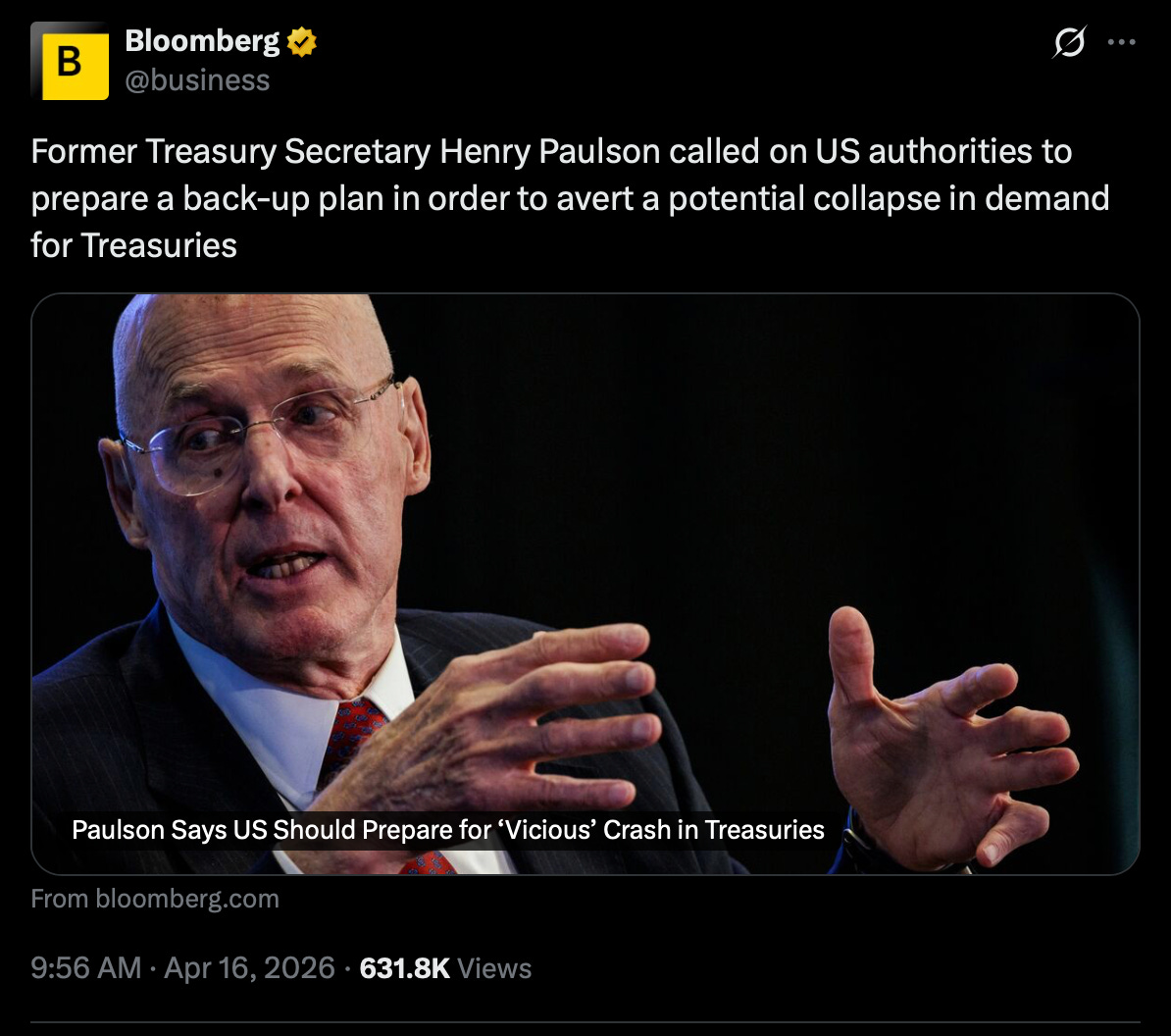
So when a man like that goes on Bloomberg Television’s Wall Street Week and tells the country to start preparing a new break-the-glass plan, it deserves attention.
Here are his actual words from Wednesday’s interview:
“We need an emergency break-the-glass plan, which is targeted and short-term, on the shelf, so it’s ready to go when we hit the wall.”
Paulson went on to describe what hitting the wall would actually look like:
“When you hit the wall and you’re trying to issue Treasuries and the Fed is the only buyer and the prices of the Treasuries are going down and interest rates are up, that’s a dangerous thing.”
Asked when the US would actually hit the wall, Paulson said bluntly, “When we hit it, it will be vicious.”
So, what is the worst-case scenario Paulson is describing here?
Put simply, it is one where demand for US government debt collapses, the Federal Reserve steps in as the emergency buyer, Treasury prices fall anyway, and interest rates spiral higher.
This is the shape of a sovereign debt crisis. The kind that has happened to Argentina, to Greece, to the UK in 2022. Paulson is asking whether it could happen here, and he is saying the US should have a plan at the ready.
Consider the numbers behind Paulson’s warning:
Total US federal debt now stands at over $39 trillion, up more than $10 trillion in just the past five years.
The marketable portion, the part that actually trades in the open market, is roughly $31 trillion and growing.
The federal deficit has averaged roughly 6% of GDP for the past three years. That level is historically seen only during wars or recessions. We are in neither.
Interest payments alone now exceed $1 trillion per year, larger than the entire defense budget (unless, of course, Trump gets his way, then both numbers are going much higher).
The CBO projects US debt-to-GDP will hit a record 108% by 2030, surpassing even the post-World War II peak, (Total US Debt to GDP is already at 125%).
Paulson ticked through America’s advantages: biggest economy, strongest companies, energy independence, a safe neighborhood. Then he named the threat:
“Our challenges are debt, fiscal and political polarization.”
The man who ran Treasury when the modern financial system nearly failed is telling the country that the biggest threat we face is our own balance sheet.
Luke Gromen, a good friend and one of the sharpest independent minds in the macro space, said:
Henry Paulson Says US Should Prepare for a ‘Vicious’ Bond Crash - BBG, 4/16/26
Conspicuous in its timing, IMO. “Why am I reading this now?”
“Conspicuous in its timing.”
That was on Wednesday afternoon. To understand why Luke used those words, you have to know what happened this past week.
🏛️ The $15 Billion Not-So-Stealth Buyback
Here’s the state of the US Treasury market in one dramatic visual:
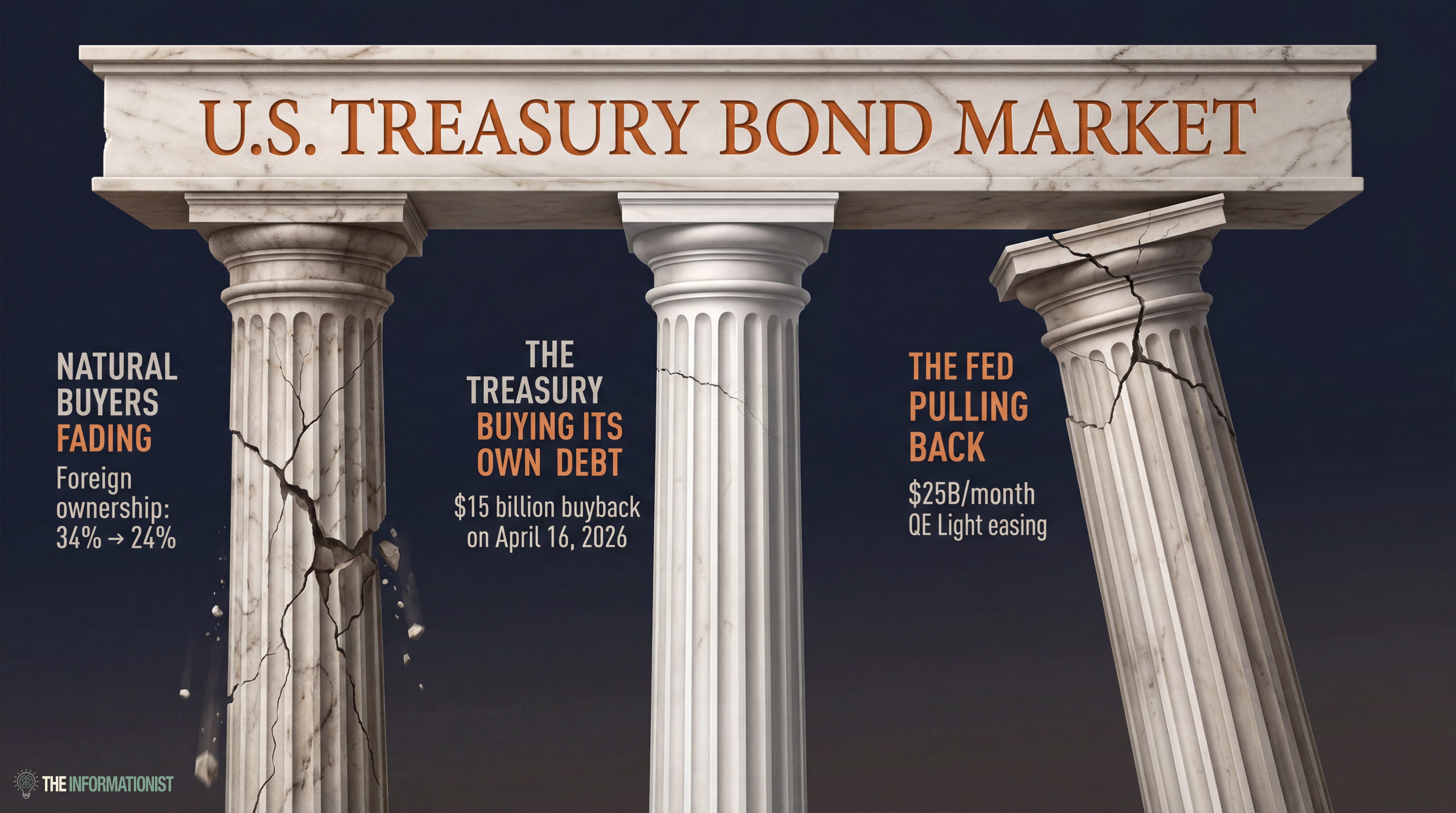
But now let’s talk about why this drama is becoming quite real.
