

✌️ Welcome to The Informationist, the newsletter that makes you smarter about money in just a few minutes each week.
🙌 One topic. Exposed and explained so you can make better decisions with your money. Like a simple walk down Wall Street.
🫶 If this was forwarded to you, you have awesome friends. Join 45,000+ readers here.
A note on disclosure before we begin.
I serve as an independent director of Strive Inc. (NASDAQ: ASST), the issuer of SATA. I am also co-managing partner of a fund that holds positions in both MSTR and ASST, and I personally hold or have exposure to MSTR, ASST, STRC, and SATA.
That means today's letter walks through two products that serve a similar purpose for investors, one issued by a company I sit on the board of, and one I do not. I have done my best to describe both honestly, on their merits, with the same lens applied to each. Where they differ in size, liquidity, yield, or risk, I have tried to name those differences plainly.
Nothing in this newsletter is investment advice. My job here is to walk you through how STRC and SATA actually work, so you can have an informed conversation with your investment advisor and decide for yourself whether either of them belongs in your portfolio.
Today’s Bullets:
🏦 What is Digital Credit?
✈️ Inside the Passenger Jet
🎯 Who STRC is Built For
⚠️ So What’s the Risk?
🎫 Should You Buy a Seat on This Jet?
Inspirational Tweet:

Picture a security that pays you 11.5% a year in monthly cash. Real money, hitting your account every month, while the share price barely budges. Boring chart, beautiful coupon.
Now picture the whole thing backed by Bitcoin.
Michael Saylor has named it Digital Credit and described it as a passenger jet in this week’s Inspirational Tweet above. The ticker is STRC. And honestly, it is the most interesting yield instrument I have laid eyes on in years.
Strategy was the first to issue one. Strive followed, with their version called SATA. Two flying jets now. Bitcoin investors have been pouring into both.
Meanwhile, the mainstream financial press has either been confused by them or simply dismissive of them.
Two camps. Same security. Opposite conclusions.
It is the kind of yield that should not exist. Sitting in plain sight. On a public exchange. And somehow, the people whose entire job is to evaluate yield instruments cannot decide if it is brilliant or a fraud.
Naturally, my inbox has been filling up with reader emails about it for months. Most asking some version of the same question.
Is this thing real?
Well this past Tuesday, I sat on Strategy’s Q1 earnings call as an analyst, where STRC dominated the discussion. Combined with what I have learned over the past year, sitting on Strive’s board while we engineered SATA, this morning’s letter is what I would tell a friend asking me to make sense of all of it.
But so you know: this is one of the longer letters I've written, because the topic deserves it.
So pour yourself a big cup of coffee and settle into your favorite seat for a walk through the new new world of Digital Credit with this Sunday’s Informationist.
Partner spot

After 17 years, bitcoin is still widely misunderstood. You get it, but what about the bitcoin blind spots you don't know you have?
Unchained just released Rethink Bitcoin → — a free interactive course covering the protocol, savings, custody, and network effects across 12 lessons and 21 interactive figures. This is the kind of thing you wished existed when you were learning, and the new best resource for those just beginning the journey.
For the friend or family member who won't sit through 12 lessons, We partnered with Atlantic Re:think to make a short film for the curious featuring Natalie Brunell, Natalie Smolenksi, and our CEO Joe Kelly. Not the crypto story. The bitcoin story.
🏦 What is Digital Credit?
Before we get into the weeds, a heads up. Today, for simplicity, we are going to focus on STRC. The other digital credit security we mentioned, Strive’s SATA, has an almost identical structure. We will touch on it in a moment so you have the comparison, but to keep it simple, the main subject today is STRC.
Digital credit is a perpetual preferred share with Bitcoin reserves behind it. Three words doing the work on the front end, plus one new thing on the back end. Let’s break each one down.
Share. STRC is technically equity. You own a piece of the issuer (in this case, Strategy, formerly known as MicroStrategy). You can buy and sell it on the exchange just like any other stock.
Preferred. STRC has priority over common stock in what is called the capital stack. Senior debt sits at the top. Preferred shares in the middle. Common stock at the bottom, with whatever is left. In good times, this order is invisible. In bad times, the order is everything.
If you want the full walk-through of every layer in a company’s capital stack, I covered it in detail back in an early issue:

In Strategy’s case, the stack is relatively simple. The only debt on the balance sheet is convertible bonds, which sit at the top. Below the converts sit Strategy’s preferred shares, including STRC. At the bottom sit the common stockholders, the MSTR shareholders.
So STRC’s place in the capital stack: above the common stockholders, below the convertible bonds, alongside Strategy’s other preferred shares (aka prefs). Strong claim. Strong protection, especially if you are a believer in the long-term value of Bitcoin.
Why does this structure exist? It gives the issuing company the best of both worlds. Like equity, the company can defer the dividend in a tough year, though not without consequences, as you will see. Like debt, the cost of prefs is lower than issuing more common stock would be. And issuing prefs does not dilute common stockholders the way issuing more common shares would.
Everyone with me? OK. Now the math.
I know, I know. It’s Sunday morning, no math please. But hang in there, because…

Perpetual. The dividend on a preferred share is set as a percentage of its par value, not as a percentage of the price you paid. Just like a bond.
STRC has a par value of $100. The current dividend rate is 11.5% of par. That means STRC pays $11.50 per share per year in cash dividends, regardless of where the share is trading.
If you buy 1 STRC at exactly $100 (par), you paid $100 and receive $11.50 per year, which is an 11.5% yield on your money. Simple.
If you buy 1 STRC at, say, $90, you paid $90 and still receive $11.50 per year, because the dividend is set against par. Your yield is now $11.50 divided by $90, or 12.78%. You picked up an extra 128 basis points (1.28%) just by buying below par.
Better yet, if Strategy ever decides to retire the security at $100, they call it back, pay you par for each share, and you pocket the $10 capital gain on top.
This is the difference between nominal yield (the rate against par) and current yield (the rate against what you actually paid). A perpetual preferred is a unique instrument where you can gain extra yield just by being patient and buying below par.
For STRC, this matters less than it does for most preferreds, and you will see why in the next section.
Now the new piece. The Bitcoin reserves on the back end.
Until last year, every preferred share you could buy was backed by a traditional corporate balance sheet. A bank’s loan book. A REIT’s real estate. A telecom’s cash flow. The preferred dividend got paid because the underlying business made money.
Digital credit changes the asset on the other side. The collateral is Bitcoin, sitting on-chain, audited, public.
Strategy has issued other preferreds before STRC, with different structures and purposes. STRC is different. It is the only one engineered as a perpetual preferred with a variable-rate dividend, designed to hold its price near par and pay you a steady cash coupon. That structure is what makes it digital credit. The others are different instruments for different purposes.
A quick note on the other passenger jet, SATA.
Strive issued SATA as their version of digital credit last year. Structurally, SATA is virtually identical to STRC. The differences are size, liquidity, and yield.
Strive’s balance sheet is smaller and simpler than Strategy’s, with almost no debt. There is $496 million total outstanding SATA, and Strive (ASST) holds 15,000 Bitcoin worth $1.2 billion and $148 million in cash on the balance sheet.
This equates to 2.3 years of cash coverage of dividend obligations.
Because it is smaller, SATA itself is less liquid, and as compensation for that lower liquidity, SATA pays a higher dividend yield, currently at 13%.
Some readers may decide a blend of the two is the right answer for their portfolio. This would reduce single security risk and, at the same time, increase the yield captured on investment.
Everything we walk through next about STRC, the engineering, who it is built for, and where the risks live, applies to SATA in the same shape, with the differences in size, liquidity, and yield we just named.
OK, back to STRC as the running example.
So we have established three things. STRC is a perpetual preferred share. The dividend is paid in cash, against a par value of $100, at a current rate of 11.5%. And the asset backing the whole structure is Bitcoin reserves on the issuer’s balance sheet.
Which leaves the question that matters most.
How does Strategy actually pay 11.5% in monthly cash, sustainably, year after year?
Good question. Let’s dig into that next.
✈️ Inside the Passenger Jet
To get a clean answer, you have to book a seat on the airplane.
Saylor calls STRC a passenger jet for a reason. The whole point of a passenger jet is to be smooth. You sit down, you read your book, you have your coffee, the cabin barely shudders. Underneath you, hundreds of engineers and thousands of decisions are working very hard to make the ride feel like nothing.
STRC is the same idea, applied to a yield instrument.
Smoothness is the product. The engineering is what makes the smoothness possible.
There are four pieces of engineering that matter, and we are going to walk through each of them in plain language. The fuel. The autopilot. The airframe. The seatbelts.
By the end of this section, you should be able to answer the question on your own.
Let’s start with the fuel.
The Fuel: What STRC actually pays you
We covered the basic math in the last section. Par is $100. The current dividend rate is 11.5%. That equals $11.50 per share per year, paid out monthly in cash. Roughly ninety-six cents a share, every month.
Now scale that up to the issuer’s side of the ledger.
Per Strategy’s Q1 2026 earnings presentation, STRC has $8.54 billion in notional value outstanding. At 11.5%, that is $982 million of dividends that Strategy must pay annually. Almost exactly one billion dollars a year leaving the company, paid to STRC holders.
That is the fuel cost.
The question, of course, is where the company finds a billion dollars a year to keep the engines burning. We will get there in a minute. First we need to look at the second piece of engineering, because it is the piece that answers a question you may already be asking.
If STRC is just a preferred share, why does the price hardly move?
The Autopilot: The variable rate that holds the price near par
Most preferred shares trade like long-dated bonds. The dividend is fixed. So when interest rates rise, the price falls until the yield catches up to the new world. When rates fall, the price floats higher. The shareholder eats the volatility either way. Just like a bond.
STRC is built differently.
Strategy designed the dividend rate to be variable. Each month, the board has the right to adjust the rate. Per the prospectus, in Strategy’s own words, the stated purpose is to “maintain STRC Stock’s trading price at or close to its stated amount of $100 per share.”
Here is how it works in practice.
When STRC came to market in July 2025, the dividend rate was set at 9.0%. As of this month, May 2026, the rate is 11.5%. As STRC came under price pressure during its first nine months of trading, Strategy raised the rate, step by step, to attract demand and pull the price back toward $100.
Take a look at this chart since STRC was launched.
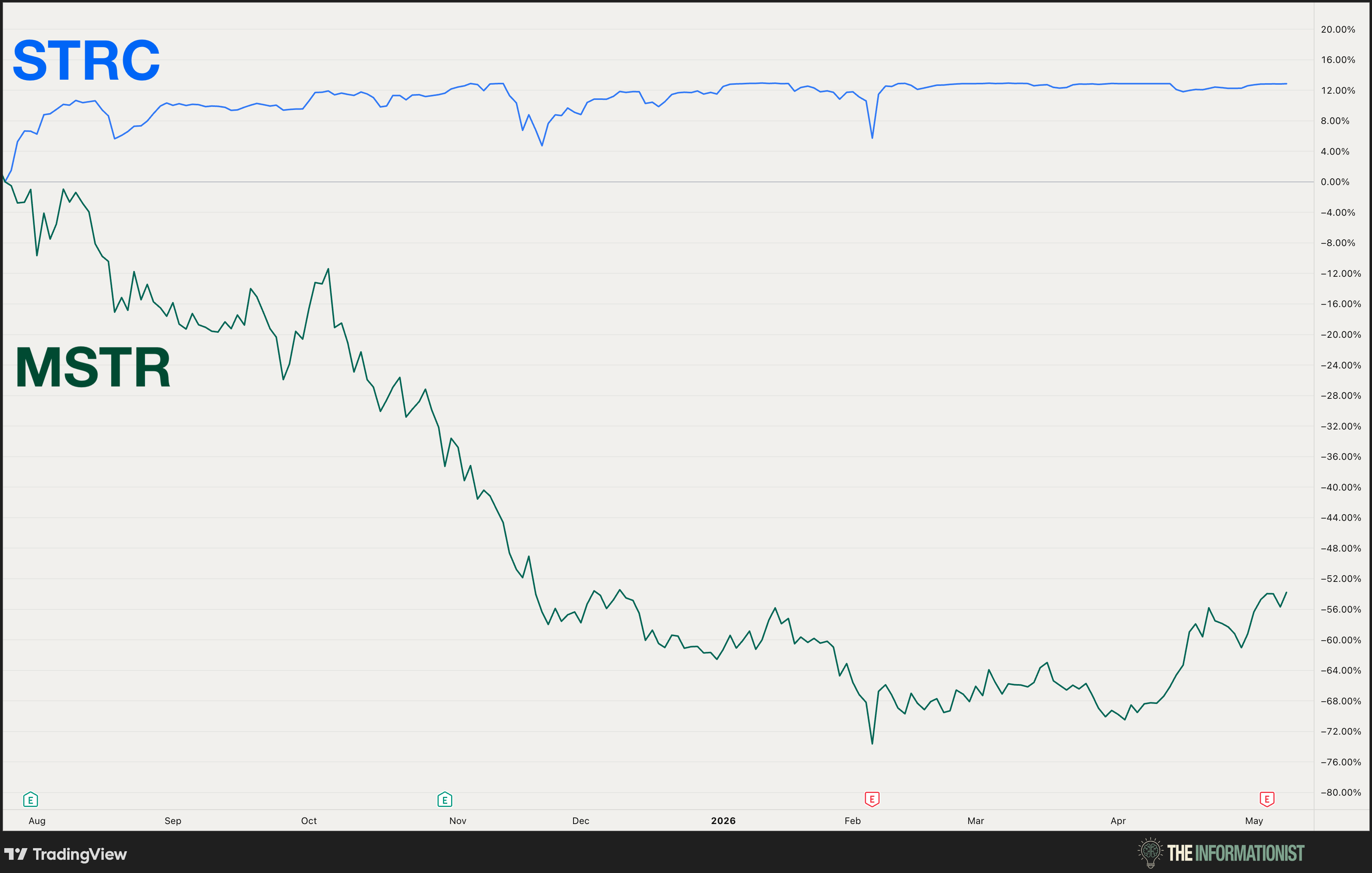
So, what do we notice?
The blue line is the passenger jet, a short ascent from IPO, then relatively steady cruise. The green one is the rocket ship coming back to earth and appears readying to launch again. The same balance sheet sits behind both. Two completely different rides on top.
Underneath the structure, the volatility is the same. Bitcoin still moves the way Bitcoin moves. And while the engineering does not erase that volatility, it does relocate it.
In MSTR common, the volatility lives on the price chart. Up huge, down huge, sideways for months, up huge again. Your ride is the volatility.
In STRC, the variable rate absorbs that same volatility and converts it into yield. The price stays anchored near $100. The dividend rate is what flexes. You receive your cash payout every month, and the share you bought sits roughly where you left it.
Same balance sheet underneath. Two different places for the volatility to land.
That is the trade. You give up the rocket-ship upside in exchange for a smoother ride and a recurring cash coupon. The volatility is still in the system. It just shows up on the dividend line instead of the price line.
Everyone with me? OK. Now the airframe.
The Fortified Airframe: What backs the whole thing
A jet is only as good as its airframe, and the digital credit airframe is unlike anything in the traditional preferred-share market.
Traditional preferreds are issued by businesses that produce cash. A bank’s loan book. A utility’s regulated cash flow. A REIT’s rent collections. The dividend gets paid because the underlying business produces the cash to pay it.
STRC’s backing is different.
Strategy is a Bitcoin treasury company. As of the most recent disclosures, Strategy holds 818,334 Bitcoin on its balance sheet, currently worth roughly $66 billion at today’s prices. That asset base is what sits behind the entire capital structure, including STRC.
That is the airframe.
Now back to the math: “How does Strategy pay 11.5% sustainably?”
Strategy’s own presentation deck, the one Saylor and his team walked the market through on the Q1 call this past Tuesday, uses two different assumptions about Bitcoin’s long-term annualized return for two different purposes.
When the deck builds the equity case (upside for MSTR holders), the model assumes Bitcoin compounds at 30% annually.
When the deck stress-tests the credit case (risks for STRC holders), the model uses a much more conservative 10% annual return.
STRC’s coupon is 11.5% of $100 par. Across all five preferred securities and the convertible debt, Strategy owes $1.488 billion per year in cash dividends and interest. That is the size of the bill.
As we said above, on the asset side, Strategy holds roughly $66 billion worth of Bitcoin. In the credit case, growing at 10% annually, that asset base produces around $6.6 billion of appreciation per year. In the equity case, growing at 30%, it produces $19.8 billion.
Per year.
Either of those numbers is multiples of the $1.488 billion annual obligation.
But wait. STRC’s 11.5% coupon costs 1.5 percentage points more than the credit-case Bitcoin return assumption of 10%.
This is precisely why Strategy holds $2.25 billion in USD reserve.
If Bitcoin entered a multi-year drawdown that meaningfully compressed the asset base, the reserve buys Strategy 18.1 months of full dividend coverage (per Strategy's own dashboard) to wait out the storm without selling Bitcoin or issuing new common shares (e.g., tapping the at-the-market or ATM facility) at unfavorable prices.
The structure works because of three things stacked on top of each other:
A large asset base relative to the dividend bill ($66 billion of BTC)
A USD reserve sized to bridge a drawdown ($2.25 billion cash)
And, in the equity case, a Bitcoin growth rate (30% annual) that produces enormous spread over the dividend cost
The Seatbelts: What happens if something goes wrong
So far we have walked through the fuel, the autopilot, and the airframe. The fourth piece of engineering is the one that lives in footnotes and legalese.
The seatbelts.
STRC is a cumulative preferred share. That word is pretty important and worth understanding.
If Strategy ever defers a STRC dividend, the missed payment does not disappear. It accrues. Per the prospectus, “compounded dividends” accumulate on the unpaid amount, compounded monthly at the then-applicable rate, until the missed payment is made whole.
Also according to the prospectus, any accumulated unpaid STRC dividends must be paid in full before any dividend or distribution can be paid to MSTR common shareholders.
That’s the seatbelt, but in legal terms.
You may now be asking, Will the seatbelts ever come into play?
In a corporate structure with a $2.25 billion USD reserve and an asset base behind it that is many multiples of the annual obligation, the seatbelts may never be needed. But they’re written in, nonetheless, just in case the air gets unexpectedly rough from underlying turbulence.
One paragraph on taxes
Before we move on, a quick note on taxes, because for some readers this changes the picture meaningfully.
Holders of STRC don’t pay taxes on every dividend.
See, Strategy has classified STRC distributions as Return of Capital (ROC). ROC lowers your cost basis instead of being taxed as ordinary dividend income in the year you receive it.
For a high-tax bracket investor, that deferral is real money.
That said.
When you eventually sell, the lower basis means a capital gain, taxed at long-term rates if you have held the position more than a year. For a holder who plans to hold STRC long-term, the deferral can effectively turn an 11.5% Return-of-Capital distribution into something closer to an 18% taxable-equivalent yield in real-world terms.
Here’s a real world example, assuming STRC remains near or at par:
Buy STRC at $100
Hold for two years, receiving $11.50 in dividends annually for a total of $23.
Pay zero taxes on dividends each year
Sell STRC for $100
Pay capital gains tax on $23
You can see how for long-term holders, this is advantageous, especially high-tax-bracket investors.
Two important caveats.
One. The classification is determined year by year based on Strategy’s earnings and profits position. What is true for 2025 is not guaranteed for 2026, and what is true for 2026 is not guaranteed for 2027.
Two. Your actual tax outcome depends on your situation, your bracket, and your accountant. I am absolutely not a tax expert, and my goal is here to walk you through how the instrument works, not to give you tax advice. Talk to your tax person before deciding what STRC means for you.
OK. So now you have been inside the passenger jet.
The fuel is real cash, an 11.5% coupon paid monthly. The autopilot is the variable rate that converts price volatility into yield volatility and keeps the cabin near level. The airframe is Strategy’s corporate balance sheet, comprised of 818,334 Bitcoin. The seatbelts are the cumulative protections written into the prospectus. And the math, drawn directly from Strategy’s own deck, holds together as long as Bitcoin keeps compounding at anything close to the 10% credit-case assumption Saylor uses in his own model.
That is the engineering.
🎯 Who STRC is Built For
So now we know how the passenger jet flies. The next question is the one that actually matters.
Is this jet for you?
Like any good piece of engineering, STRC was built with specific passengers in mind. It was not built for everyone, and the writers of the prospectus would be the first to tell you so. The honest answer to the “is it for me” question starts with recognizing yourself, or not recognizing yourself, in a few specific investor profiles.
Let’s first walk through who this is built for. Then we’ll talk about who it is not built for, because that part matters just as much.
Built for: The yield-replacement investor
This is the largest group of buyers, in my opinion, and probably the most natural fit.
You have cash. Maybe you sold something recently. Maybe you have always kept a meaningful slug in money market funds and short-duration Treasuries. Maybe you’re a retiree who needs the cash flow but is watching every traditional yield instrument leak ground to inflation in real terms.
You want your money to work and beat the rate at which the dollar is being debased.
If that is you, STRC was built with you in mind. The whole engineered structure exists to deliver a steady cash payment that compares favorably to anything in the traditional yield ladder, with price stability as the second feature.
Built for: The Bitcoin-curious income investor
You have read about Bitcoin for years. You believe the long-term thesis. You may already own some, in a small allocation, sitting quietly in cold storage or an ETF.
But you cannot bring yourself to ride MSTR common, because the volatility makes you sick to your stomach. And you cannot put a meaningful slug of your retirement into spot Bitcoin, because the swings would put you in front of your portfolio screen at three in the morning.
STRC gives you a way to participate in the Bitcoin treasury thesis without taking the Bitcoin treasury ride. You ride the passenger jet that flies over the same airspace as the rocket.
For a lot of Bitcoin-curious investors, this is the first instrument that actually lets them sleep through the night while still expressing the view.
Built for: The tax-aware investor
If you are in a high federal bracket, the Return-of-Capital treatment we walked through changes the comparison.
A high-bracket investor comparing a fully taxable yield instrument to STRC’s ROC distributions is not an apples-to-apples comparison. The deferral matters. For a long-term holder who plans to sit in the position, the after-tax math meaningfully favors STRC over comparable taxable yield products.
Note: if you have a CPA who pays attention to where your dollars actually land after tax, this is the kind of instrument they should be aware of.
Built for: The studious investor
This is the reader who reads prospectuses for fun. Or at least reads them seriously.
You read the cumulative-dividend language we walked through above and concluded that is real protection. You understand that STRC sits senior to MSTR common in the capital stack. You know what “perpetual” means and you know what “preferred” means. You followed the rate-on-rate spread reality and the role of the USD reserve, and you came away with a clearer mental model rather than a more confused one.
If you are that reader, STRC may belong in your portfolio because you actually understand it. Which, as we will see, turns out to be the most important qualification of all.
Now, who STRC is not built for
This part matters too. Maybe more than the part above.
Not for: The growth investor
If you are looking for a security that doubles or triples your money on a good Bitcoin run, STRC is the wrong tool. The whole design strips out price upside in exchange for price stability. The autopilot that keeps the price near $100 on the way down also keeps it near $100 on the way up.
If you want torque on the Bitcoin thesis, the rocket ship is MSTR common. STRC is the passenger jet. Boring on purpose.
A growth investor putting money into STRC and expecting the ride of MSTR common will be disappointed. That smoothness is the point of the design, not a flaw in it.
Not for: The “I want completely risk free” investor
Let’s be honest. There’s no such thing as completely risk-free. Not even US Treasuries can claim that.
But the fact is, STRC pays a high yield because it is taking risk.
This is the part Strategy itself takes pains to disclose on their own STRC information page. STRC is not a bank deposit. It is not FDIC insured. It is not regulated like a money market fund or a Treasury bill. And so, it is not a comparable apples to apples comparison.
If you need an instrument that absolutely cannot lose value, that has the explicit backing of the federal government, that comes with deposit insurance, STRC is not the answer. Treasuries are the closest answer. Money market funds are the easiest avenue for that.
The honest framing of STRC is a higher-yield instrument with real risks, engineered to manage those risks well, but no engineering can completely eliminate them.
Not for: The investor who cannot explain it
If you cannot explain to a friend at dinner in simple terms what STRC is and how it pays you, you are probably not ready to own it.
Not yet, anyway.
Digital credit is a category that did not exist a year ago. There is no shame in saying, this is new, I do not understand it well enough yet, I am going to keep reading.
The right answer for a reader in that position is to read this newsletter again, read Strategy’s own materials, talk to your financial advisor, and come back to the question in three months. The instrument is not going anywhere. The category is not going anywhere.
There is a real temptation to chase the yield without understanding the structure. If someone tells me, “I bought some STRC, can you help me understand what I own?” That order of operations is backward. Understand first. Buy second.
If you read this far and felt like the engineering made sense, you’re probably ready to make the decision. On the other hand, if you felt like you were drowning, don’t take it as a failure, it just means you need a bit more time to get it fully.
Where this leaves us
So who is STRC actually built for?
The yield-replacement investor who wants a coupon that beats inflation. The Bitcoin-curious income investor who wants the thesis without the ride. The tax-aware investor whose after-tax math meaningfully changes. The studious investor who has done the work.
Who is it not built for?
The growth investor chasing torque. The “I want risk-free” investor who needs FDIC. The reader who cannot yet explain it.
The one question we have yet to answer is the one all of those profiles are sitting with.
If the engineering is real, and the buyer profiles are clear, where do the actual risks live?
⚠️ So What’s the Risk?
The question every experienced investor asks before touching anything new.
Where do the downside risks live?
Every yield instrument trades risk for return. The 3.7% you get on a Treasury bill comes with arguably the lowest risk on the planet. The 11.5% on STRC comes with more. The trick is naming the risks honestly so you can decide what you are comfortable owning.
The Four Real Rewards
Yield. STRC pays roughly 11.5% in monthly cash. That is 400 to 700 basis points over what traditional preferred shares pay today. For an investor who has watched the traditional yield ladder fall behind the rate of monetary debasement (actual inflation), that spread is the whole point.
Smoothness. STRC's implied volatility runs around 6%. MSTR common's implied volatility sits near 59%, with realized volatility running in the 60s and 70s. Same balance sheet underneath, very different ride on top. The autopilot is doing its job.
Tax efficiency. Under the 2025 Return-of-Capital classification, an 11.5% distribution behaves more like 18% on a taxable-equivalent basis for a high-bracket holder. That treatment is set year by year, but for now, it is real.
Capital structure protection. Cumulative dividends. Seniority over MSTR common. A claim on the Bitcoin reserve in any wind-down scenario. The seatbelts we walked through are written into the prospectus.
Those are the four reasons people are buying it. Now let’s talk about what could go wrong.
The Four Honest Risks
Risk one: A multi-year Bitcoin drawdown.
Strategy holds a $2.25 billion USD reserve against $1.488 billion in annual dividend and interest obligations across all preferreds and convertibles. Per Strategy's own dashboard, that equals 18.1 months of full coverage on the dividend line, without touching the asset base at all.
Behind that reserve sits the asset base itself. $66 billion of Bitcoin. Per Strategy's dashboard, that asset base alone equates to 44 years of dividend coverage at current Bitcoin prices.
There has been plenty of drama on Twitter about this. On the Q1 call, Saylor named selling Bitcoin as one of the tools Strategy would use to secure the dividend if needed. Bottom line for STRC holders, having that tool explicitly available adds another layer of structural protection.
Knowable risk. Sized in the company’s own deck. Not a surprise.
Risk two: Capital markets access.
The whole digital credit machine runs on Strategy being able to issue new preferred shares when the time is right. New issuance funds Bitcoin purchases. Bitcoin purchases grow the asset base. The asset base is what backs the dividend.
If capital markets close to Strategy for any extended period, the issuance flywheel slows. Slower issuance does not break the structure on day one, because the existing asset base is already huge relative to the obligations. But over time, a permanently closed capital markets door changes the math the deck relies on.
This is the risk that depends most on factors outside Strategy’s control. A regulatory shift. A credit cycle. A reputational event in the broader Bitcoin treasury category.
I personally put this risk at low probability.
Risk three: Cumulative deferral.
In real stress, Strategy’s board has the right to defer the STRC dividend. The deferred payments accrue, compound monthly, and must be paid in full before MSTR common ever sees a dividend. So you eventually get made whole.
But during the deferral period, your monthly cash stops arriving. If you bought STRC because you needed the income, that interruption matters. The seatbelt protects your principal claim. It does not protect your monthly cash flow during the storm.
For a yield-replacement investor living off the coupon, that is a real consideration.
From a first-principles perspective, though, deferral is a highly unfavorable step for Strategy. It would likely impair their ability to use STRC as a source of liquidity going forward. So I put deferral at very low probability, and only as a last-resort action.
Risk four: Tax and regulatory classification.
The Return-of-Capital treatment is determined year by year based on Strategy’s earnings and profits position. What is true for 2025 is not guaranteed for 2026. What is true for 2026 is not guaranteed for 2027.
Beyond the year-to-year ROC question, the broader regulatory environment for Bitcoin treasury companies is still being written. The SEC, the IRS, and the banking regulators have all moved in friendlier directions over the last two years, but a future administration or a future enforcement priority could change the picture.
Possible? Yes. Likely in the near term? No. But it does belong on the list.
Where this leaves us
Four real rewards. Four real risks. All sized in Strategy’s own disclosures.
🎫 Should You Buy a Seat on This Jet?
So we walked through the engineering. We walked through who digital credit (STRC and SATA) is built for and who it is not. We walked through the rewards and the risks honestly.
Now the decision is yours.
I cannot make it for you, and I would not if I could. I walked you through the machinery, named the trade-offs, and told you where the real risks live. The rest is your call, your portfolio, your conversation with your advisor.
But one thing I want you to take with you, separate from the question of whether either STRC or SATA belong in your portfolio.
Digital credit is a category that did not exist a year ago. Right now there are exactly two instruments in it. STRC and SATA. A year from now, two years from now, more issuers may come to market with their own versions, their own structures, their own yields, their own wrinkles.
When that happens, the same plain questions apply.
What asset is backing the dividend, and is it transparent?
How is the dividend rate set, and what protects the price?
Where does this security sit in the issuer’s capital stack?
What happens if something goes wrong?
Those four questions are the framework that survives this letter. They apply to STRC and SATA today. They will likely apply to the next digital credit instrument that is created. And likely for the one after that.
That is the gift of taking the time to understand a new instrument carefully the first time. So whether STRC or SATA end up in your portfolio or not, you now have what you need to evaluate the next one when it shows up.
That, more than anything else, is what I hope you take from this morning’s read.
One last thing before I let you go. Every Sunday, paid Informationist readers get 'What I'm Watching This Week,' a focused look at the data prints and market events that will set the tone for the days ahead. Here's a peek at what's on my radar this week:
What I’m Watching This Week
📌 The Number That Matters: April CPI, dropping Tuesday at 8:30 AM ET. The first inflation print Kevin Warsh will inherit when he takes the Fed chair on Thursday. A hot number puts immediate pressure on the rate path. A soft number gives him room. This print sets the entire backdrop for his confirmation week. (Source: BLS schedule.)
📌 PPI Wednesday, Import/Export Prices Thursday. Stack these against CPI for the cleanest read on whether inflation pressure is actually cooling or just sliding around between consumer and producer baskets.
📌 The Treasury curve. Watching the 2-year and 10-year for any Warsh-related repricing. If markets believe Warsh runs a more dovish shop than Powell, the front end moves first.
📌 Warsh sworn in Friday, May 15. Powell’s last day at the Fed. First public Warsh remarks could come within days. Markets will trade every comma.
📌 The MOVE index. Bond market volatility can spike around Fed leadership transitions. Watching for any unusual moves into and out of the swearing-in.
That’s it. I hope you feel a little bit smarter knowing how digital credit actually works, and ready to evaluate whichever instrument lands in front of you next.
This week, you got both the full deep dive and the full “What I’m Watching” list. That is exactly what paid Informationist subscribers receive every Sunday. If you want this in your inbox every week, join the paid family right here:
And if you enjoyed this free version of The Informationist and found it helpful, please share it with someone who you think will love it, too!
Talk soon,
James✌️
───
Join 1,500+ premium subscription readers who get the full breakdown every Sunday
Yet another great missive James. I've held STRC since it's first month, and now own some SATA. For people who want more context on these new securities often referred to as digital credit, there are two podcasts that offer considerable insight. The first is "The Hurdle Rate," which has as the regular hosts the senior management team of Strive. The other is "True North", which also covers the world of digital credit in great detail. One of the cultural aspects of the bitcoin world is that many of the experts in it are relatively young. The guys on the two podcasts mentioned above are probably all in their 30s, all very smart, and have experience in the "Tradfi" world. I'm 65 yoa, my primary career was as a military officer, however, I got a real MBA on my own, at night, and have been immersed in the world of finance for over 40 years. I initially dismissed bitcoin outright in 2017 because I was a big believer in Buffet and, well, he dismissed it. Bitcoin is not intuitive and STRC and SATA are not either because they seem to good to be true. To survive and prosper in this world today you have to be willing to listen to folks younger than you (they might just know something), think about first principles, and have an open mind. Pride is your worst enemy. There are false narratives everywhere surrounding the bitcoin space, but all I know is about every 10 minutes a new block is mined......Besides, even Lavish is still young!
Sorry about the long comment, and a Happy Mother's Day to everyone.
Please take the time to understand this, even if you hate bitcoin, this could help you.