

📶 Welcome to The Informationist. Each week I take you inside the decisions that move markets and make sense of the forces at work.
✅ One topic, exposed and explained, so you can make sharper decisions with your own money.
➡️ If this was forwarded to you, you have good taste in friends. Join 45,000+ readers here.
Today’s Bullets:
A Tale of Two Charts
Statistics Can Be Biased
The Prices Matter
Who’s Actually Falling Behind?
What This Means for Your Money
Inspirational Tweet(s):
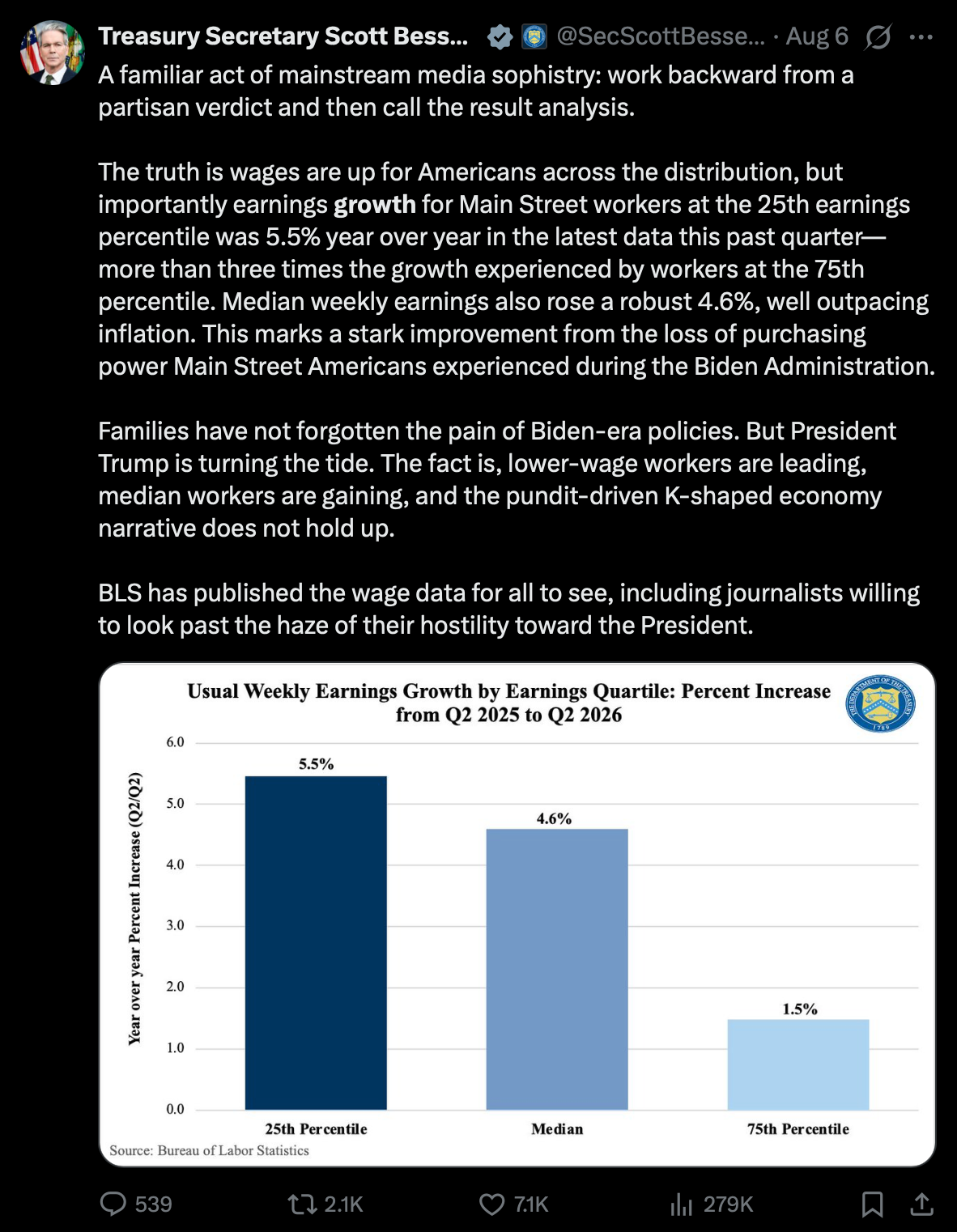
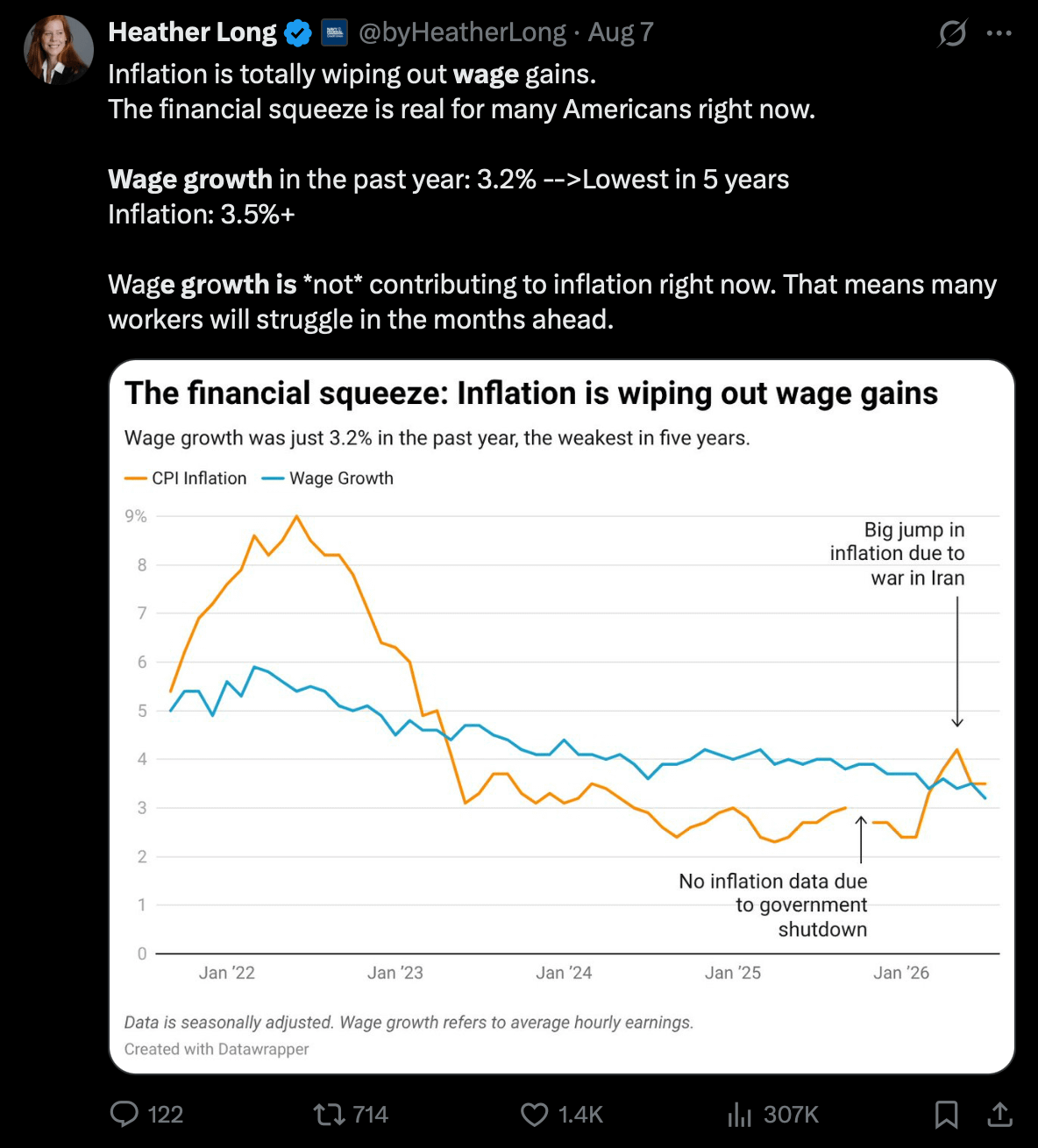
Forget politics. What we care about today is paychecks. Specifically, are the paychecks we receive keeping up with inflation?
Not theoretical paychecks, actual paychecks. The ones that pay our bills, the ones that pay for the groceries that seem to never stop going up in price.
On the one hand, Treasury Secretary Scott Bessent gives an emphatic yes, pointing out that Main Street wages are growing faster than any other group, and so-called median wages are doing pretty well, too.
But hold on a minute.
In complete contrast, and the very next day, Heather Long says, “Inflation is totally wiping out wage gains.”
She continues with, “many workers will struggle in the months ahead.”
Optimism versus ominous-ism.
I mean, we’re talking about the same country here, right? We’re all using the same numbers from the Bureau of Labor Statistics here, aren’t we?
So, who’s right? Are wages really keeping up with inflation or not? How can two professionals read the same exact government data and give two completely different viewpoints on it? And most importantly, are we in the camp of workers who should be worried about struggling in the months ahead?
All good questions, super important ones. Ones we are going to answer, nice and easy as always, right here today.
Stick with me to the end on this one, because it all has to do with a lot more than just wages.
So pour yourself a big cup of coffee and settle into your favorite seat, as we untangle these wage numbers and see how they actually affect you and your money, with this Sunday’s Informationist.
Partner spot

Reduce risk in your bitcoin setup
The recent Coldcard incident is a good reason to review how your bitcoin is secured. If you already self-custody and want to eliminate your reliance on a single device, Unchained can help.
A multisig vault requires multiple keys to move bitcoin. When those keys are stored on different devices, a problem with one device does not give an attacker everything needed to spend the bitcoin.
Throughout the Coldcard incident, Unchained has been helping hundreds of Coldcard users on their platform move bitcoin into new vaults, review their setups, and make informed decisions about what to do next.
Strengthen Your Setup is Unchained’s Premium Service Suite for bitcoin holders who want to upgrade to collaborative multisig. Across multiple one-on-one sessions, a dedicated bitcoin expert guides you through creating your first vault and provides advanced security training.
You leave with a fully configured vault, a tested recovery plan, and a setup reviewed by a bitcoin expert.
If you use a Coldcard or hold your bitcoin in a single device and have questions about what to do next, or know someone who does, contact Unchained.
Strengthen your setup with Unchained
A Tale of Two Charts
Looking at the two charts above, if you’re a normal everyday person, e.g., not a PhD economist or econ-obsessed investment advisor, you likely thought something along the lines of, is one of them greatly exaggerating? Or worse, outright lying?
On one hand, you have Bessent saying wages are outpacing inflation, and on the other hand, Heather Long says inflation is wiping those gains out.
And then there’s you and me standing at the checkout line of Costco doing the math in our heads. Ground beef was way cheaper a few years ago.
Like half the cost that it is now.
And that’s exactly what’s so irritating about this whole conversation.
You know exactly how much your money can buy, you’ve watched it change month-for-month, year-over-year. You have the receipts!
But then a PhD economist, or maybe the US Treasury Secretary himself, goes on TV and says everything is great. Wages are outpacing inflation. Americans are doing just fine.
Uh huh. Which Americans, you ask.
Or are you somehow calculating it all wrong?
Hold on to that question, we’re going to come back to it.
Because the important part is that both of the claims above are mathematically correct. Or at least defensible with the data we have from the BLS.
The almighty Bureau of Labor Statistics.
If you’ve been reading me for a while, you know where I usually go from here. I’ve spent plenty of time showing you how the agency creates a basket and then changes the weights of the items in that basket to come up with a number that they can stomach, even if it isn’t exactly founded in reality.
Now you may be asking, is the same thing going on here? Are they cooking the books again?
In short, no.
What’s happening here is not a conspiracy, and it’s actually valuable to understand.
Scott’s measuring what the middle full-time worker earns in a week.
Heather is measuring what the average hour of work pays, including all the private payrolls in the country.
Two completely different surveys answering two completely different questions, and so, of course, they don’t match up.
And there are actually four different main ways to look at wages. Four. All of them published by experts and defensible. Neither of them admitted that.
Scott merely chose one, and Heather chose another.
Question is, which one relates to you and your paycheck? Which one tells us about what’s really going on with the economy?
Because only one of those four follows the same person from one year to the next. Same worker, this year against last year, no averaging, sorting, or mixing.
That’s the one to watch. And be honest, it hasn’t been doing all that great lately.
That’s what we’re going to sort out here.
To recap: Two people read the same government numbers and claimed opposite things about our paychecks. One measured which workers got the biggest raises. The other measured whether the average raise beat the average rise in prices. Both are right, but using entirely different context.
